Stackable Bento Set Procurement for Retail Programs
A factory-side guide to defining modular bento formats, checking stack behavior, and approving a retail-ready set without locking the brief to unverified dimensions or performance claims. Use it to turn an early concept into a reviewable buyer specification.
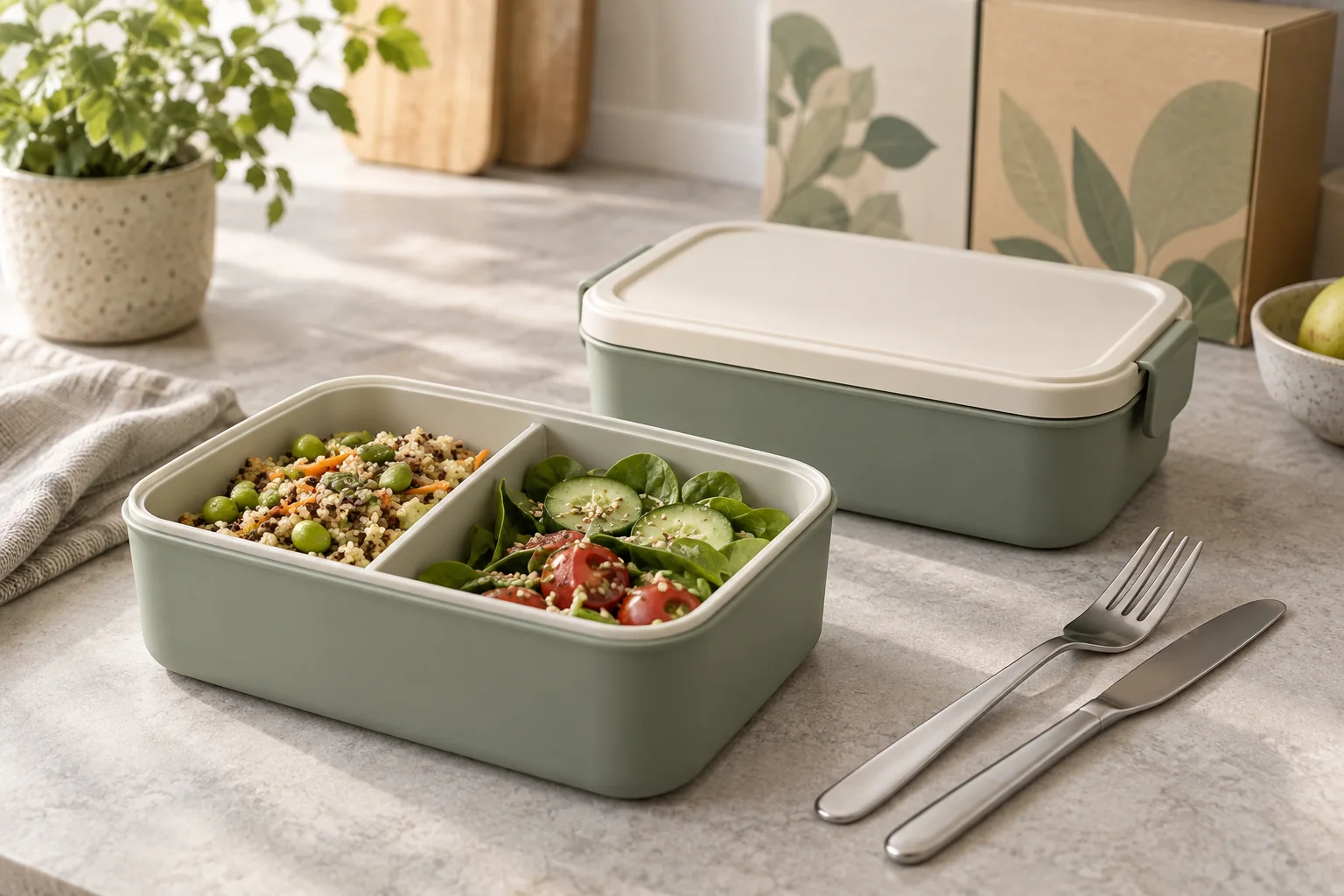
Illustrative product concept, not a verified Naike SKU. Confirm actual product materials and fit with project samples.
Retail programs often begin with a simple brief: create a reusable lunch set that looks coordinated, stores neatly and is easy to explain at shelf. The difficulty appears when the buyer converts that idea into distinct product sizes, lid interfaces, colors, accessories and packaging versions.
At the factory-facing specification stage, “stackable” needs a practical definition. It may mean the complete set stacks for retail display, empty containers nest for storage, modules stack during use, or all three. Each behavior affects dimensions, contact surfaces, tolerance review, packing sequence and the evidence a buyer should request before approval.
In This Guide
What Stackable Bento Set Procurement Means
A modular bento set is a group of components designed to work together under a defined bill of materials (BOM). The set may include one or more food containers, removable dividers, lids, a sauce cup, cutlery, a sleeve or a carry solution. A retail buyer does not need every possible component; the objective is to choose the smallest useful system for the intended customer and channel.
Stacking, nesting and packing are different operations. A stable stack describes how filled or closed modules sit above one another in an approved arrangement. Nesting describes how empty parts fit partially inside matching parts. Packing describes how all saleable components are retained in the retail package or carry bag.
These behaviors can conflict. A deep rim that helps one module locate on another can affect how efficiently empty containers nest. A divider may improve portion separation while preventing a lid or accessory from sharing the same internal space. Retail pack dimensions may therefore differ from the apparent size of the closed container.
Stackable Bento Set Procurement Starts with a Use Definition
Before choosing a shape, write one sentence that describes the use case. For example: “A one-person office lunch set with one main container, one removable portion divider, a lid, and a compact utensil option, sold as a private-label retail kit.” This statement is not a final product specification; it gives the sourcing team a shared reference for decisions.
Then separate requirements into three groups: required features, optional features and items that are explicitly out of scope. If the buyer expects a separate sauce cup but does not want a carry bag, record both. Clear exclusions prevent a product concept from accumulating components that increase cost, package size or assembly complexity without improving the proposition.
Choose an Architecture Before Locking the Module Count
Most retail programs can be evaluated against a few architecture patterns. These are starting points for discussion, not promises that every configuration is available from an existing mold. The best route depends on the intended portion format, sales price architecture, material choice, packing plan and development budget.
| Architecture | Buyer benefit | Trade-off to review | Sample check |
|---|---|---|---|
| Single container with removable divider | Fewer loose parts and a straightforward shelf proposition. | Divider position may limit portion flexibility; one footprint may not suit every menu. | Divider retention, lid clearance, usable compartment area and cleaning access. |
| Two separate stackable containers | Distinct foods can be separated and modules may be offered in different combinations. | More interfaces, lids or handling steps may be required. | Stack order, alignment, contact surfaces and whether each module can be closed independently. |
| Tiered set with shared outer closure | Can create a compact multi-level meal format when the interfaces are designed as a system. | A shared closure or top lid can make the set dependent on a particular module combination. | Closure engagement, stack stability, mixed-module compatibility and assembly sequence. |
| Container plus accessory module | Cutlery, condiment or small accessory can be included without enlarging the food base. | Accessory storage can displace usable volume or require extra insert features. | Accessory retention, rattle, contact with food surfaces and pack-out consistency. |
During concept review, ask the supplier to label every part with a neutral component ID such as B1 for base, L1 for lid and D1 for divider. Then build a compatibility matrix. A checkmark should mean “verified on the specified sample,” not “looks like it should fit.” If there are three bases and two lids, list the six possible combinations and mark only the combinations approved for sale.
This matrix also supports future assortment planning. A retailer may launch one core set and later add a compact base or replacement lid. If the original specification records interface rules and approved compatibility, adding a new item is easier to evaluate than reverse-engineering the first shipment.
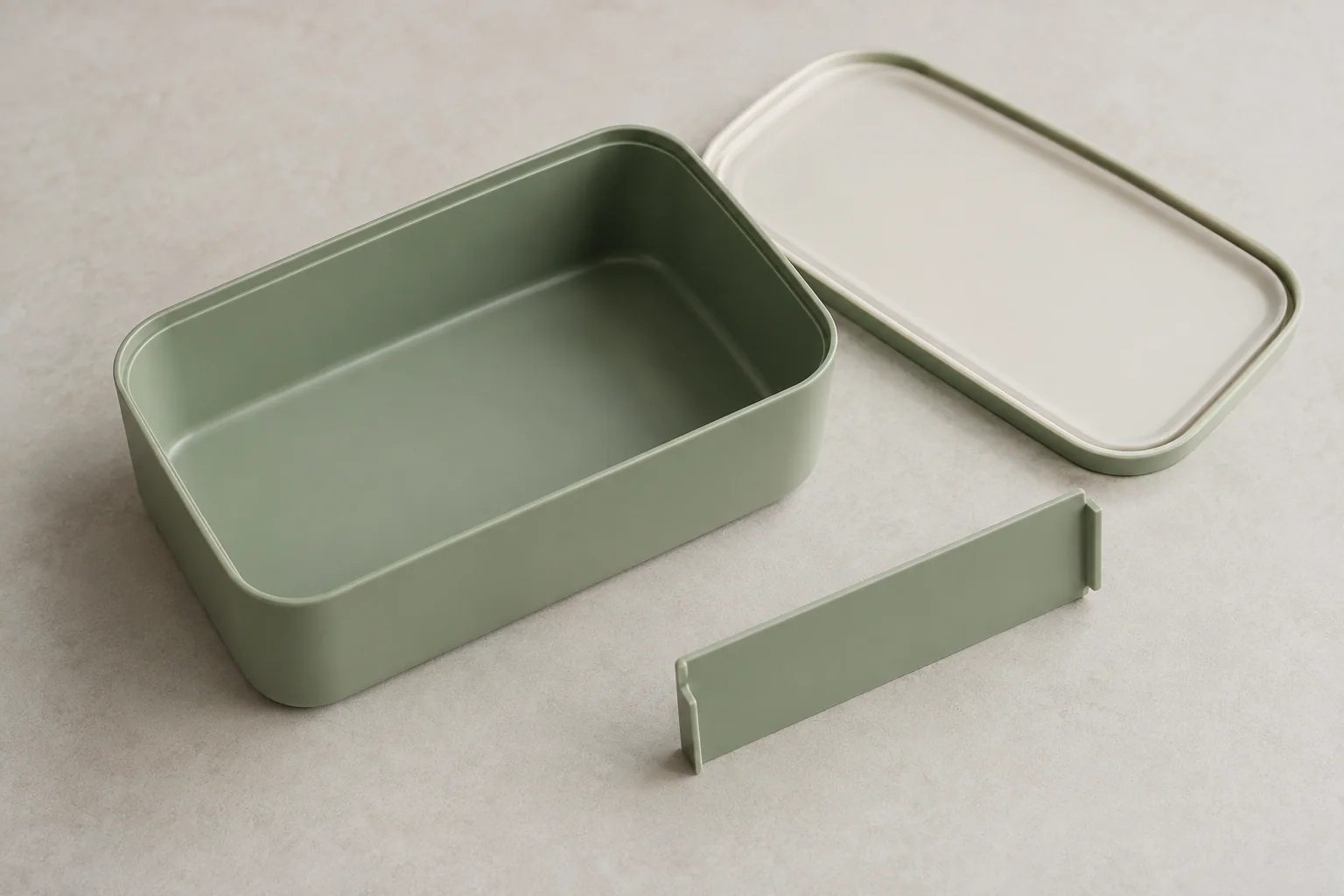
Concept image: a buyer-review arrangement illustrating component interfaces. Verify actual fit on the selected production-intent sample before approval.
Specify Dimensions, Stack Order and Fit as a Set
Do not specify only the outside length, width and height of a closed box. The buyer brief should distinguish external dimensions, internal usable area, divider positions, lid projection, stack height and packed retail dimensions. Where the final numbers are not known, label them as targets for sampling rather than presenting estimates as confirmed specifications.
List the intended stack order from bottom to top and state whether modules should remain closed while stacked. A simple sequence might be B1 base, D1 divider, L1 lid, then B2 upper module. The actual arrangement should be photographed or diagrammed during sample review so that a factory, packaging designer and quality reviewer use the same reference.
How Stackable Bento Set Procurement Handles Fit Tolerances
Two parts can each meet their individual dimensions yet still fit poorly together if the interface was not defined. Buyers should review the locating rim, overlap, lid clearance, corner geometry and any features that prevent lateral movement. Avoid inventing a universal tolerance number; acceptable fit depends on the material, part geometry, manufacturing route and the functional requirement for that interface.
Use a signed sample or approved digital drawing to record what was actually checked. The review should include the minimum and maximum configurations planned for the assortment, not only the most attractive hero set. If a buyer expects modules to be interchangeable across sizes, test each claimed combination rather than extrapolating from one sample.
For an empty nested stack, record the number of parts in the stack, the separation method, and whether removal should be easy by hand. For a closed stack, record the number of tiers, total height, expected orientation and whether a carry sleeve or bag changes the result. These details help the pack designer plan shelf footprint and transport cartons.
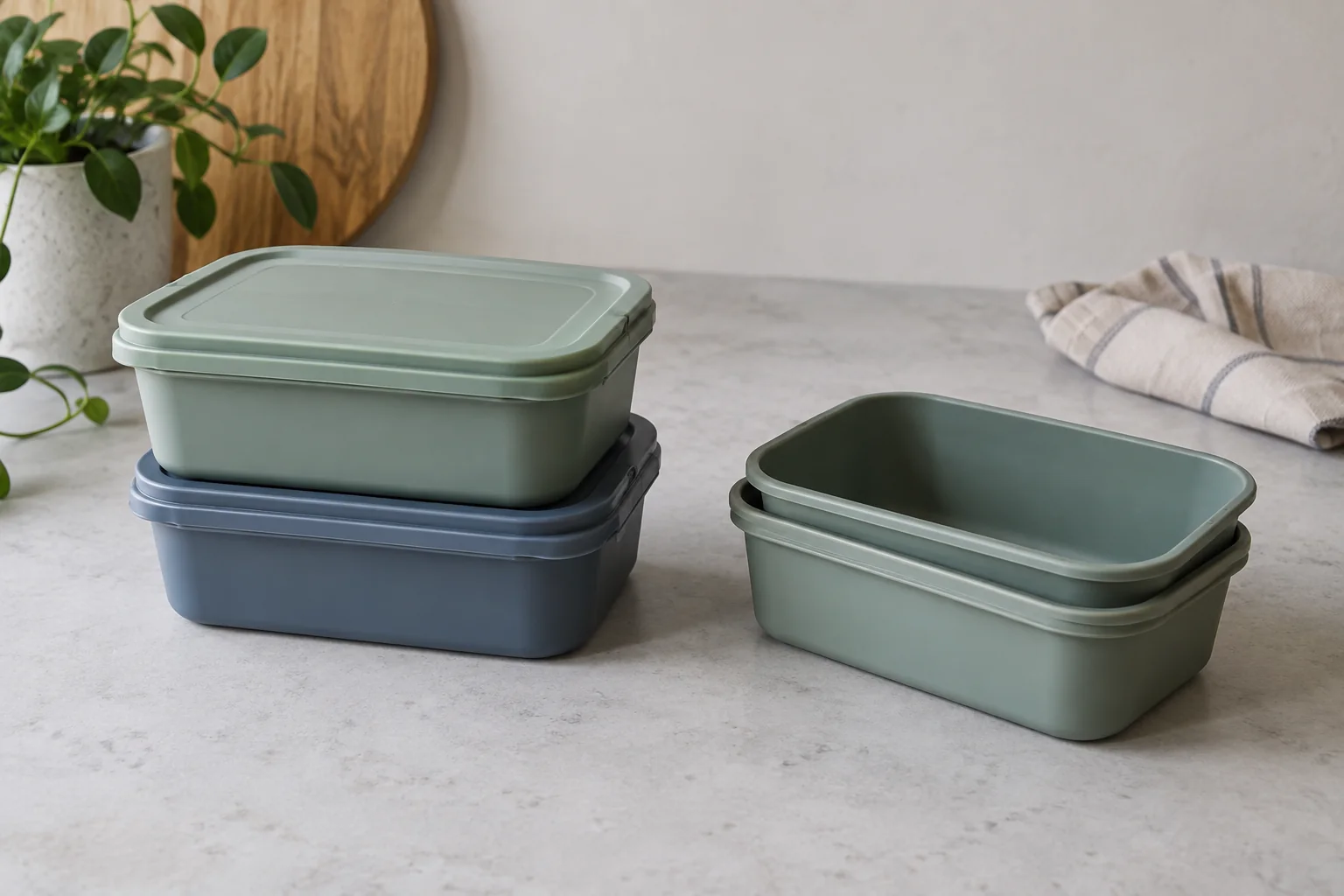
Concept image: stacking and nesting are shown as separate behaviors. Test the chosen SKU in its intended configuration before approval.
Compare Materials, Lids and Accessories Without Overclaiming
Material selection should follow the product function, the expected care instructions, the destination market and the buyer's evidence requirements. Food-contact suitability cannot be inferred from a material name alone. It depends on the exact formulation, colorants, additives, manufacturing conditions, intended use and applicable market requirements.
For any food-contact component, ask which exact parts and variants are covered by the supplier's available documentation. Tie every report or declaration to a material identity, color, manufacturing source, intended condition of use and, where relevant, the finished SKU. A document for one resin or color should not automatically be treated as proof for a different component.
Likewise, do not treat a lid, seal or utensil as an incidental accessory. A seal changes the user experience and the cleaning surfaces. A removable divider changes the usable volume and the number of small channels to wash.
Cutlery adds a retention and rattle question. Each component deserves an explicit decision: include, offer as an option, or omit.
| Buyer decision | Questions for the brief | Evidence or review item |
|---|---|---|
| Food container body | What food types, portion arrangement and care instructions should the product support? | Material identity and applicable finished-product documentation for the selected SKU. |
| Lid and closure | Does the lid locate, snap, overlap or use another closure approach? Is a seal required? | Sample fit review, opening and closing assessment, and buyer-approved care language. |
| Divider or insert | Is it removable, fixed, adjustable or shared across module sizes? | Compatibility matrix, fit sample, cleaning access and pack-out check. |
| Utensil or accessory | Where does it sit, and can it move or touch food surfaces in transit? | Retention check in the closed and packed configuration. |
| Color and decoration | Which part receives color, logo or artwork, and what sample is the approval reference? | Physical color approval and signed artwork positioned on the correct component revision. |
When a program combines plastic, stainless steel and textile components, maintain a separate evidence line for each material group. The scope should be reviewed against the exact destination market and use conditions. Naike can discuss possible material and customization routes, but the buyer and supplier must confirm the applicable requirements and evidence for each final SKU before release.
For background, buyers can consult the FDA overview of food chemical safety and food-contact substances and the official text of EU Regulation (EC) No 1935/2004. These are starting points for market-specific review, not a blanket certification of any product shown or discussed here.
Make Retail Packaging Part of the Product Specification
A set that works on a sample table may still be difficult to merchandise if the inner components shift inside the retail box or obscure one another through a window. Decide whether the package should present the set as a closed stack, an open component layout or a compact gift-ready arrangement. The display objective affects insert geometry, artwork hierarchy and the position of instruction material.
Ask the packaging team to build a pack-out with production-intent components. Confirm the order of assembly, the orientation of each module, protection at contact points and whether a buyer can remove and replace the parts without damaging the insert. Record the package dimensions only after the components, insert and artwork are aligned to the approved version.
The exterior should be planned for the retail channel and the destination market. The buyer may need a barcode, product identifier, material description, care language, origin details or other legally required statements. Requirements vary by market and product; this guide does not replace a regulatory review. Approve the final artwork and the source files before print production.
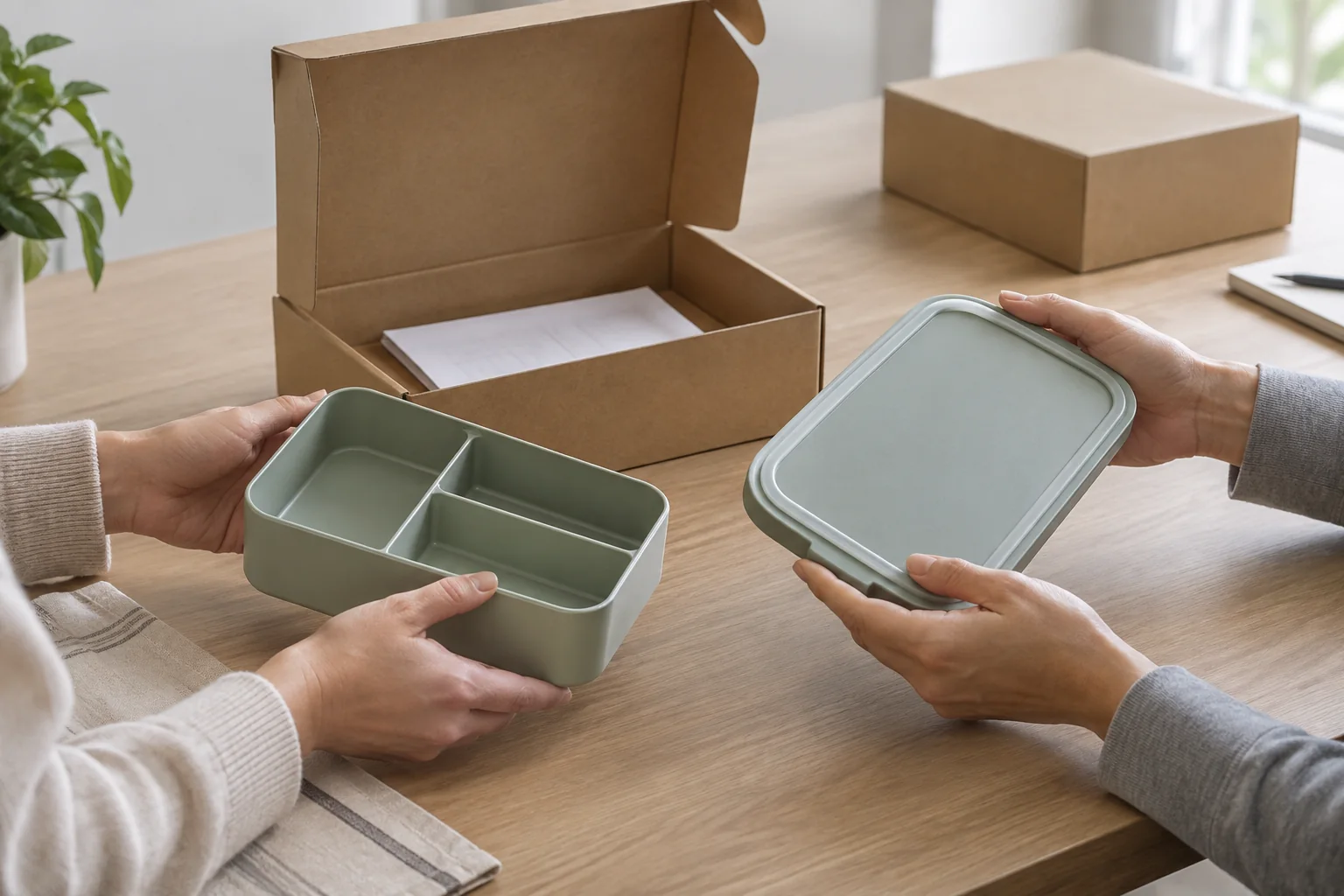
Concept image: a packaging fit review. Artwork, package dimensions and legal copy must be confirmed for the buyer's market.
For a multi-SKU launch, keep the carton and insert revision tied to the same BOM revision as the product. If a divider changes or a module is removed, check whether the retail pack still retains the set securely. Packaging sign-off should therefore follow the approved component set, not precede it.
Use Sample Approval to Reduce Retail Launch Ambiguity
A useful sample plan separates appearance, interface, functional and packaging questions. One sample may be enough to review shape and approximate color, but that does not automatically approve the production pack-out or all component combinations. Define what each sample is intended to prove, who signs it, and what happens when a revision is requested.
- Concept sample: confirm the proposed module count, shape, use logic and broad packaging direction.
- Interface sample: review lid, divider and stack fit across the combinations intended for sale.
- Branding sample: check color, decoration position, logo size, texture and the effect of different materials on appearance.
- Packing sample: confirm the final component order, insert, printed packaging and packed external dimensions.
- Production reference: identify the approved revision used for the agreed quality and pack-out checks.
The exact sampling route depends on the project. An existing component, modified tooling route and new tooling project may require different checkpoints. A buyer should request a project-specific sequence rather than relying on a generic promise about timing or sample count.
Keep drawings, artwork, BOM, packaging dieline and approval notes under revision control. A short change log should identify what changed, why it changed and which sample or document supersedes the prior revision. This prevents one team from approving a lid against an old base drawing while another team packs a newer component.
Inspect the Complete Set, Not Just Individual Parts
Individual inspection asks whether each component appears acceptable. Set-level inspection asks whether the parts are the right parts, fit together, assemble in the correct order and arrive in the package the buyer approved. Both views matter when a product contains multiple modules and accessories.
Before order release, agree which attributes are checked and how the reference is defined. Possible review points include component count, visible defects, fit, stack order, lid engagement, divider position, logo placement, color reference, packaging artwork and carton identification. This list is a discussion framework, not a claim that a particular test has already been performed.
For market-specific food-contact or product-safety requirements, confirm the test scope with qualified compliance professionals and the relevant laboratory. Match the evidence to the final material, color, supplier, intended use and destination market. Avoid marketing claims that go beyond what the final evidence supports.
Prepare a Quote-Ready Retail Brief
A supplier can review a project more efficiently when the buyer provides the decisions already known and marks the open questions. A perfect CAD drawing is not required to start a feasibility discussion. A concise brief with a target user, channel, module list and packaging direction is more useful than a mood board alone.
Include an initial quantity range if available, but ask the supplier to confirm whether the commercial route changes between standard components, color or logo customization, tooling modification and new tooling. Do not assume that one MOQ, price or lead time applies to every configuration. Request those terms after the selected materials, branding, packaging, evidence and market requirements are understood.
If the project may launch in multiple colors or sizes, clarify whether the quantity is per SKU, per color or across a family. State if the buyer plans a pilot run before a larger assortment. This helps the supplier explain which items can potentially share components and which decisions require separate samples or tooling.
B2B Buyer Checklist for Stackable Bento Programs
Use this checklist in a request for information or RFQ. “To be confirmed” is a valid answer at the concept stage, provided the responsible owner and approval milestone are clear.
| Check | Question | Why It Matters |
|---|---|---|
| Retail purpose | Who is the user, and which channel will sell the set? | Use and channel shape the required modules, instructions and package presentation. |
| Module list | Which bases, lids, dividers and accessories are required, optional or excluded? | A controlled BOM prevents assumptions and makes quotation scope comparable. |
| Stack behavior | Should units stack closed, nest empty, fit a carry bag, or support more than one behavior? | These are separate requirements with different fit and storage checks. |
| Dimensions | Which external, internal, stack and packed dimensions are targets? | Separating target dimensions from approved dimensions reduces false certainty. |
| Compatibility | Which lids, dividers and bases are intended to be interchangeable? | Only tested combinations should be represented as compatible. |
| Materials | What material options and market-specific evidence must be reviewed? | Documentation needs to match the exact component and conditions of use. |
| Branding | Which part receives color, logo or other decoration? | Different substrates may need separate artwork and physical approvals. |
| Packaging | What retail format, insert, barcode and instructions are needed? | The package changes the final dimensions, protection and shelf presentation. |
| Sample gate | Who approves each sample and what does each sample prove? | Clear gates prevent a visual sample from being mistaken for full production approval. |
| Commercial scope | What quantity, destination market and launch window should be quoted? | These inputs help suppliers explain the applicable production route and terms. |
| Change control | How will the BOM, drawings and packaging revisions be identified? | Revision alignment protects fit and pack-out consistency across teams. |
Conclusion: Approve the System That Will Actually Be Sold
Good stackable bento set procurement is a coordination exercise. The buyer needs a module architecture, named interfaces, a defined stack order, a compatibility matrix, packaging that fits the approved components, and a sample route that distinguishes appearance from full set approval.
Start with the desired customer proposition, then turn it into a controlled BOM and a list of verifiable checks. Keep uncertain dimensions, MOQ, testing and timing marked for project confirmation rather than treating early concepts as final specifications. That approach gives purchasing, product development, packaging and quality teams the same version of the product they are preparing to buy.
Naike Tableware works with B2B buyers on portable tableware configurations, material options, logo and color customization, packaging review, and tooling discussions based on the selected project. Share the intended market, channel, approximate quantity, module list, preferred materials and retail pack direction to request a scoped review.
Frequently Asked Questions
What makes a bento set stackable?
A stackable design uses defined contact surfaces and a stable load path so approved modules can sit securely in a specified order. The actual fit should be verified on production-intent samples.
Is stackable the same as nestable?
No. Stackable modules sit one above another for use or storage, while nestable parts fit partly inside one another when empty. A design may support one or both behaviors.
How should a retailer set the module count?
Start from the meal occasion and selling format, then define each required container, divider, lid and utensil as a controlled BOM line. Add optional parts only when they support a clear buyer benefit.
Can lids or dividers be shared between sizes?
Possibly, but compatibility should be proven against drawings and physical samples. Do not assume parts are interchangeable based only on a similar outside dimension.
What should be checked before approving retail packaging?
Check the final packed set, insert retention, closure, barcode and artwork placement, protection, carton dimensions and handling marks. Confirm destination-market requirements with the responsible compliance reviewer.
What information helps a supplier quote a modular bento program?
Share target market, channel, module list, materials, approximate dimensions, color and logo requirements, packaging direction, order quantity and sample objective. Open questions can be labeled for confirmation.