
Short answer: The landed cost of a custom meal set is the total cost to move the agreed, saleable set from the supplier’s quoted handover point to the buyer’s defined destination. Start with the matching product and packaging scope, then add tooling or setup, origin handling, freight, insurance, destination duties and taxes, brokerage, and delivery charges. Confirm every amount against the selected trade term and shipment plan.
A B2B buyer should treat landed cost as a calculation model, not as a single permanent price. It changes with the product specification, order quantity, carton plan, shipping mode, destination, customs classification, and the point at which responsibility transfers.
The landed cost of a custom meal set: what it includes
At sourcing stage, a supplier quote may cover only the product at a named location or handover point. That price can be useful for comparing manufacturing scope, but it does not automatically include every expense needed to deliver the goods into a warehouse, fulfillment center, or retailer’s distribution network.
For a meal set, the “unit” also needs a precise definition. One quote might mean a lunch box only, while another may include a divider, cutlery, cup, carry pouch, insert, retail carton, and outer shipping carton.
Write down the destination and delivery point before calculating. “Delivered to our warehouse” is not sufficiently specific if there are multiple receiving locations, unloading requirements, or final-mile charges.
A practical landed-cost formula buyers can use
A working formula is: landed shipment cost = product and set assembly + tooling/setup allocation + packaging + origin charges + international freight + cargo insurance + import duties and taxes + customs brokerage + destination handling and delivery. Divide the total by the number of conforming, saleable retail units actually delivered to calculate a landed cost per set.
This equation is a framework, not a universal accounting rule. Your finance team may treat tooling, recoverable tax, inspection, or warehousing differently, so keep the raw inputs visible and agree which costs belong in the purchasing comparison.
How to build the landed cost of a custom meal set from quote lines
Request costs in separate lines instead of accepting a single bundled total. When an amount is unknown, mark it “buyer to confirm” or “forwarder estimate” rather than filling the gap with an assumed rate.
| Cost block | What to include | Buyer check |
|---|---|---|
| Product | All components, finish, decoration, assembly and agreed quantity | Does one unit mean a complete saleable set? |
| Tooling and setup | New mold, modification, fixture, color or print setup where applicable | One-time charge or allocated per unit? Who owns the tool? |
| Packaging | Retail box, insert, labels, inner protection, master carton and palletization | Are print run minimums and carton specifications included? |
| Origin logistics | Pickup, export preparation, terminal and documentation charges as quoted | Which party books and pays each leg under the named trade term? |
| International movement | Air, ocean, rail, courier or multimodal freight, plus insurance if selected | Is billing based on actual weight, dimensional weight or volume? |
| Import and delivery | Brokerage, applicable duty/tax, port handling, storage and final-mile delivery | Have destination-specific amounts been confirmed by the broker? |

Product, tooling and setup costs need separate treatment
Start with the bill of materials for the exact retail set. List every piece, material, color, logo method, assembly step, and included accessory, then confirm whether spares, samples, or inspection units are part of the order or charged separately.
Tooling should be clear as a one-time project investment, not hidden in a unit price. If the parties agree to amortize it across production, show both the total tooling charge and the assumed volume used to calculate the per-set allocation.
Do not spread tooling across an optimistic forecast unless the buyer is comfortable with that assumption. A first order that is smaller than the forecast can make the effective cost per delivered set materially different from the plan.
Compare existing, modified and new-tooling routes
Existing products may avoid new tooling but can limit dimensions, colors, or component choices. A modified design may preserve some existing geometry while introducing engineering, sample, and validation costs that should be quoted explicitly.
New tooling gives more design control but introduces investment and approval gates. Compare each route at the same finished-set scope and ask which costs recur with every order and which occur only during development.
| Route | Typical cost pattern | Questions for the RFQ |
|---|---|---|
| Existing product | Product, decoration, set assembly and packaging | Which options are actually available for this SKU? |
| Configured set | Several existing components plus coordination and pack-out | Are components sourced and priced by piece or by complete set? |
| Modified design | Product plus defined engineering, modification and sample work | Which dimensions or interfaces change, and what revalidation is needed? |
| New tooling | Product plus separate tooling, trial and approval costs | What is included in tool acceptance, maintenance and ownership terms? |
Packaging can change freight more than buyers expect
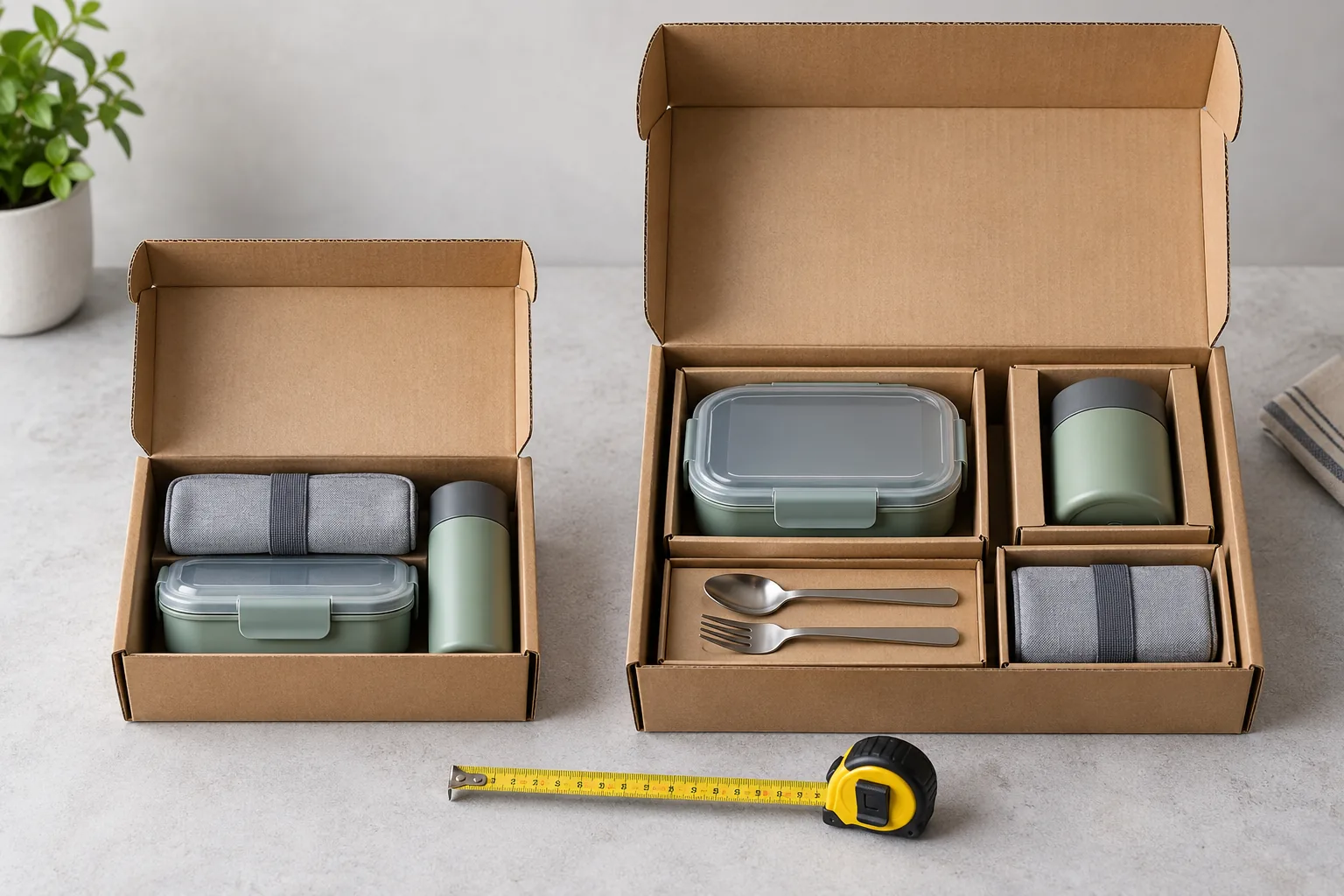
Packaging protects the set and communicates the brand, but it also determines shipment volume. Nested bowls, fitted cutlery, a compact pouch, or a shared carton may use space differently from individually boxed components.
Request the packed dimensions and gross weight for a representative master carton, not just the product dimensions. Confirm carton count, units per carton, pallet plan if relevant, and whether the dimensions are based on an approved pack-out or an early estimate.
Do not optimize for the smallest carton without checking protection and retail requirements. A package that is too tight can damage products or make packing inconsistent, while unnecessary inserts or oversized voids can increase shipping volume and material use.
Freight and trade terms define who pays which leg
Ask the supplier and forwarder to identify the exact trade term, named place, and applicable version used in the quotation. The term affects responsibilities and cost allocation, but it does not by itself tell the buyer every local fee, service charge, or tax that may appear.
Compare shipping modes on the same basis. Air freight can reduce transit time for a small urgent shipment but may be sensitive to chargeable weight; ocean freight is often evaluated by volume and container utilization, while courier or rail options may have their own size and handling rules.
Ask the forwarder to show the estimated chargeable weight or volume, route, service scope, estimated transit window, and exclusions. Confirm whether pickup, export clearance, origin terminal handling, destination terminal handling, customs brokerage, demurrage risk, and final delivery are included or separate.
Transit time also has a financial consequence that may not appear on a freight invoice. A slower replenishment route can affect safety stock, seasonal readiness, cash tied up in inventory, and the cost of a missed retail window.
Import duties and taxes must be destination-specific
Do not calculate import duty from a generic product label alone. Classification can depend on the product’s material, function, construction, and the destination’s tariff schedule, while taxes and customs processes vary by jurisdiction and can change over time.
Give your customs broker accurate product descriptions, material breakdowns, intended use, country of origin information, and shipment details. Ask the broker or qualified trade adviser to confirm the likely classification and applicable duties, taxes, and documentation for the particular market.
Keep assumptions labeled in the landed-cost sheet. If the duty amount is provisional, record who supplied the estimate, the date, the classification basis, and what still needs formal confirmation.

Use a worked example without treating it as a quote
Suppose a buyer receives a product-and-packaging quote for a defined quantity and separately obtains a freight estimate. The buyer can place those amounts into a worksheet with tooling allocation, origin fees, insurance, broker estimate, destination handling, and the final delivery cost.
The arithmetic is straightforward: add the agreed cost lines, subtract any amount already included in the supplier’s quoted scope, then divide by the count of good retail units delivered. The difficult part is preventing overlap, missing costs, and inconsistent assumptions between supplier, forwarder, and broker.
For illustration only, imagine the buyer compares two shipping arrangements and one uses a smaller carton configuration but requires additional packaging work. The right comparison is not simply “lower freight”; it is total landed cost, product protection, packing labor, delivery timing, and any effect on retail presentation.
Do not use hypothetical figures as a supplier price, duty rate, or shipping promise. Replace every placeholder with a dated quote or broker-confirmed input before approving a purchase decision.
Normalize supplier quotes before comparing them
Two proposals are comparable only when they describe the same product and delivery scope. Check components, material, dimensions, color, logo, retail pack, units per carton, inspection criteria, order quantity, named handover point, and destination.
Ask each supplier to separate included items, options, and exclusions. A quote that omits packaging or assumes a different handover term may look lower while leaving the buyer to pay for unlisted work later.
Record the quote date and validity period, currency, payment assumptions, and the person responsible for confirming each open item. This simple control helps procurement compare versions consistently when specifications change during sampling.
B2B buyer checklist for landed cost
Use the table below before approving a quotation or freight plan. It is designed to expose missing assumptions early, not to replace finance, customs, or logistics advice for the destination market.
| Check | Question | Why It Matters |
|---|---|---|
| Sellable unit | What exact components and packaging make up one retail set? | Prevents component-level pricing from being compared with a complete-set quote. |
| Specification | Are materials, sizes, colors, logo and finish aligned across quotes? | Different specifications can change both manufacturing and packing costs. |
| Tooling | Is tooling separate, amortized, reusable, and tied to written ownership terms? | Keeps one-time investment visible and avoids hidden assumptions in unit cost. |
| Packaging | Are retail packaging, master cartons, labels and pack-out included? | Packaging can have separate minimums and materially affect shipment dimensions. |
| Shipment basis | Are packed carton size, gross weight, carton count and shipping mode confirmed? | Freight may be billed by actual weight, dimensional weight, or volume. |
| Trade term | Which named place and responsibilities apply to the quote? | Defines which logistics costs are paid by each party and where risk transfers. |
| Import costs | Have classification, duties, taxes and brokerage been confirmed for the market? | These amounts are destination-specific and should not be guessed from a generic estimate. |
| Delivery point | Does “delivered” include local handling, appointment, unloading or final-mile service? | Last-leg charges can be missed if the receiving location is not defined. |
| Quality allowance | How are inspection, nonconforming units and replacement terms handled? | Cost per saleable unit depends on the accepted quantity and agreed remedy process. |
| Version control | Does the cost sheet identify the approved sample, artwork and quote revision? | Prevents an old estimate from being applied to a changed design or pack. |
Common landed-cost mistakes to avoid
The first mistake is comparing different delivery points as if the quotes were equivalent. The second is dividing the total purchase spend by ordered quantity even when the shipment includes samples, spares, inspection units, or a different number of accepted sellable sets.
Another frequent gap is using early carton dimensions as if they were final. Carton size can change after inserts, dividers, retail box strength, or packing sequence are confirmed, so freight estimates should be refreshed against the approved pack-out.
Buyers also sometimes mix taxes that may be recoverable with permanent product costs without consulting their finance team. Keep duties, taxes, fees, and product costs in separate worksheet lines so the company can apply its own accounting treatment.
How to reduce avoidable cost without weakening the product
Start by simplifying choices that do not add customer value. Fewer color variants, a shared packaging structure, and a clearly defined component list can reduce coordination and avoid small, fragmented runs, but each option should be checked against the sales plan.
Review pack-out with physical samples and measured cartons. Nesting or arranging components efficiently may improve volume, but do not assume that a more compact layout is safe until the buyer has checked product protection, ease of packing, customer use, and retail display requirements.
Ask for a side-by-side route comparison instead of requesting a discount without changing scope. For example, compare an existing product with a new-tooling option, or compare two packaging levels, while keeping quantity, shipping destination, and trade term consistent.
Finally, share the target market, channel, order range, launch window, and customization priorities early. That gives the supplier context to flag cost drivers while there is still time to revise the brief rather than after artwork, samples, or production materials have been committed.
What to send a supplier for a useful landed-cost estimate
Provide a product reference or drawing, intended materials, approximate dimensions, component list, logo and color direction, retail packaging requirement, expected order range, and destination country or port. If a detail is undecided, mark it as an open option instead of allowing the supplier to guess.
Ask for separate lines for product, set assembly, tooling or modification, sampling, packaging, origin charges, and any shipping arrangement being quoted. Tell the supplier the delivery point and whether your own forwarder or customs broker will handle particular steps.
For a new design, include the launch target and the level of sample required for review. Our team can use that brief to distinguish product questions from logistics assumptions, then indicate which items need engineering, packing, forwarder, or broker confirmation before the total can be treated as decision-ready.
If you are still defining the product, review the lunch box product range or portable dining set category to identify a starting configuration. For the sample sequence, see the guide to custom tableware sample lead time; for minimum-order planning, see custom lunch box MOQ considerations.
B2B buyer FAQ
What is included in the landed cost of a custom meal set?
It generally includes the agreed product and packaging scope plus the logistics, import, handling, and delivery costs required to reach the named destination. The buyer should confirm which charges are already included in the supplier quote and which are payable to a forwarder, broker, carrier, or local service provider.
Is a factory unit price the same as landed cost?
No. A factory unit price is only one input and may apply at a particular handover point. Landed cost adds the other agreed expenses required to deliver the defined set to the buyer’s specified location.
How should we compare air and ocean freight?
Use the same carton plan, order quantity, destination, and delivery scope for each option. Ask the forwarder to confirm the chargeable weight or volume, fees included, estimated transit window, and exclusions, then weigh inventory timing against total delivery cost.
Should mold cost be included in the per-set landed cost?
Show the one-time mold charge separately and provide an optional per-unit allocation based on an explicitly stated volume. This lets the buyer model first-order cash requirements and future unit economics without hiding the investment.
Can a supplier confirm duties and taxes for every country?
A supplier can help provide accurate product information, but the buyer should have a qualified customs broker or trade adviser confirm current classification, duty, tax, and documentation for the destination. Do not rely on a generic rate without checking the product and market details.
Conclusion: compare the full landed cost, not one attractive line
The landed cost of a custom meal set becomes useful when it is tied to a defined sellable unit, approved packaging, a named delivery point, and dated logistics and customs assumptions. Keeping one-time development charges separate from recurring product and shipment costs makes the comparison easier to explain and update.
For a quote review, send the product direction, quantity range, target market, logo and packaging needs, and intended delivery point. The more clearly those inputs are separated, the easier it is to identify what is confirmed and what still needs a forwarder, broker, or engineering decision.