Lunch Box Leak Test: Buyer Acceptance Guide
A scenario-based factory guide for brands, importers and wholesalers that need a leak-resistant lunch box specification to survive real packing, transport and consumer handling.
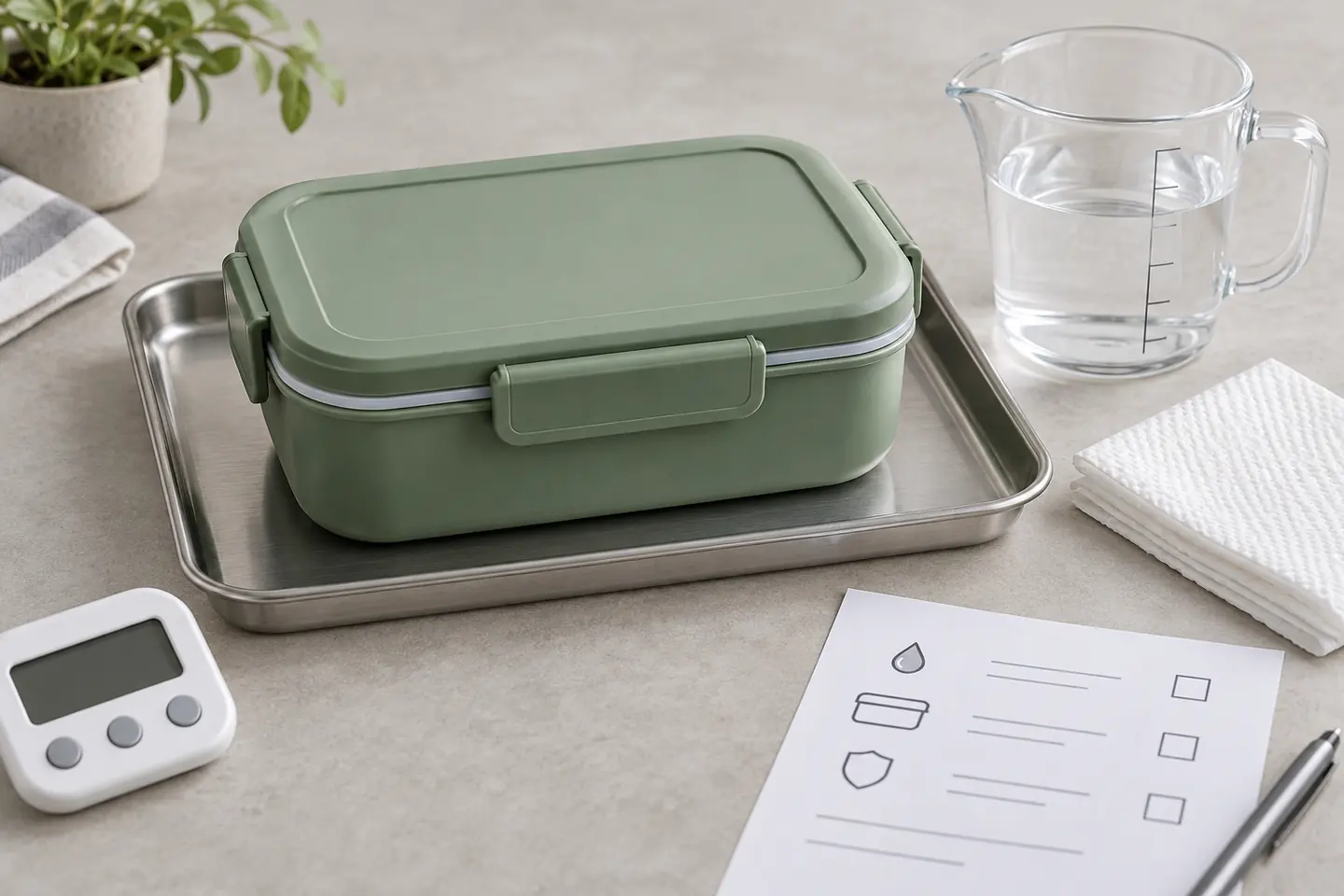
From the factory side, most arguments about leakage begin before water reaches the container. One party imagines an upright lunch box carrying dry food, while another imagines soup inside a backpack that is turned on its side. Both may use the word “leakproof,” but they are evaluating different products.
The practical solution is not a stronger adjective. It is a written scenario that connects the product claim to the way a user fills, closes, carries and cleans the box. That scenario becomes the basis for sample approval, packaging instructions, inspection and any claim printed on the retail box.
A lunch box leak test begins with the use case
A lunch box designed for sandwiches and fruit does not face the same challenge as a container intended for thin soup. A divided bento may control food migration between compartments yet still use a different perimeter seal for the outer box. The buyer should therefore start with the meal, not with a generic test copied from another SKU.
Write down who will carry the product, what may be packed, how full it may be and where it will travel. A school lunch carried upright in a rigid bag is one scenario. A commuter container placed beside a laptop in a soft tote is another, and the acceptable commercial claim may need to be different.
Define the lunch box leak test claim before testing
“Leak-resistant,” “spill-resistant” and “leakproof” can be interpreted differently by retailers and consumers. Naike Tableware does not treat these words as interchangeable promises without a buyer-approved definition. The label, product page, instructions and test method should describe the same intended behavior.
A defensible brief states the boundary of the claim. It can specify whether the product is intended for dry meals, moist foods or free liquid; whether the container may be inverted; and whether valves, removable dividers or utensil compartments are included. Exclusions should be visible before artwork approval, not discovered after complaints.
Four buyer scenarios expose different sealing risks
Testing several positions is not about making the protocol look rigorous. Each position moves liquid and internal pressure toward a different part of the seal. A weak corner, interrupted gasket path or uneven clip load may appear only when the container rests on a specific side.
The following matrix is a planning example rather than a universal standard. The buyer should adjust the sequence to the product, target market, instructions and risk level, then approve the final protocol in writing.
| Buyer scenario | Primary question | Variables to define | Acceptance observation |
|---|---|---|---|
| Upright meal transport | Does the closed box retain contents during normal carrying? | Fill level, closure sequence, hold time, movement and tray condition | No visible liquid outside the agreed seal boundary under the stated method |
| Long-side storage | Does one long edge receive even gasket compression? | Side selected, duration, fill, initial dryness and absorbent sheet placement | Result recorded by edge and location, not only as a general pass |
| Short-side storage | Do corners, clip transitions or hinge areas remain controlled? | Orientation, component assembly, time and allowable moisture definition | No result beyond the buyer-approved threshold for that scenario |
| Inverted handling | Can the product support an inversion-related claim? | Whether inversion is allowed, duration, temperature, headspace and agitation | Pass or fail judged only against the written inversion claim |
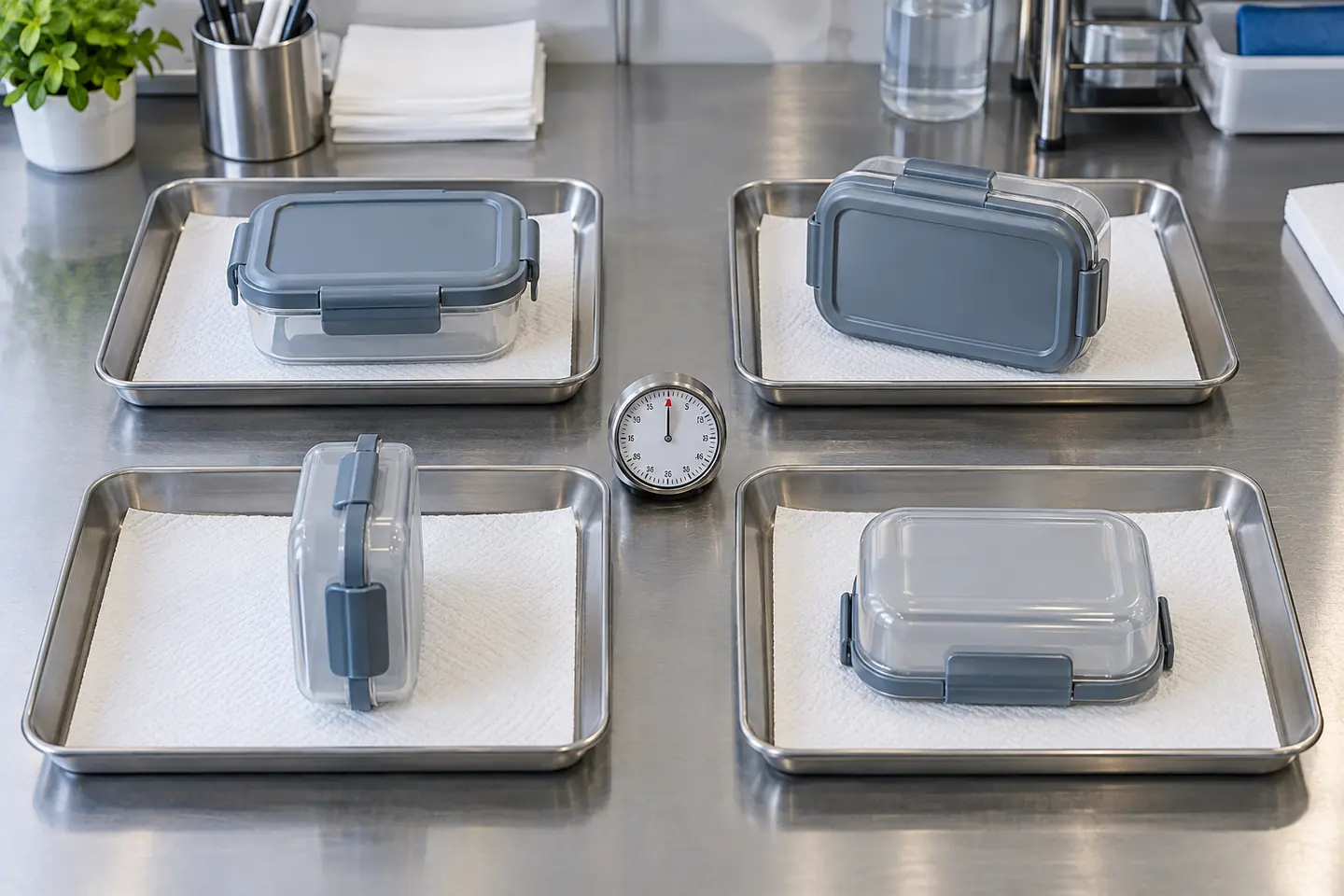
An upright pass should not automatically support an inverted-use claim. Likewise, a single inverted demonstration does not reproduce repeated opening, food residue, thermal expansion or wear. The result belongs to the exact conditions written in the protocol.
When a buyer needs a retail demonstration, separate it from the technical acceptance method. A dramatic marketing video may not control fill volume, closure force or timing. The factory and buyer should rely on the controlled record for approval, while marketing content stays within the approved claim.
Seal architecture determines what the test is actually measuring
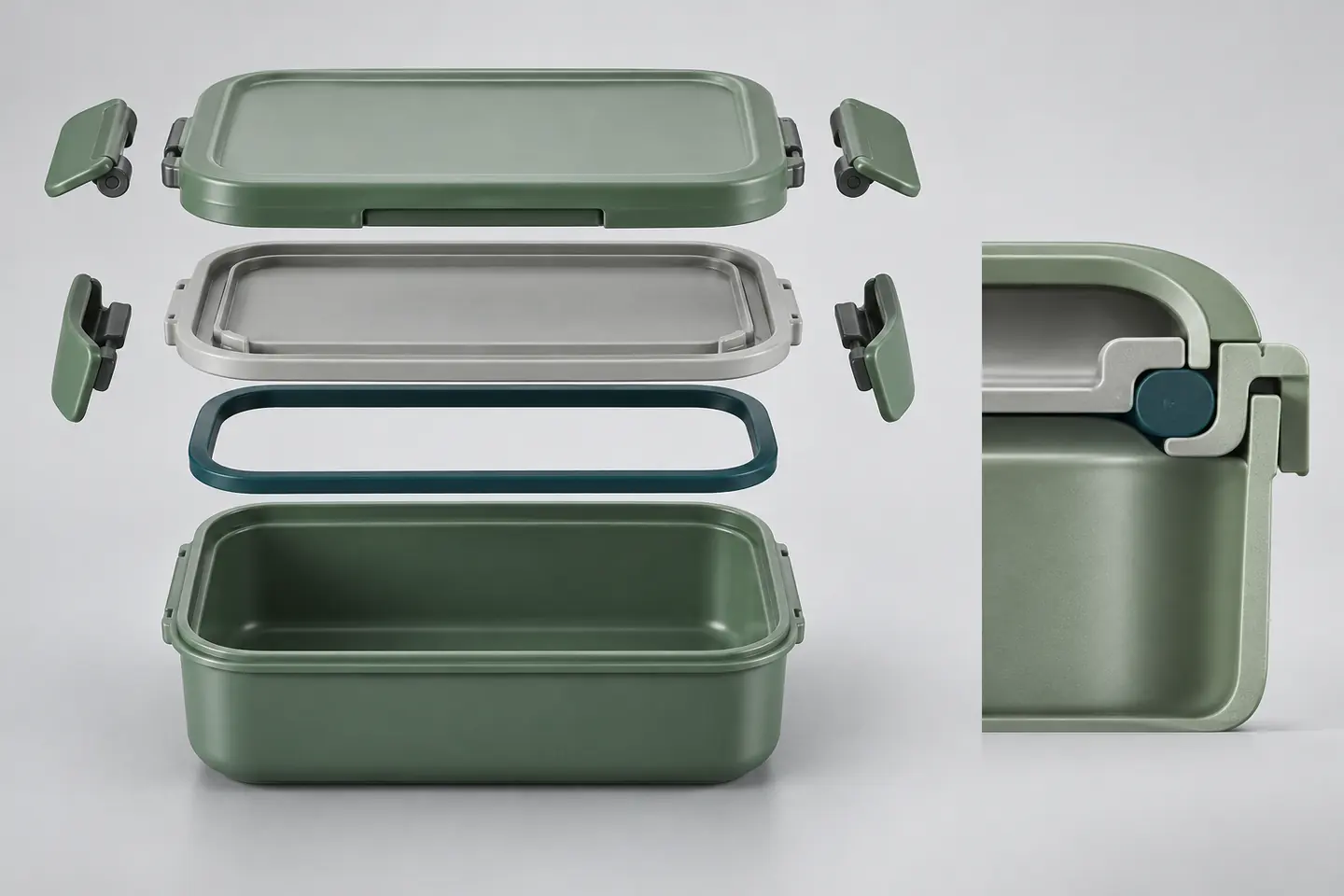
A perimeter gasket is only one part of a sealing system. The lid channel locates the gasket, the rim provides the mating surface, clips or hinges generate compression, and the molded parts must remain sufficiently consistent for those elements to meet. A failure can come from any link in that chain.
For a new project, review the cross-section before committing to tooling. The team should look at gasket retention, corner radii, compression space, draft, part stiffness and the path around clip or hinge features. A test result is easier to improve when the suspected mechanism can be connected to a visible design feature.
Use the lunch box leak test to locate the failure path
A wet absorbent sheet tells the team that moisture escaped, but not automatically why. Mark the first observed location and compare it with the gasket joint, corner geometry, clip position or vent feature. Photographs should show the orientation and the location before the sample is moved.
Disassemble the failed sample carefully. Check whether the gasket was seated, twisted, stretched, contaminated or damaged. Then inspect the lid and box rim for flash, deformation, sink, contamination or an assembly mismatch without assuming that every visible difference caused the failure.
Repeat only after documenting what changed. If a technician reseats a gasket and the second run passes, the report should not erase the first result. It should identify assembly as a possible factor and define how production and consumer instructions will control it.
Fill condition can change a leak result more than buyers expect
Water is convenient because it is visible, available and easy to clean, but it does not represent every food. Thin liquid, oil, sauce, condensation and small food particles interact with a seal differently. A buyer may use water for screening and still need a separate use-relevant review before approving broader claims.
Temperature also matters because the contents and product can change dimension or pressure. Do not improvise hot-fill or cold-fill conditions at the factory bench. State the safe intended use, define how the sample reaches the target condition, and protect the operator while recording the sequence.
Headspace must be controlled. A nearly empty container and a container filled close to the rim may load the seal differently during movement or inversion. Record the actual fill quantity or level for each cavity, including whether internal dividers are installed.
For multi-compartment products, distinguish perimeter leakage from migration between compartments. The outer seal may retain liquid while a divider allows sauce to move into an adjacent section. These are different buyer requirements and should have separate acceptance language.
Assembly conditions turn a good sample into a repeatable product
Sample-room staff usually know how to seat a removable gasket and close clips evenly. Consumers may close one side first, leave a corner raised or trap food at the rim. A buyer acceptance plan should include the correct assembly method and decide which foreseeable misassembly conditions belong in instructions or risk review.
Gasket direction should be unambiguous. If two faces look similar but perform differently, the design or instructions may need a clearer orientation cue. Removable gaskets also require a defined cleaning, drying and reinstallation process that matches the product claim.
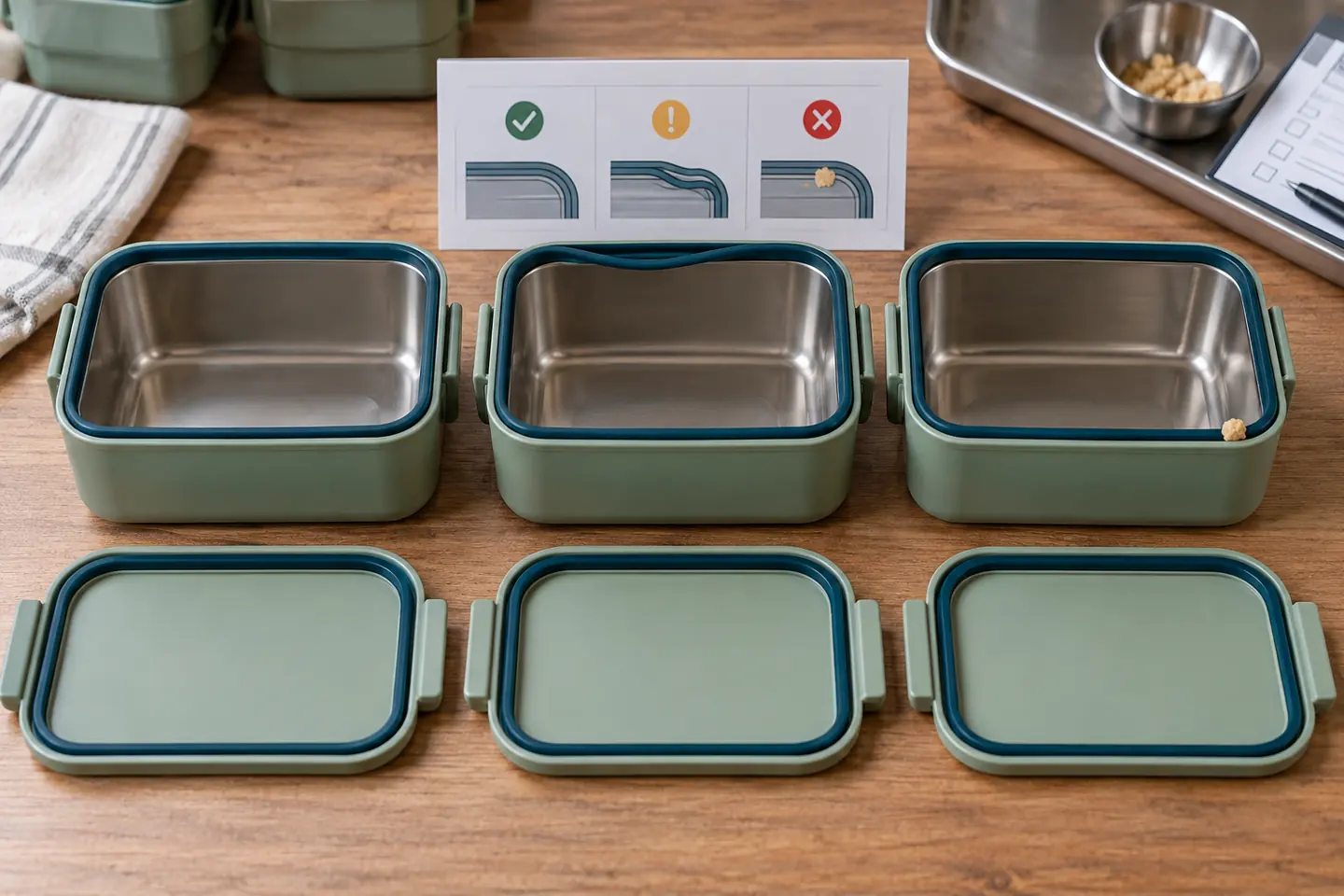
Closure force and sequence deserve attention when several clips are used. A lid that requires excessive force may pass a controlled test but create poor user experience or incomplete closure in the market. The project team should balance compression, usability and part durability rather than maximizing one variable in isolation.
After cleaning cycles or repeated use, inspect the same interfaces again if durability is part of the buyer's requirement. Define the procedure before testing and avoid claiming a cycle life that has not been established. A development observation is not the same as verified performance data.
Sample approval should lock a method, not just a physical box
An approved sample is useful when it is connected to drawings, BOM revision, material and color references, gasket specification and the leak-test record. A loose sample on a shelf cannot explain which fill, temperature or orientation it passed. The approval package should make the result repeatable by another trained person.
Use photos that show the sample code, assembly state and test orientation. Record date, operator, equipment or fixture used, fill condition, duration and observations. If the buyer approves a deviation, identify the exact deviation and whether it affects future production.
Color variants may share geometry but still require a reasoned coverage decision. Material formulation, shrinkage and process settings can influence fit. The buyer and factory should decide which variants are represented by the approved sample rather than assuming one color automatically covers all.
The same rule applies to size families. A small and a large box may scale visually while using different rim stiffness, clip spacing or gasket length. When geometry or components change, review whether the previous method and evidence still apply.
Production controls must connect back to the approved leak rule
Mass production does not need every unit to repeat an extensive development protocol, but it does need controls that protect the approved design. The buyer and supplier should agree which dimensions, visual conditions, assembly checks and functional tests are monitored, at what stage and under what sampling plan.
Incoming gasket checks may cover identity, condition and dimensions appropriate to the drawing. Molding controls may monitor part fit and visible defects. Assembly and final inspection can confirm seating, closure and the agreed functional sample method without replacing the broader quality plan.
When a failure appears, containment should preserve evidence. Record cavity, line, shift, component lot or other available traceability before sorting or adjustment. A corrective action is stronger when it connects the symptom to process evidence instead of merely repeating the test until a pass appears.
Packaging can also protect the seal system. Compression during storage, a lid shipped partially closed or a gasket stored out of position can change the condition received by the customer. Include pack-out state in the release review when it affects product geometry or assembly.
Buyer checklist for a leak-resistant lunch box specification
| Check | Question | Why It Matters |
|---|---|---|
| Claim | What exact leak-related wording will appear online, on pack and in instructions? | The test must support the commercial promise actually shown to buyers. |
| Contents | Are dry food, moist food, sauce, oil or free liquid within intended use? | Different contents create different sealing and consumer-expectation risks. |
| Fill | Is quantity, level, headspace and compartment distribution defined? | An uncontrolled fill condition makes results difficult to compare. |
| Temperature | What is the safe and intended product condition during the test? | Temperature can affect pressure, dimensions, handling and safety. |
| Orientation | Which upright, side or inverted positions represent the transport claim? | Each position loads a different region of the seal. |
| Duration | When does timing begin and how long is each condition maintained? | Consistent timing is essential for a repeatable comparison. |
| Assembly | How are gasket, dividers, valves and clips prepared and closed? | Assembly variation can dominate the result. |
| Pass rule | What visible observation constitutes pass, fail or investigation? | “No leak” is ambiguous without an agreed boundary and threshold. |
| Variants | Which colors, sizes and component sources does the sample represent? | Coverage should follow real geometry and material evidence. |
| Production | Which controls, sampling plan and failure response protect the approval? | A development pass has limited value without production continuity. |
Frequently asked questions about lunch box leakage
Does leak-resistant mean the same as leakproof?
No universal equivalence should be assumed. Define the intended claim, use conditions and acceptance method, then confirm that the approved sample and production controls support that wording. Retailer requirements and local legal review may also influence final copy.
What liquid should be used for a lunch box leak test?
The medium should reflect intended use and the buyer's risk assessment. Water is practical for screening, but viscosity, temperature, oil content and food particles may change sealing behavior. Record the selected medium rather than describing it only as “liquid.”
How many orientations should a buyer evaluate?
Use the positions that represent transport and storage risk for the target product. Upright, long-side, short-side and inverted positions are common planning categories, but not every claim requires every position. State the applicable positions and duration in the approved protocol.
Can one approved sample define every color and size?
Only when the buyer documents why variants share the relevant geometry, materials and process conditions. Different sizes, lids, gaskets, colors or sources may require separate review. Coverage should be an evidence-based decision, not an administrative shortcut.
Should leak testing continue during production?
The buyer and supplier should agree on incoming, in-process or final controls appropriate to product risk. Document the method, sampling plan and response to failure before shipment. Production checks should protect the approved design without pretending that one quick test replaces the full quality plan.
Conclusion: make the lunch box leak test commercially specific
A strong lunch box leak test does not begin with a bowl of water and end with a pass sticker. It begins with the claim, meal, user and transport scenario, then controls fill, temperature, assembly, orientation, duration and observation. The result should point back to a released sample and a production plan.
For a project-specific lunch box leak test, send the SKU, intended contents, target market, product claim, drawings and packaging copy for a factory-side review. Naike Tableware can use that brief to discuss the sample route and the evidence needed for your project without inventing a universal promise.
Editorial note: these original conceptual images illustrate purchasing decisions; they do not represent laboratory evidence or certified test outcomes.