Tableware Carry Case Comparison for B2B Buyers
A factory-side tableware carry case comparison for importers, brands and wholesalers choosing between a rigid case, an insulated soft bag and a roll-top carrier.
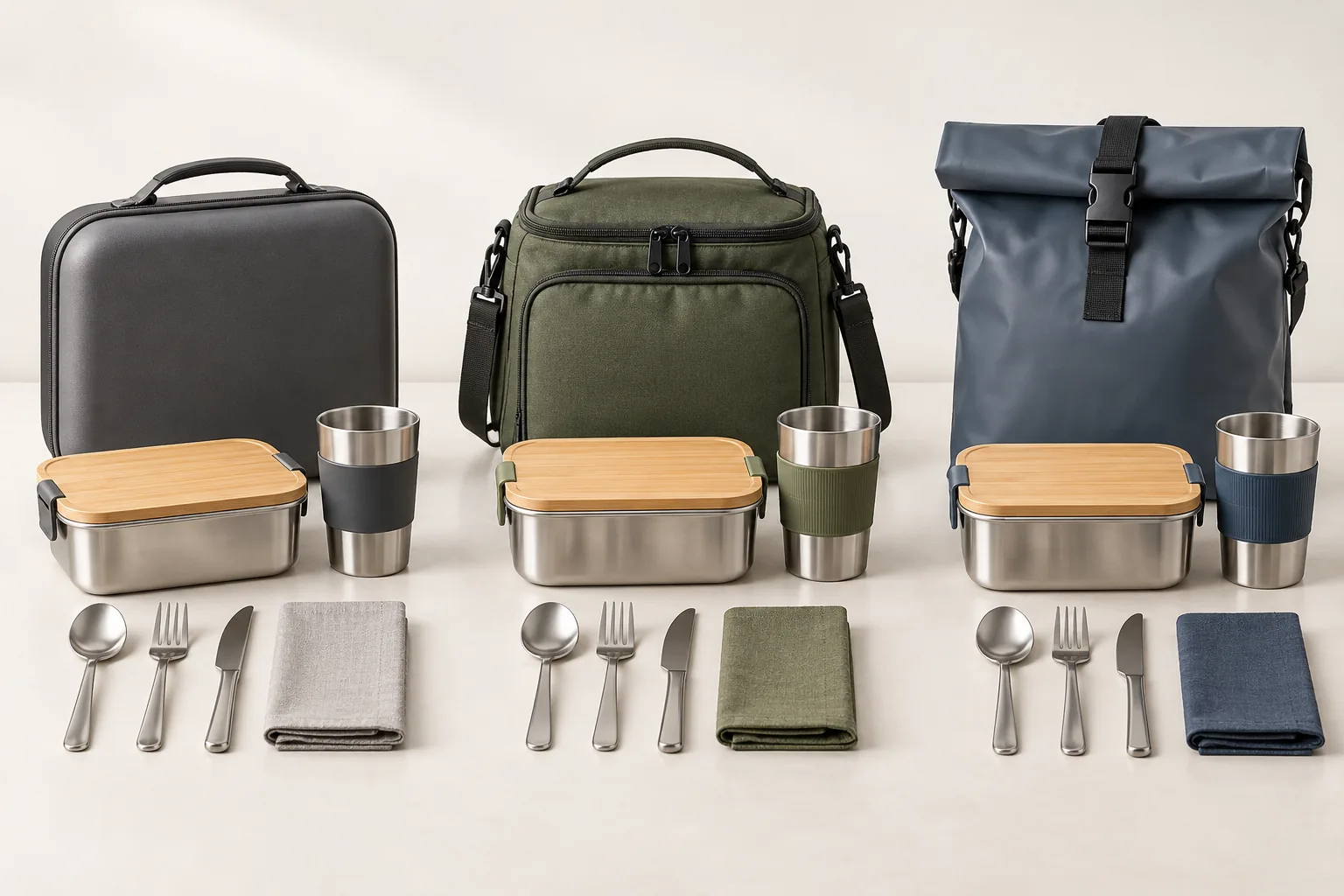
From the factory side, carrier problems usually begin when a buyer approves the bag before the dining set is frozen. A visually attractive case arrives, but the assembled lunch box is taller than expected, the cutlery rubs the lid, or the retail carton gains unnecessary volume. The carrier then becomes a late-stage constraint instead of an engineered part of the product.
A stronger purchasing process treats the carrier as one line in the complete bill of materials. Its usable dimensions, construction, closure, retention system, logo method and pack-out state should connect to the approved components and the sales channel. This guide explains how to compare the three common formats without assuming that one is universally superior.
Start the tableware carry case comparison with the load
The first input is not the carrier style. It is the complete object that the carrier must hold: container, lid, dividers, cup, cutlery, napkin, bottle, cold pack or any accessory included in the commercial SKU. Buyers should also identify which parts are optional, because an accessory added after bag approval can change closure tension and surface contact.
Record the intended orientation of each component. A lunch box carried flat may need a wide base and controlled vertical clearance, while a set designed to stand on edge can use a slimmer footprint but may load the seal differently. If both arrangements will be sold, treat them as separate pack configurations during sample review.
Build a tableware carry case comparison from usable space
External dimensions are helpful for carton planning, but they do not describe the space available to the product. Foam, lining, piping, zippers, insulation, seams and corner radii reduce usable internal volume. A supplier should therefore check the actual packed set against internal length, width and height at the narrowest relevant points.
Allowances also require judgment. Too little clearance can stress zippers, distort a soft bag or create abrasion; too much clearance allows components to move, rattle and collide. The target is controlled insertion and removal with the product retained in the intended position, not simply a mathematical fit.
Rigid cases solve protection and presentation in a specific way
A rigid or semi-rigid case maintains a defined outer shape. This can protect tableware edges, support organized internal cavities and create a premium opening experience. It can also simplify shelf presentation when the case itself is part of the product value rather than disposable transport packaging.
That structure has tradeoffs. A case generally consumes a fixed cube even when partially loaded, and shaped inserts can become obsolete when the tableware changes. Hinge, zipper and shell geometry must be reviewed together because a strong body does not help if the closure is overstressed by the packed set.
Buyers should inspect how the inner tray or elastic system retains each component. Deep cavities improve location but can make removal awkward, while shallow cavities may release parts when the case is moved. If a molded insert is proposed, confirm whether it uses an existing structure, a modified tool or new tooling before the design is treated as final.
A soft bag balances flexibility, insulation and sewing control
An insulated soft bag is familiar to lunch-program buyers because it can combine carrying, thermal separation and branding. The body can accommodate modest variation more easily than a rigid shell, and flat textile panels offer useful locations for screen printing, transfer, embroidery or patches when those methods suit the material and artwork.
Flexibility does not remove the need for dimensional control. A soft wall can bulge around a component, but repeated stress at a zipper, seam or handle attachment may still cause a failure. The sample review should consider the packed shape, lifting load and opening path rather than approving fabric swatches in isolation.
Insulation is also a system, not a generic promise. Face fabric, foam or other insulating layer, inner lining, seam construction and closure gaps all affect the result. Buyers should define the intended use and evidence before using temperature-retention language, and should not infer a performance duration only from material thickness.
Roll-top carriers trade fixed geometry for adaptable volume
A roll-top carrier can create a strong outdoor or travel identity while allowing the upper volume to adjust within a designed range. The rolled section also gives the buyer a clear closure ritual and may reduce dependence on a long perimeter zipper. This format can work well when the packed height varies across a product family.
The closure must still be specified precisely. The number of turns, direction of roll, buckle location and load below the roll affect the closed form. If the body is overfilled, the requested number of turns may be impossible, which changes both appearance and any resistance claim connected to the closure.
Water-resistant fabric does not automatically create a water-resistant finished carrier. Needle holes, seam type, taped or welded construction, hardware openings and the roll itself form the real boundary. Claims should be approved against the completed sample and intended use, not transferred from a fabric data sheet.
Compare the three carrier formats against buyer priorities
The matrix below is a procurement framework, not a ranking. Each result depends on the selected materials, construction, size, insert and order configuration. Buyers should use it to identify which questions need proof during sampling.
| Decision factor | Rigid case | Insulated soft bag | Roll-top carrier |
|---|---|---|---|
| Shape protection | Strong potential when shell and insert support the actual load | Depends on padding, panel structure and component retention | Depends on body stiffness and how the rolled load is secured |
| Volume flexibility | Usually fixed around the approved cavity | Moderate flexibility within seam and closure limits | Adjustable height within the approved roll range |
| Thermal option | Possible, but must be engineered into the case | Common format for an insulated construction | Possible with suitable layered construction and closure design |
| Internal organization | Defined cavities, panels or straps can locate components | Pockets, dividers and elastic systems can be sewn in | Often simpler unless removable organizers are added |
| Retail presentation | Structured, premium opening experience | Familiar, accessible and easy to brand | Distinctive outdoor appearance and adjustable silhouette |
| Export cube | Fixed shape may use more volume | May ship compressed if construction permits | May flatten or roll depending on the approved pack-out |
| Change tolerance | Insert or shell changes can be significant | Some adjustment may be possible through pattern revision | Height variation may be tolerated, but footprint still matters |
Protection depends on contact points, not only outer material
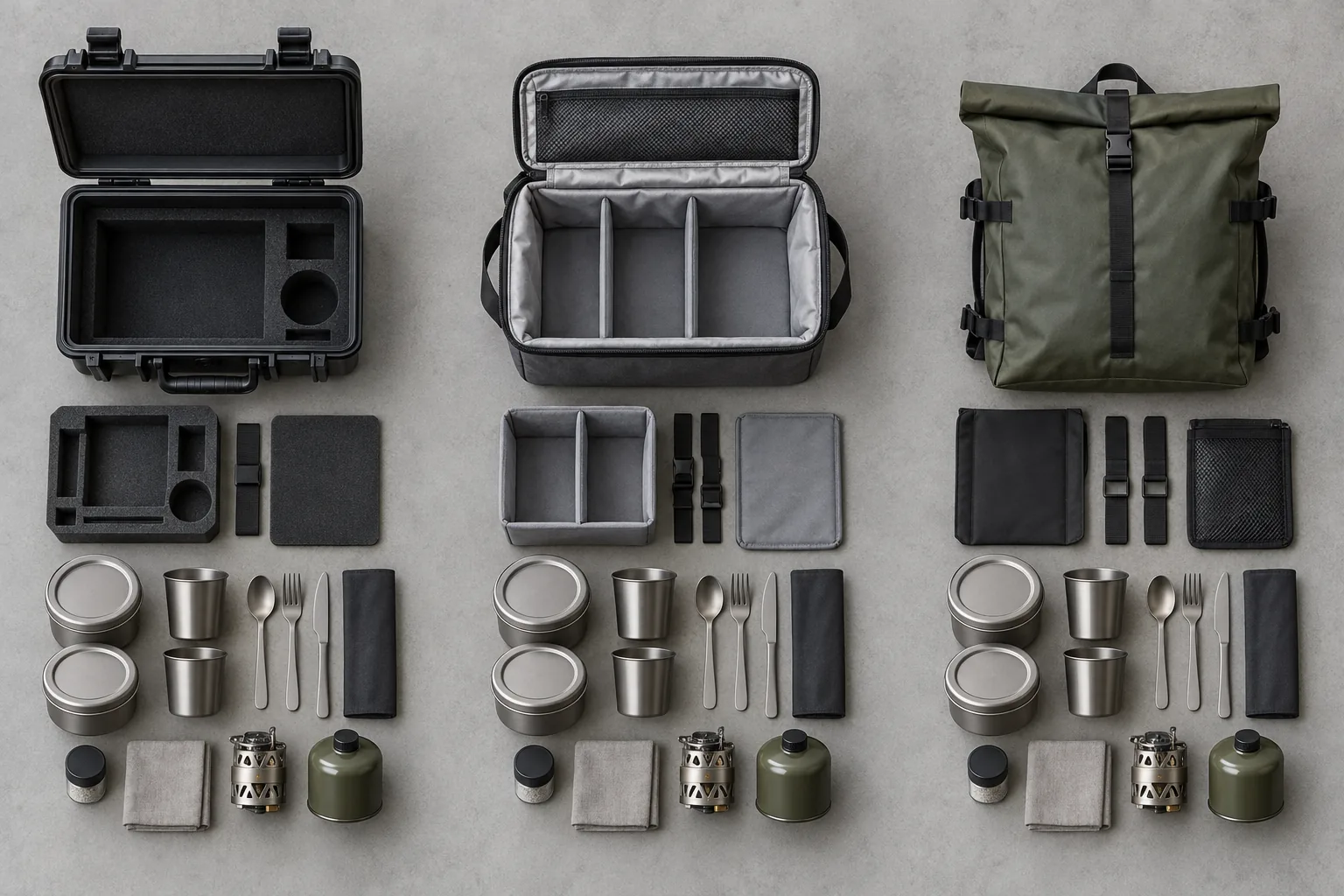
A hard exterior can still allow a steel spoon to scratch a coated cup if the internal parts are loose. A padded bag can protect surfaces well when dividers and elastic retention control movement. Buyers should map where components touch during lifting, side loading and opening instead of assigning protection grades by carrier name.
Pay particular attention to raised logos, coated surfaces, transparent lids, polished steel and sharp utensil ends. A soft fabric that appears harmless can mark a surface when dust or repeated vibration is present. Physical separators, sleeves or shaped pockets should be considered when appearance at unboxing is important.
Rattle is both a quality signal and a damage risk. Shake screening can reveal movement, but it should be performed under an agreed method and should not replace transport testing appropriate to the complete retail and shipping pack. Document which sounds or movements are acceptable before revising the carrier around subjective comments.
Review closures and load paths before approving a carrier
A closure sees more than repeated opening. It may also carry outward pressure from an overpacked set, tension from compressed insulation and shock when the loaded bag is lifted. Zipper gauge, slider, stitch line, buckle, webbing and reinforcement should be reviewed as one load path.
Handles and straps need the same attention. Confirm where their forces enter the body and whether the lining or insulation is caught into the reinforcement. A visually large patch does not prove strength; the construction and completed-sample evidence should match the packed weight and intended use.
Cleaning and condensation change the practical carrier choice
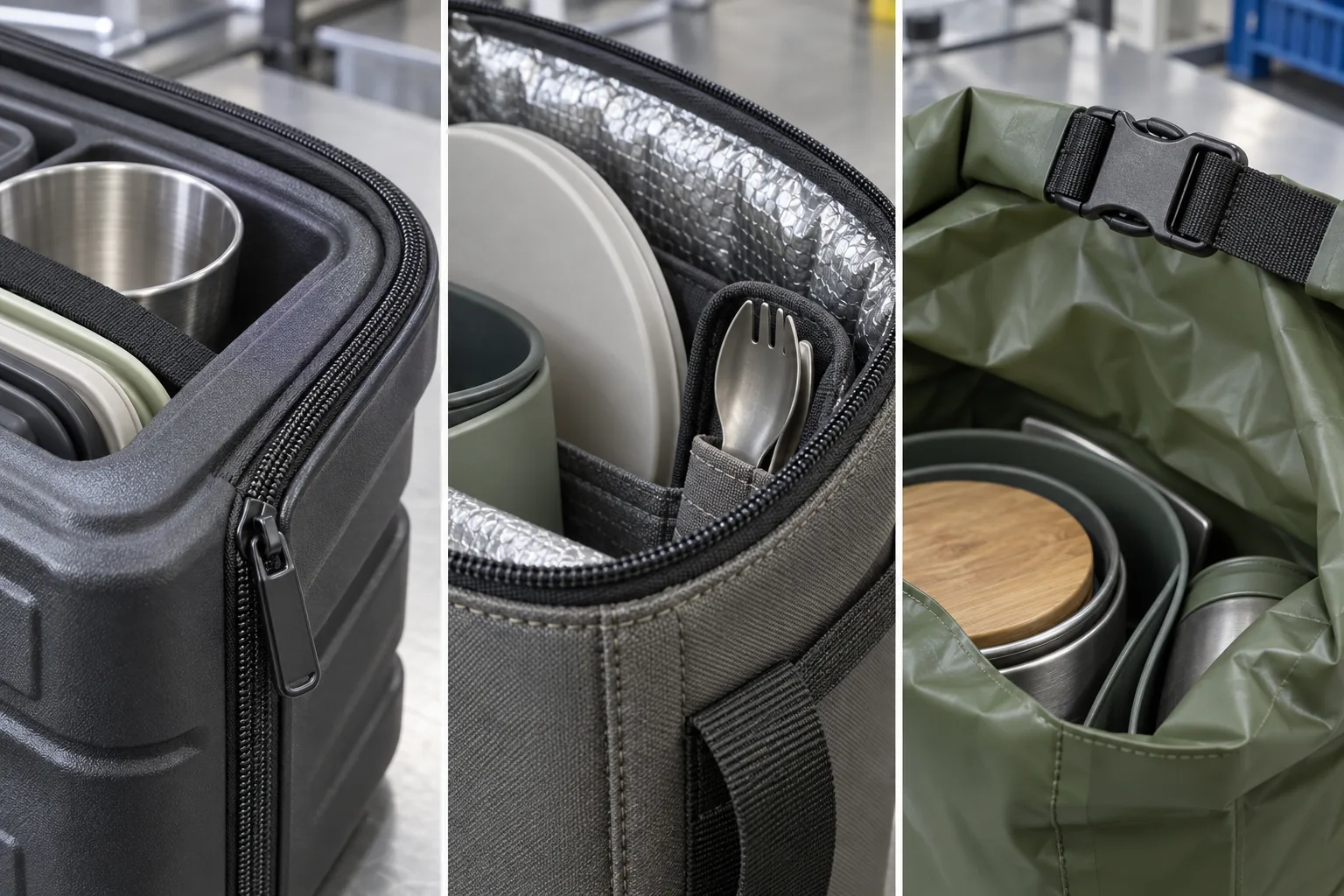
Food-contact components should be closed before entering the carrier, but spills and condensation can still reach the lining. Buyers should define whether the interior must wipe clean, whether a liner is removable and how seams or corners will be accessed. Deep rigid cavities and heavily padded corners can both trap residue if the cleaning route is not considered.
For insulated soft bags, condensation management deserves a separate review. The project should distinguish liquid leaking from the food container from moisture created by temperature difference. Lining, seam placement, absorbent materials and drying instructions affect hygiene and user experience even when the lunch box itself remains sealed.
A roll-top design may appear simple to rinse, but hardware, folds and multilayer seams can retain water. State the recommended cleaning and drying process only after checking the production-intent construction. Claims such as washable or waterproof require their own defined evidence and should not be added casually to artwork.
Branding must survive the material and the carrier geometry
Logo approval should begin with artwork size, color, location and process. A mark placed on a flat digital mockup may cross a seam, disappear into a fold or distort when a soft bag is packed. The supplier should apply the proposed method to the selected face material and evaluate it on the closed, loaded carrier.
Rigid surfaces may support molded, printed, labeled or inset branding depending on the material and design. Textile carriers may use print, transfer, embroidery, woven labels or patches. Each process changes cost, tactile feel, color behavior and minimum practical detail, so the decision should follow a physical branding sample where needed.
Pantone references are useful targets, but identical color appearance across molded plastic, coated fabric, webbing and printed retail packaging should not be assumed. Approve the acceptable relationship between materials under agreed viewing conditions. Keep the approved references connected to the BOM and artwork revision.
Export packaging can reverse an apparently cheaper decision
A carrier quotation is only one part of landed cost. A rigid case can increase carton cube, while a collapsible bag may need stuffing or a protective insert to prevent creasing. A roll-top product may ship efficiently when flattened, but the first-use presentation and recovery of the material must still meet the buyer's expectations.
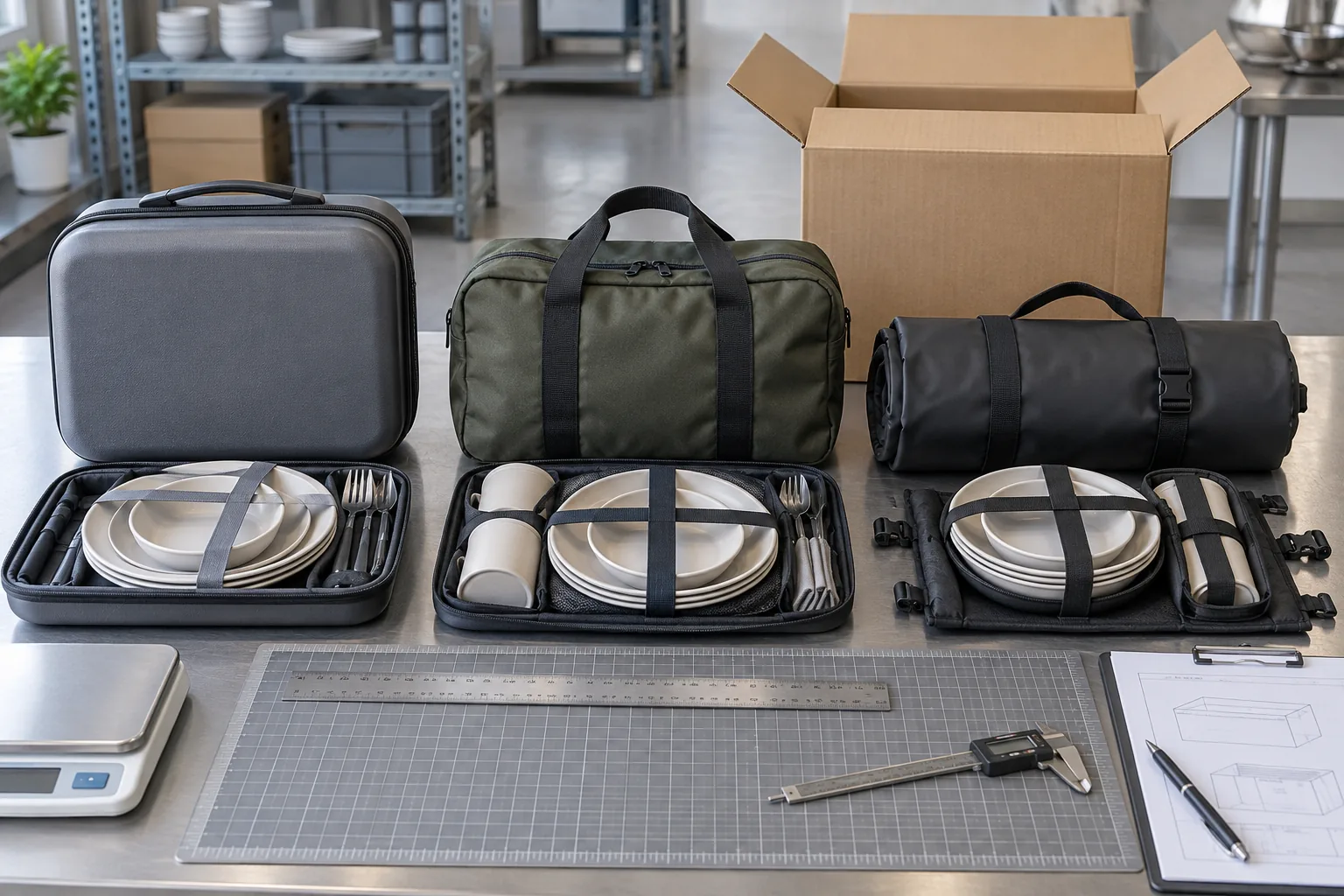
Request a pack-out drawing or sample that shows the tableware inside the carrier, the carrier inside the retail box and the retail units inside the master carton. Record the actual packed dimensions and weight of the approved configuration. Do not build freight estimates from an empty carrier or a preliminary component list.
Retail packaging also influences inspection. If the set is sealed before final functional checks, the quality plan must establish when component count, closure and appearance are confirmed. Repacking after inspection should preserve the approved arrangement rather than forcing the team to improvise on the production line.
Sampling should narrow risk in a deliberate sequence
Start with the real component load and a simple volume or pattern mock-up. This stage checks orientation, access and gross fit without pretending that materials and performance are final. It is cheaper to change the layout before detailed sewing, molded inserts or branded hardware are committed.
The next sample should use representative construction and closure details. Review insertion, removal, movement, carry behavior, cleaning access and pack-out. Any change to the tableware geometry should trigger a fit review because the carrier and set are mechanically connected.
A branding or pre-production sample then confirms artwork, color references, BOM, packaging and agreed performance checks. Approval should identify which sample stage is being accepted and which questions remain open. “Sample approved” is too broad when only appearance has been signed off.
Buyer checklist for selecting a tableware carrier
| Check | Question | Why It Matters |
|---|---|---|
| Complete load | Which exact components and optional accessories must fit? | The carrier cannot be sized accurately from a hero product alone. |
| Orientation | Must the lunch box remain flat, vertical or support both positions? | Orientation changes footprint, seal loading and user access. |
| Usable dimensions | What internal space remains after lining, padding, seams and inserts? | External measurements can hide interference inside the carrier. |
| Retention | How are polished, coated or fragile surfaces separated? | Movement can create rattle, scuffing and poor unboxing quality. |
| Closure | Can the loaded sample close without abnormal tension? | Overpacking transfers stress to zippers, buckles and seams. |
| Carry load | What is the actual packed weight and intended handling route? | Handles and straps must be assessed with the real load. |
| Cleaning | How will spills, condensation and trapped moisture be removed? | Cleaning access affects hygiene and repeat-use satisfaction. |
| Claims | Which insulation, water-resistance or durability statements are planned? | Finished-product evidence must support the commercial wording. |
| Branding | Is the logo process approved on the selected production material? | Color, adhesion and distortion depend on material and geometry. |
| Pack-out | What are final retail and master-carton dimensions? | Carrier shape can materially affect freight and shelf efficiency. |
Frequently asked questions from B2B carrier buyers
Which carrier is best for a premium retail tableware set?
A rigid case often creates the most structured presentation, but premium positioning can also come from a well-made textile carrier. Compare the full unboxing sequence, component protection, branding, carton cube and target price. The best option is the one that supports the product promise consistently.
Is an insulated soft bag suitable for every lunch box?
No. The bag must fit the actual closed box, utensils, cooling elements and intended orientation. Insulation construction, zipper path and condensation management should match the approved use and claims rather than relying on a generic lunch-bag description.
When does a roll-top carrier make sense?
A roll-top can suit brands that want adjustable upper volume and an outdoor carry identity. Buyers must define the required number of turns, packed height, buckle position and actual load. Any water-resistance statement should be based on the completed carrier and its seam construction.
Can one carrier fit several tableware SKUs?
Yes, when internal dimensions, retention and load limits are deliberately designed around a named SKU family. Use inserts, dividers or adjustable straps only where they remain intuitive and production-ready. Each approved configuration should still receive a physical fit review.
What should a buyer send for a carrier quotation?
Send the component list, samples or drawings, packed orientation, target market, expected quantity, branding locations, packaging plan and required performance. The factory can then review feasibility and confirm sample, MOQ and lead-time details for the selected SKU rather than guessing from a reference photo.
Conclusion: use the tableware carry case comparison to approve a system
A useful tableware carry case comparison does not ask which empty bag looks strongest. It asks how the complete product fits, moves, closes, cleans, presents and ships. Rigid cases, soft bags and roll-top carriers each solve different priorities, and every advantage depends on production-intent construction.
Send Naike Tableware your component list, packed orientation, target market, artwork and packaging goal for a project-specific review. We can discuss the feasible carrier route around the actual set and confirm commercial details by SKU without inventing unsupported performance claims.
Editorial note: these original conceptual images illustrate sourcing decisions; they do not represent certified test results or a fixed production specification.