Portable Dining Set Packed Dimensions: Buyer Guide
A factory-side method for importers, brands and wholesalers to turn a component list into a realistic closed-pack size before approving a carry case, retail carton or shipping plan.
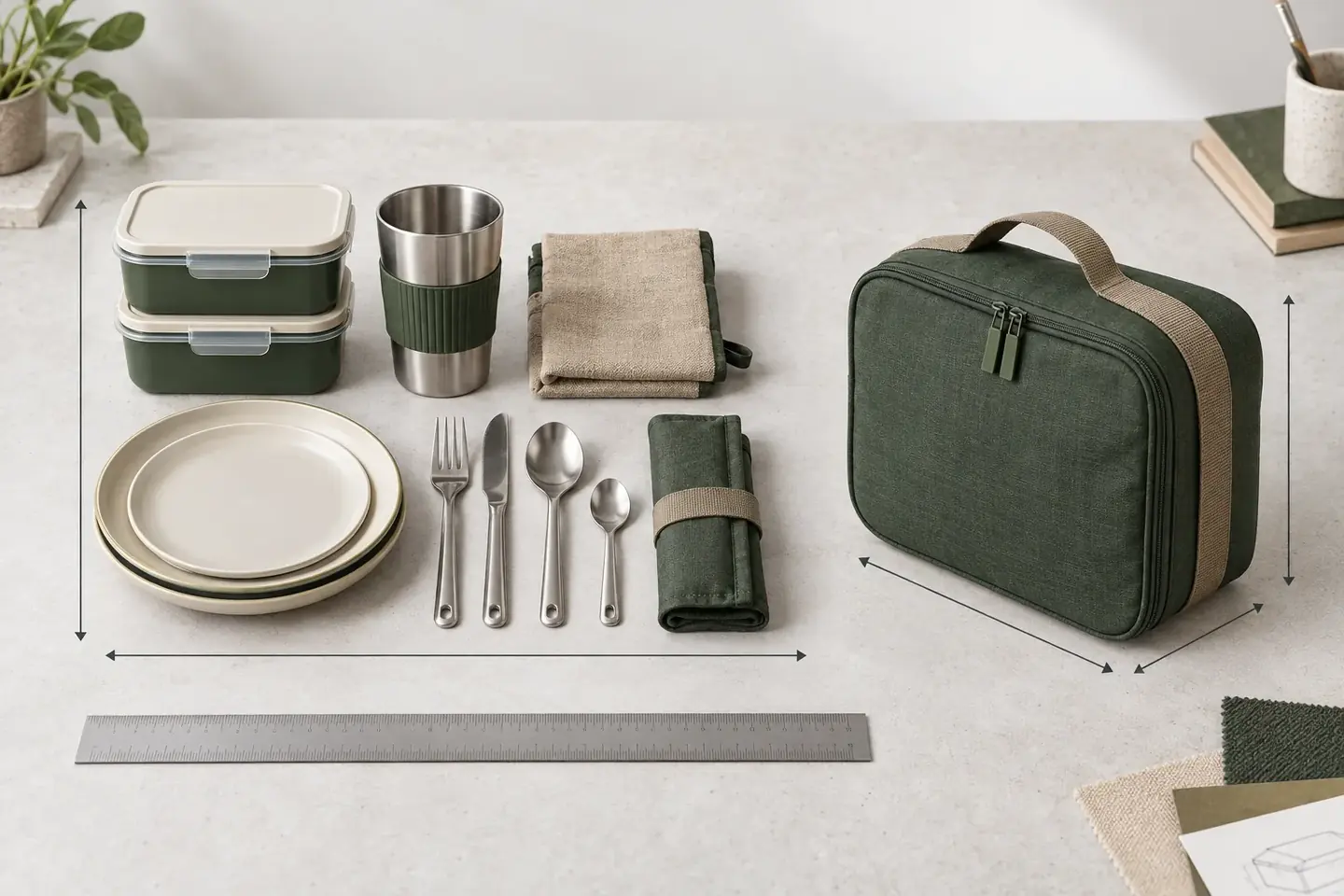
Portable dining set packed dimensions influence more than freight. They determine whether the zipper closes without strain, whether plates rub against cutlery, whether a cup handle creates a pressure point, whether a shelf-facing pack feels compact, and whether the buyer can keep a stable carton count. A small change in a lid profile or pouch seam can move several downstream decisions.
From the factory side, the most common mistake is receiving one target length, width and height before the final bill of materials exists. That number may describe an aspiration, but it is not yet a specification. A usable packed-size requirement links the measurement to a named component revision, an exact packing sequence, a defined carrier and an approved closed sample.
Begin portable dining set packed dimensions with the real BOM
Start with every item that must travel inside the sold set: containers, lids, seals, plates, bowls, cup, cutlery, napkin, dividers, straps, instruction card and any removable protective pieces. Record quantity per set and identify which parts are optional, because an optional accessory can change the height, closure path or internal retention.
Use actual maximum dimensions or controlled drawings rather than catalog summaries. A listed plate diameter may omit a raised rim, a cup dimension may omit its handle, and a container length may omit latch projection. Those features often control the pack even when they contribute little to nominal capacity.
Set the portable dining set packed dimensions boundary
Decide what the measurement includes. A buyer may need the external size of the fully closed carry case, the packed product before it enters a retail sleeve, or the complete retail unit including box and handle. These are different commercial dimensions and should not share one unlabeled value.
State orientation as length × width × height and include a simple reference image or drawing. Soft bags can change shape when turned, and an oval or round case may be measured differently by separate teams. One agreed orientation prevents a correct number from being entered in the wrong field.
Nesting turns component dimensions into a packing envelope
Nesting can reduce volume when one bowl sits inside another or a cup enters a larger vessel. The apparent saving is limited by rims, tapers, handles, base rings and the need to separate surfaces. Two parts may fit geometrically yet bind, scratch or become difficult for the user to remove.
Identify the first hard contact in each direction. In height, that might be a cup rim beneath a lid; in width, a latch beside a plate; in length, a utensil handle against a case wall. These controlling points matter more than empty areas elsewhere in the pack.
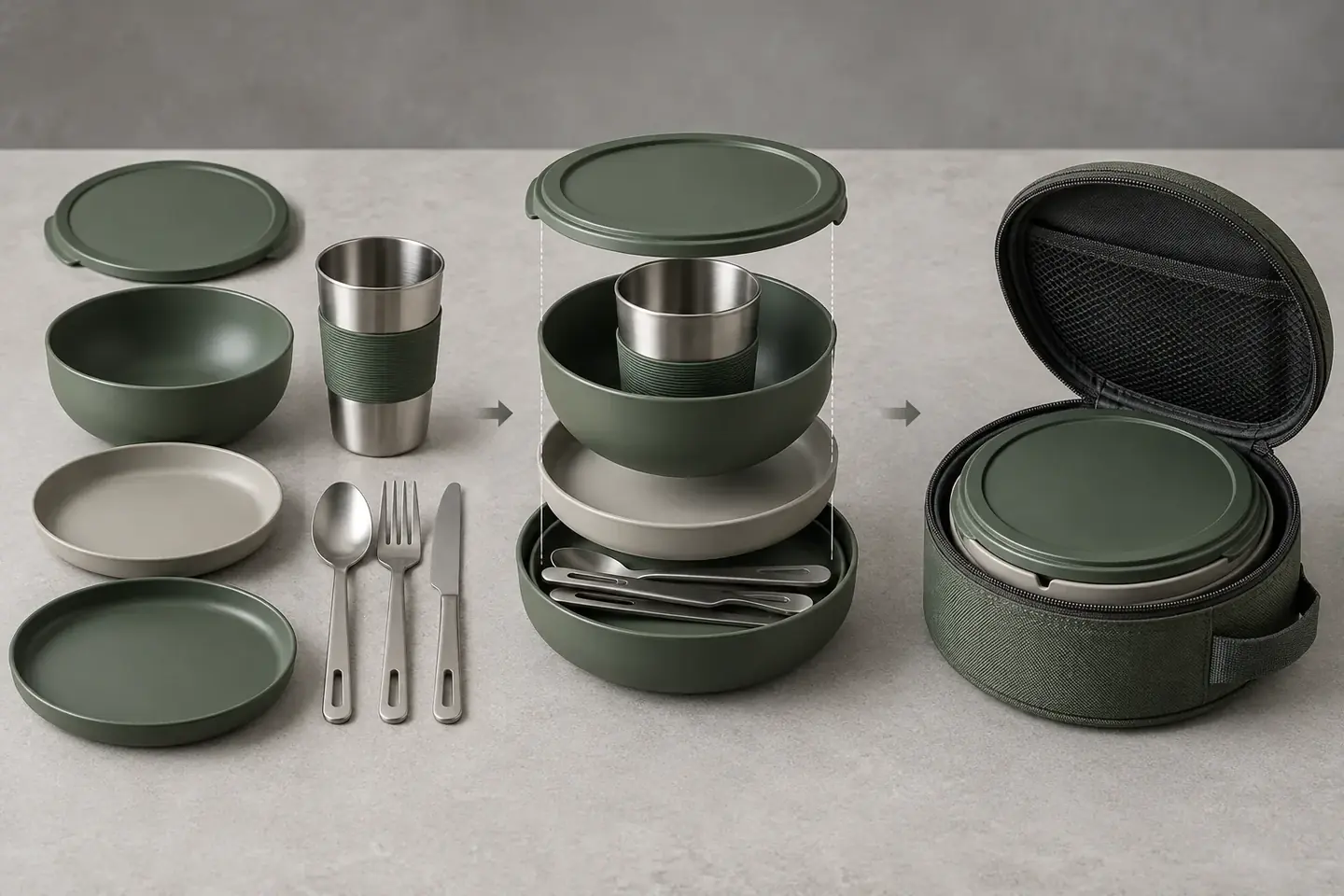
Check removal, not only insertion
A tightly nested stack can pass a one-time factory packing trial but frustrate the customer after washing and repeated use. Allow finger access or a defined removal order, and assess whether flexible lids or seals can be damaged when pulled from a deep stack. A pack that is one or two movements simpler may deliver more value than a marginally smaller envelope.
Orientation also affects hygiene and appearance. Cutlery should not be forced against food-contact surfaces if the design intent requires separation, and a painted or polished component may need a sleeve or divider to avoid scuffing. The resulting protection becomes part of the packed dimensions.
Compare the carrier before promising a final volume
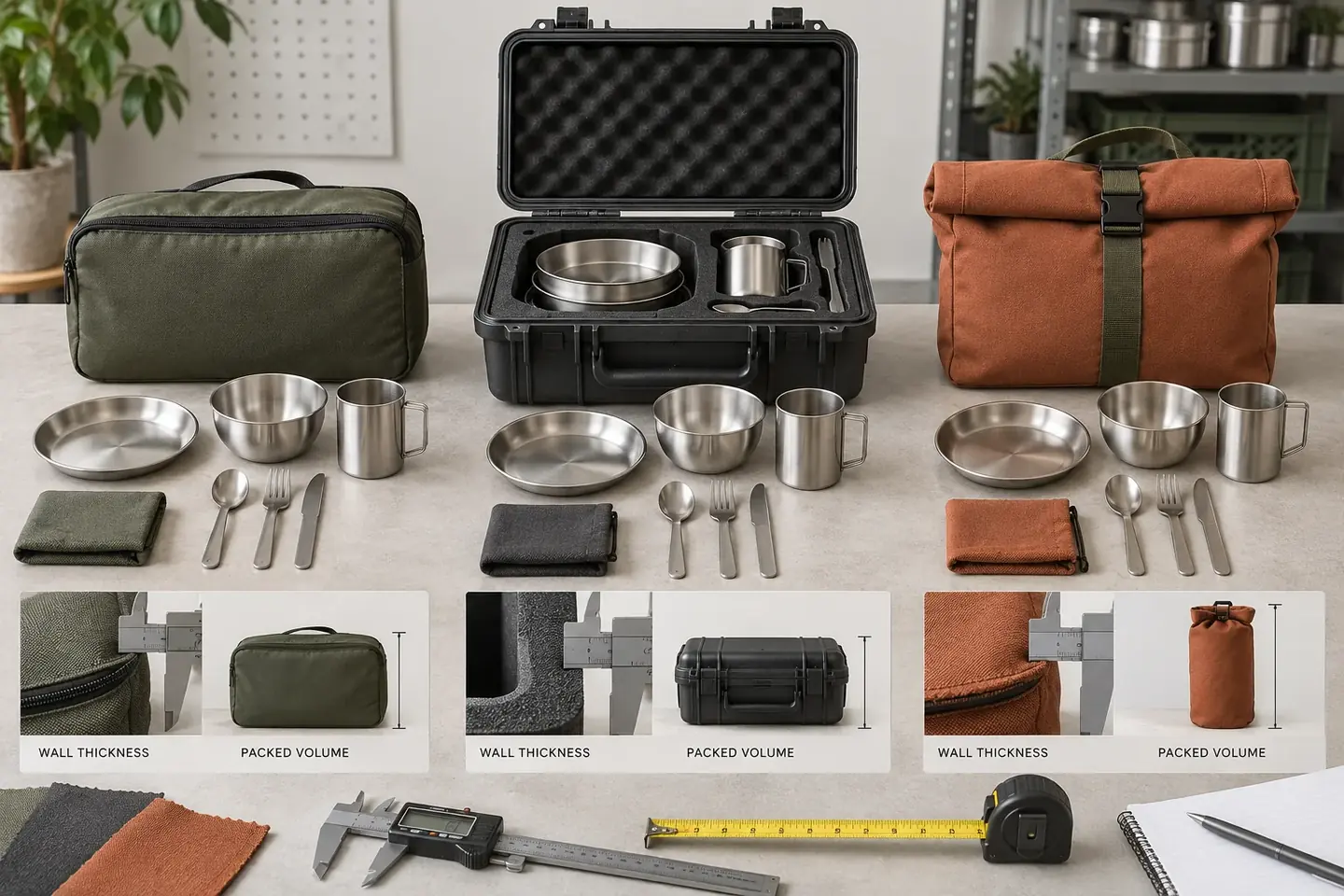
The same component set can produce different external dimensions in a soft bag, rigid case or roll-top carrier. Carrier construction adds walls, seams, insulation, reinforcement, zipper turns and handles. Buyers should compare these systems using the same BOM and the same protection requirement.
| Carry route | Packed-size behavior | Protection and usability question | Best evidence before approval |
|---|---|---|---|
| Soft zip bag | Can conform around parts, but seams, insulation and zipper radius create local limits | Does normal closure compress lids, seals or corners, and does the bag retain an acceptable shape? | Fully sewn sample packed with the representative component set |
| Rigid case | External size is stable, while wall thickness and inserts reduce usable internal space | Are hard contact points isolated and can every component be removed without levering? | Case shell and insert sample with closed-latch verification |
| Roll-top carrier | Height may vary, but the closure requires fold or roll length above the contents | Is the specified closed height based on the required number of rolls and a repeatable load? | Loaded sample photographed and measured in the approved closure state |
| Retail box around an inner carrier | Adds board, inserts and clearance outside the product pack | Does the carton restrain the carrier without crushing handles or leaving excess movement? | Assembled carrier inside a representative printed or plain packaging mockup |
A soft carrier is not automatically smaller. If it requires thick insulation, piping and an easy zipper path, its external envelope can approach that of a thin rigid case. Conversely, a rigid case can use internal geometry efficiently when the component layout is developed with the shell instead of added afterward.
Protection gaps are functional space, not wasted space
Zero clearance is rarely a dependable target. Molded parts vary within their approved controls, textiles relax, inserts compress and users do not reproduce a factory-perfect arrangement every time. The pack needs enough practical tolerance to close without forcing components into damaging contact.
Protection space should be intentional. A thin separator between steel cutlery and a coated plate may prevent marks more efficiently than a larger general gap. A shaped pocket can restrain a cup handle while leaving another zone available for a folded napkin or instruction card.
Do not treat the first foam or paper insert as final. Early inserts are useful for checking architecture, but their density, wall thickness and forming radius may differ from the production route. Recheck the envelope when the approved retention material and geometry become available.
A measurement method keeps teams from reporting different sizes
Measure the fully loaded set on a flat surface after closing it in the agreed way. For a soft case, do not squeeze the body with the measuring tool or pull loose fabric outward to create a larger value. Record the greatest natural external extent, including structural seams and fixed projections that affect packing.
Handles require a specific rule. A flexible handle that folds flat may be excluded from one logistics dimension but included in a retail display dimension; a rigid handle may always control the carton. State the treatment instead of assuming every department will interpret “packed size” identically.
Take more than one sample when the construction is flexible or manually assembled. The purpose is not to invent a universal tolerance in advance, but to understand repeatability and identify which feature drives variation. A stable measurement method is essential before a buyer and supplier can agree on an acceptance rule.
Record volume without hiding the three dimensions
A cubic-volume figure can help compare concepts, but it cannot show whether a pack fits a shelf, backpack, locker or master-carton pattern. Keep length, width and height as the controlling data and use calculated volume as a secondary comparison. Two packs with similar volume can have very different commercial fit.
Move from the product pack to retail and export packaging
Once the closed carrier is representative, develop the retail sleeve, color box, display box or protective shipper around that verified unit. Include instructions, spare parts and promotional inserts in the retail BOM before measuring. Materials added late can distort a soft bag or force a box revision.
Master-carton planning should consider orientation, divider thickness, carton board, top and bottom protection, and a practical loading method. A mathematical grid may appear efficient but become unworkable if handles interfere, cases taper or operators cannot load the last unit without damage.
Shipping efficiency should be compared alongside product protection and channel needs. Reducing one dimension may improve a carton pattern but create a poor user pack, while a modest layout change may reduce void space without changing the product. The buyer should define the priority rather than letting freight alone decide the consumer experience.
Use sample stages to retire packed-size risk
An early digital layout can identify obvious conflicts and compare broad architectures. A physical mockup then tests human packing order, removal and closure. The production-representative sample is where the buyer should confirm the final external envelope and release dependent packaging work.
Each sample report should name the component and artwork revisions, even when artwork seems unrelated. A printed instruction sheet, barcode label or retail card still occupies space. Photographs should show the open layout, packing sequence and closed measurement orientation so another team can reproduce the result.
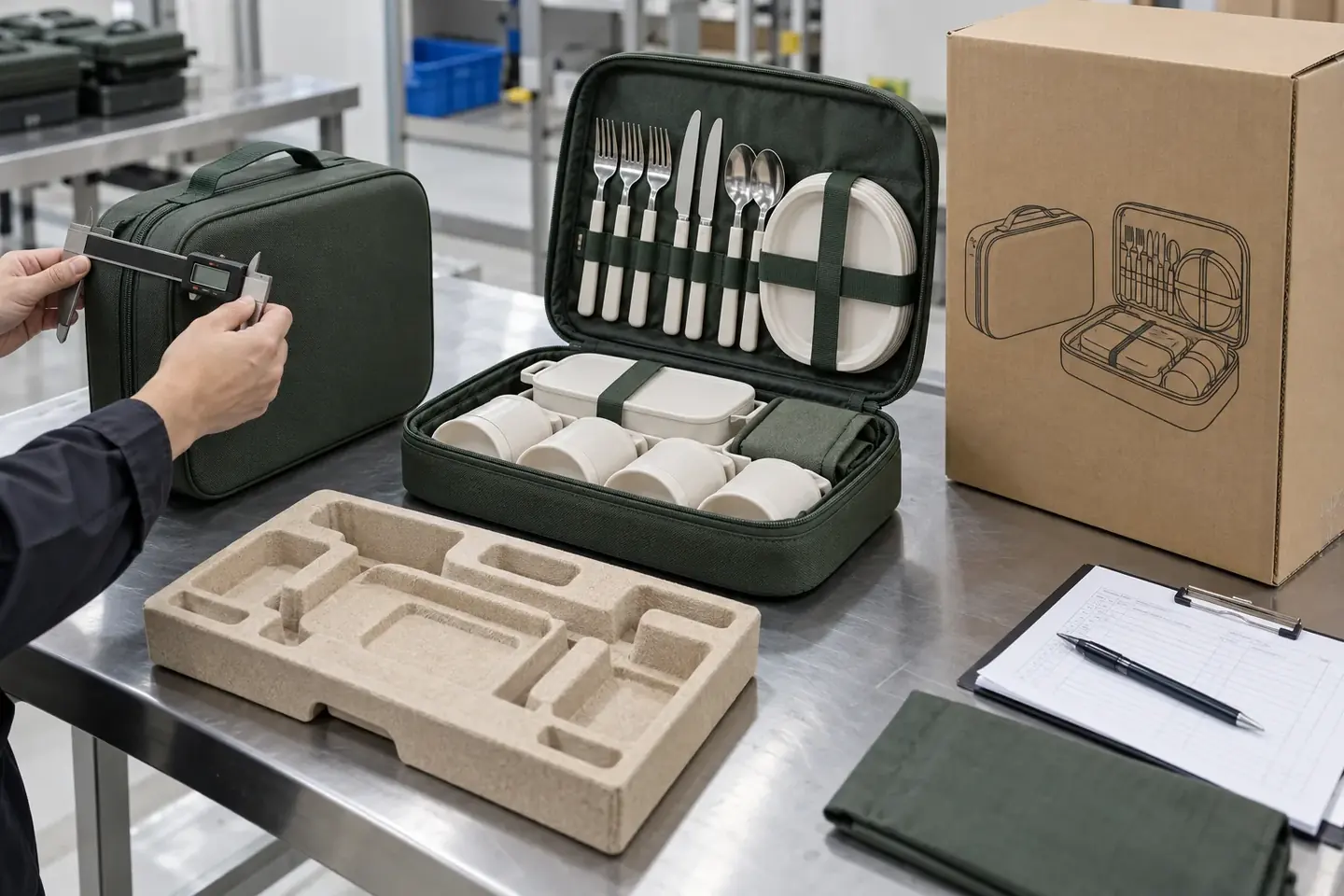
Change control continues after approval. A thicker napkin, revised latch, new zipper pull, different insert or added spare seal can change the envelope or closure load. Classify which changes require a simple confirmation and which require a new packed-size sample.
Buyer checklist for packed-dimension approval
Use this checklist before requesting a quote or releasing packaging. It is designed to expose missing inputs; the final method and acceptance criteria still need to match the chosen SKU, carrier and sales channel.
| Check | Question | Why It Matters |
|---|---|---|
| BOM revision | Are every component, lid, seal, accessory and insert listed with quantity per set? | The envelope is valid only for the exact contents used to establish it. |
| Maximum geometry | Do dimensions include rims, handles, latches, feet and other projections? | Small projections often become the controlling contact points. |
| Measurement boundary | Does the target describe the closed carrier, retail unit or master carton? | Different teams otherwise report different but apparently valid numbers. |
| Orientation | Is length × width × height shown with a photo or drawing? | It prevents fields from being exchanged and makes retesting repeatable. |
| Nesting sequence | Can an ordinary user pack and remove the set without forcing parts? | A theoretical fit may fail during repeated real-world handling. |
| Contact control | Which surfaces must be separated to prevent rattle, scratching or deformation? | Protection materials and gaps become part of the final size. |
| Carrier construction | Are wall, insulation, seam, zipper, handle and insert details representative? | An early shell or bag can understate the production envelope. |
| Closure state | Is the zipper, latch or roll-top closed in the approved way without excessive load? | Forced closure hides an undersized design and can damage components. |
| Packaging dependency | Will retail and export packaging wait for a verified closed sample? | It prevents carton work from being based on an unstable estimate. |
| Change rule | Which component or material revisions trigger packed-size reapproval? | It keeps a previously approved dimension from becoming obsolete. |
Frequently asked questions about packed dimensions
Can packed size be calculated by adding every component dimension?
No. Components overlap, nest and occupy irregular space, while lids, handles, seams and protective layers add clearance. Calculations can establish an early envelope, but the released value should come from a complete representative pack.
Should buyers specify internal or external packed dimensions?
Both can be useful. Internal dimensions control component fit, while external closed dimensions affect retail space, carry experience and shipping cartons. Label each set of values and state its orientation and measurement method.
How much compression is acceptable for a soft carry bag?
There is no universal allowance. It depends on the textile, insulation, zipper path, component edges and appearance standard, so compression should be evaluated on a representative loaded sample and agreed for that project.
When should packed dimensions be frozen?
Freeze them after component geometry, nesting order, retention and carrier construction are representative, but before dependent retail packaging and master-carton quantities are finalized. Reconfirm them if a controlling part changes.
What should a buyer send for a packed-dimension review?
Send the component list, drawings or samples, required quantity of each item per set, material and carrier direction, protection needs, target sales channel, packaging limits and any shelf or logistics constraints. Mark optional components separately.
Conclusion: verify the packed system before fixing the carton
Portable dining set packed dimensions become reliable when the buyer treats them as the output of a controlled system. Freeze the component list, identify maximum geometry, test nesting and removal, add purposeful protection, measure the representative closed carrier and then develop retail and export packaging. This sequence reduces late revisions because each downstream number has physical evidence behind it.
For a Naike Tableware review, send the proposed set composition, drawings or reference samples, target channel, carry format, branding and packaging direction. The team can assess which dimensions must be confirmed for that selected SKU and whether an existing, configured or newly developed route is appropriate, without assuming universal MOQ, timing or performance values.
Editorial note: the images in this guide are original conceptual visuals created to explain packing decisions. They are not test records, product specifications or photographs of verified Naike production results.