
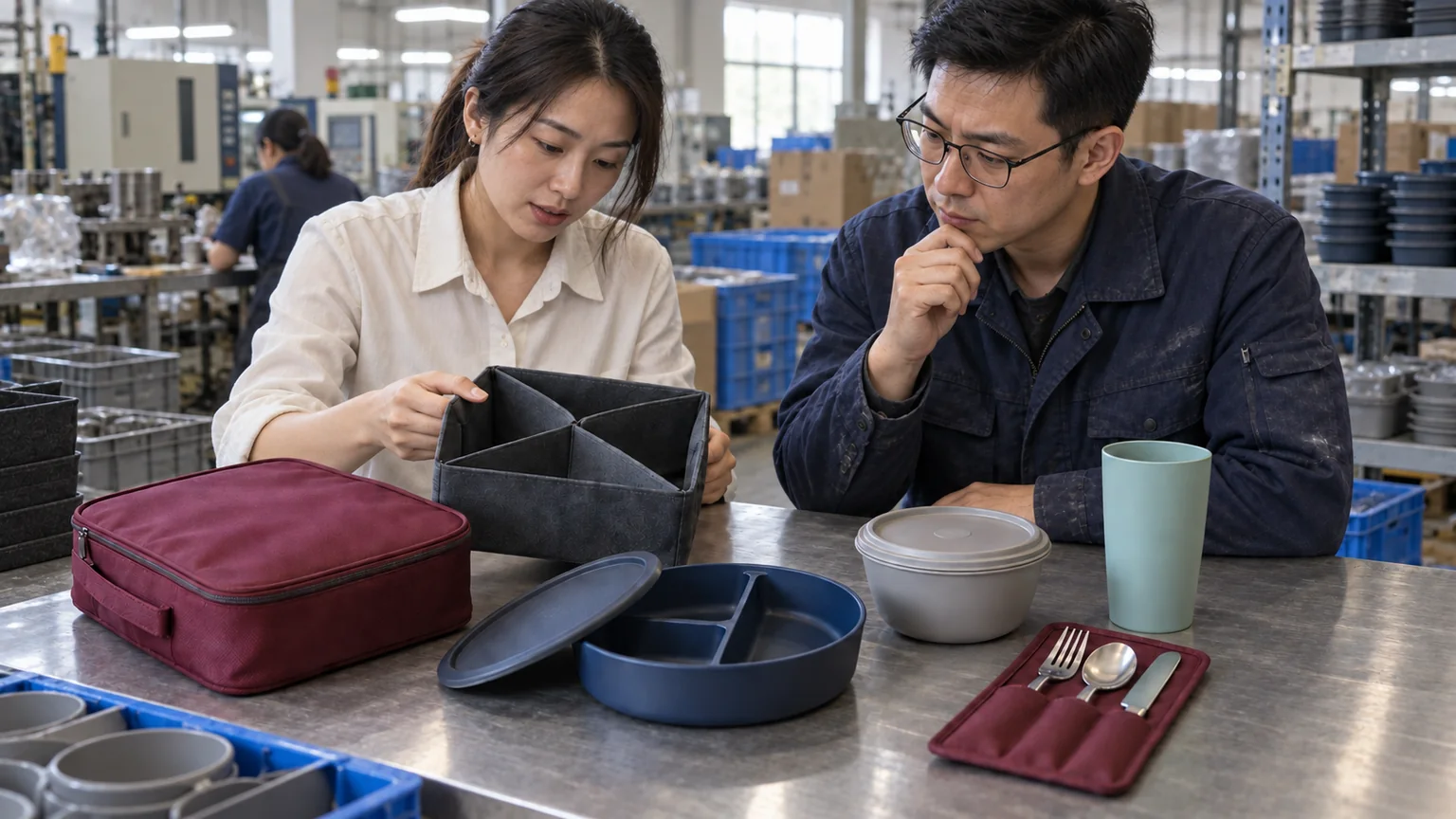
How should airlines specify crew layover tableware?
Crew layover tableware procurement should begin with the crew profile, hotel-room use, approved packing envelope, exact component count, issue and return ownership, cleaning route, replacement rules, food-contact evidence and branding controls. Approve one controlled bill of materials, test the complete packed kit in representative luggage zones and hotel storage, then pilot issue, use, return and reissue before production.
A crew dining kit moves through more environments than ordinary household tableware: procurement storage, an issue point, a suitcase or crew bag, layover accommodation, a collection point and a service hub. A concept may look compact in a photograph yet create operational problems if the packed cube is too deep, the lid is not counted separately, or damp parts return to a closed textile case.
This guide concerns meals in crew layover accommodation. It does not represent onboard service equipment, prove compatibility with a carrier’s baggage policy, or make aviation-safety claims. Dimensions, weights, capacities, cleaning performance, durability, food-contact status, MOQ and lead time remain to be confirmed for the final SKU and destination.
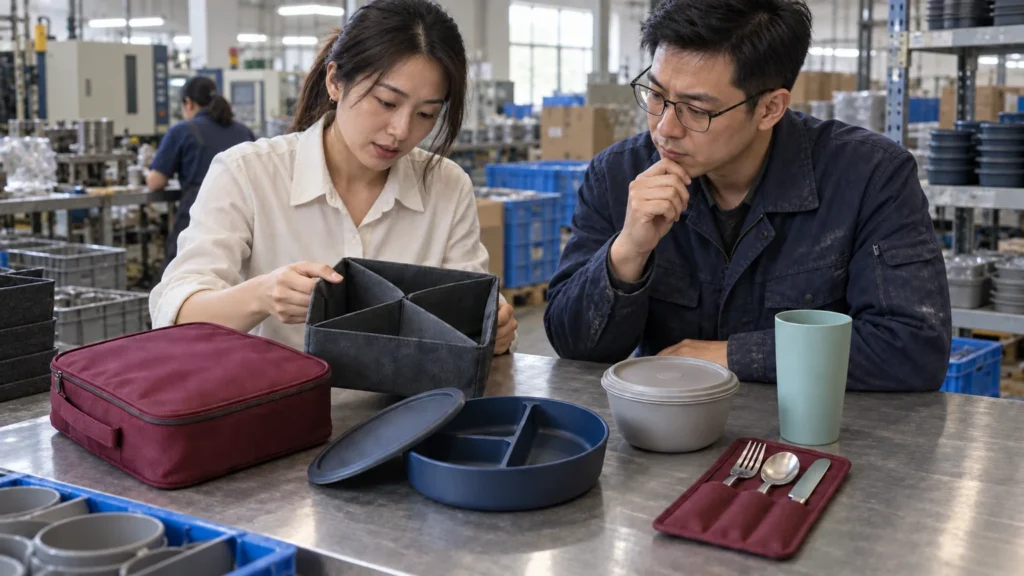
Build the Crew Layover Operating Brief
Start with the people and the stay. Record the typical crew group, nights away, room type, available kitchenette equipment, expected meals and whether each kit is individually assigned or held in a shared pool. Identify the smallest approved packing zone and the actual drawer, shelf and table surfaces in representative hotels.
Next, define custody. An airline may issue the kit at base, distribute it through a crew-services partner, position it in accommodation, or include it in a longer-stay pack. Each model changes labeling, tracking, cleaning and replacement. Named ownership may reduce mixing; pooled inventory needs stronger count, quarantine and reissue controls.
| Program input | Buyer question | Controlled output |
|---|---|---|
| Crew and stay | Which meals and parts are needed? | Approved module and BOM |
| Packing zone | Where must the closed cube fit? | Maximum packed envelope |
| Hotel room | Where is it stored and used? | Room-fit checklist |
| Ownership | Assigned, loaned or pooled? | Issue and return procedure |
| Destination | Which evidence applies? | Document request list |
Assign decision owners early. Crew operations defines the journey. Hotel or mobility partners confirm accommodation constraints. Quality reviews materials and evidence. Service-hub teams approve cleaning and drying. Brand teams approve color and decoration. Procurement controls supplier exceptions, quantities, tooling and commercial assumptions.
Select Controlled Crew Layover Tableware Modules
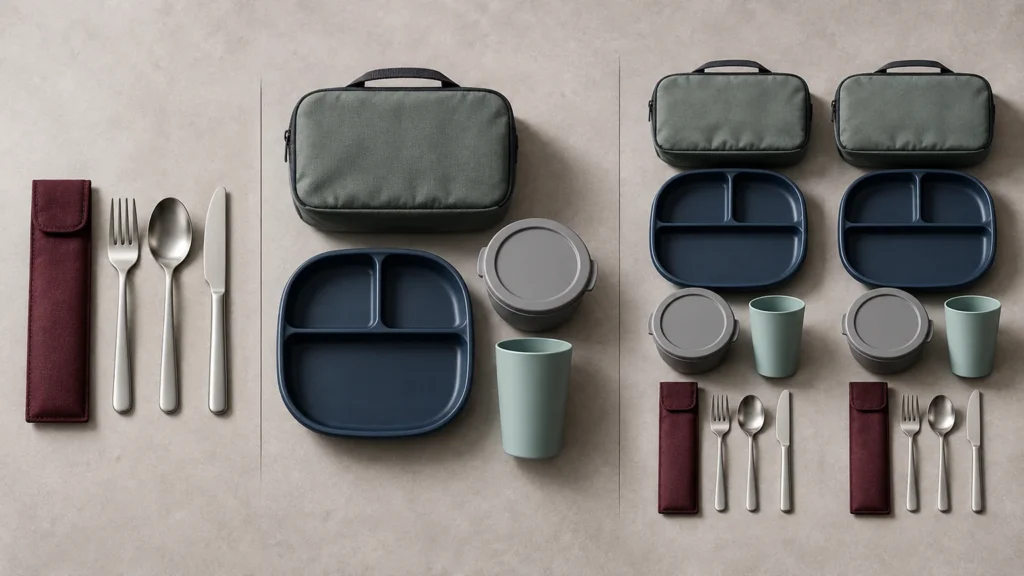
Use named modules rather than informal omissions. An utensil-only sleeve may suit a limited program with approved hotel tableware. A complete single-person module can include one midnight-blue divided PP plate with charcoal lid, one warm-gray lidded PP bowl, one seafoam PP tumbler, and a stainless fork, spoon and blunt table knife in a burgundy sleeve. A two-person allocation should contain two separately countable complete kits.
The companion Single-Person Airline Crew Layover Dining Kit With Packing Cube shows the complete reference module. A deep-burgundy semi-rigid cube and removable graphite X-divider organize components without implying leak containment or baggage acceptance. Final geometry, capacity, weight, cleaning route and commercial terms require physical approval.
Keep the bill of materials countable
Assign separate part numbers to the plate body, plate lid, bowl body, bowl lid, tumbler, fork, spoon, knife, sleeve, divider and cube. A visually similar replacement is not automatically compatible. Recheck lid engagement, divider clearance, nesting, zipper closure, color and evidence whenever a component changes.
Control substitutions in writing. Suppliers should disclose any proposed resin, pigment, steel, coating, zipper, foam, lining or packaging change before production. Procurement should not accept a broad “equivalent” description where fit, food contact, color or cleaning behavior can change.
Validate Packing, Drawer, Shelf and Meal-Surface Fit
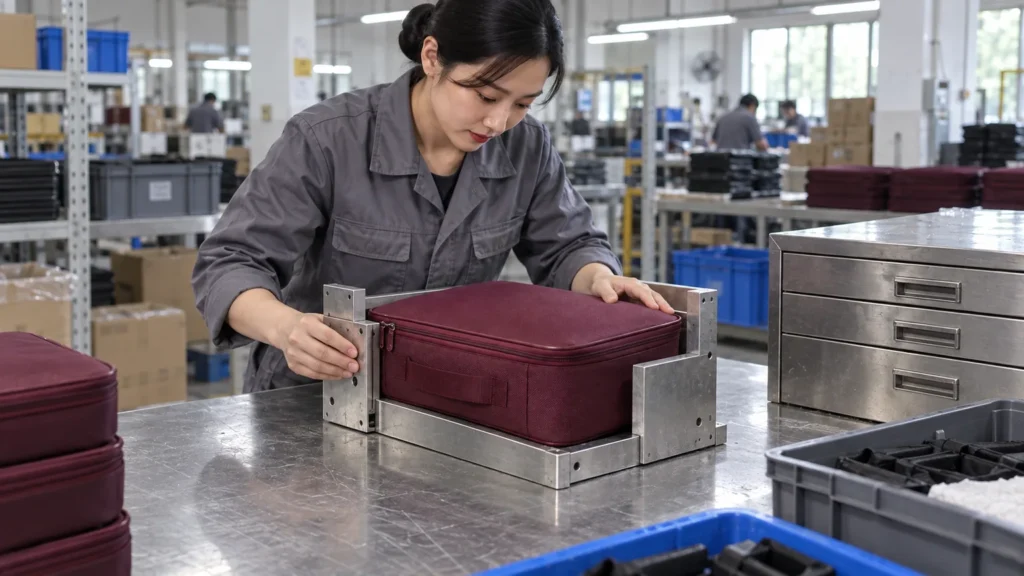
Measure the smallest approved crew-bag or suitcase zone and each representative hotel location. Test the complete closed cube, not an empty shell. Include handle projection, zipper movement, corner radius, packed thickness and finger clearance. Confirm that the kit can be removed from a drawer without disturbing work equipment or personal items.
Run a repeatable fit trial. Load the exact approved bill of materials, close the cube without force, place it in the intended packing zone, move it through normal handling, open it on the hotel meal surface, remove each component and repack it. Record photos, observations, sample revision and accepted conditions. Repeat after any dimensional or material change.
Do not convert a sample-room observation into a universal claim. A photograph cannot prove cabin-baggage acceptance, resistance to crushing, leak containment, thermal performance or protection of nearby electronics. The airline’s own procedures and each carrier’s applicable baggage rules remain authoritative.
Control stacking and nesting
If the plate, lids, bowl and tumbler touch during packing, identify every contact point. Check release after storage, scuffing, deformation and rattle. Confirm whether the divider prevents hard contact and whether parts can be removed without levering. State the maximum approved stack only after a physical trial.
Map Issue, Use, Return and Reissue
At issue, count every body, lid and accessory. Record the kit revision, assigned person or pool, base, date and condition. Provide concise instructions for intended layover-accommodation use, cleaning, complete drying, repacking and reporting missing or damaged parts.
During use, the divided plate can separate foods, the lidded bowl can hold an approved meal portion, and the tumbler and utensils complete a place setting. These descriptions do not prove liquid-tightness, microwave use, freezer use, dishwasher use, stain resistance or sanitation. Validate every claimed use against the exact material and process.
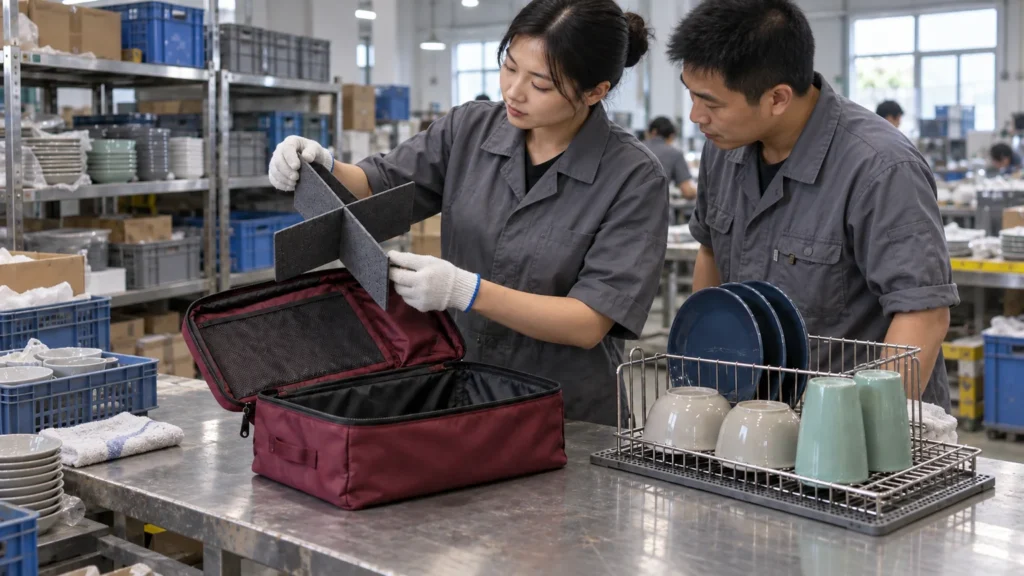
At return, count the plate and lid, bowl and lid, tumbler, three utensils, sleeve, divider and cube. Quarantine cracked, warped, deeply scratched, stained, loose or incomplete parts. Separate food-contact components from textile and divider elements because cleaning chemistry, temperature, mechanical action and drying needs may differ.
Never close a damp kit for storage. Establish a visual drying standard, protected air-dry area and release check. Record issued kits, complete returns, loose parts, wash failures, quarantined pieces, replacements and closing inventory. Analyze losses by base, route pattern, hotel partner, duration and custody model before setting reserve stock.
Estimate program quantity
Quantity begins with the peak number of simultaneous users. Add units in transport, hotel use, cleaning, inspection, quarantine and redistribution. Add a controlled reserve based on a representative pilot, not an arbitrary percentage. Assigned kits need replenishment planning; pooled kits also need turnaround capacity and reconciliation.
Match Materials and Evidence to the Exact SKU
Food-grade PP may be considered for lightweight molded tableware and the divider, stainless steel for reusable utensils, and coated textile for the semi-rigid cube and sleeve. Exact resin, additives, pigments, steel grade, finish, fabric, coating, reinforcement, zipper, thread and adhesive remain project decisions.
For United States programs, review the FDA overview of food-contact substances. For European Union programs, review the European Commission framework for food-contact materials. These references do not certify this concept or any supplier.
Request records that identify the exact material or finished article, color, test method, conditions, result, laboratory and date. Match evidence to the intended food, contact time, temperature, cleaning route and destination. Useful internal references include Food-Grade PP, Stainless Steel and Portable Dining.
Approve Logo, Pantone and Packaging Separately
Potential decoration routes include printing or molded identification on PP, laser marking on stainless steel, and woven or printed marks on the cube and sleeve. Each surface needs its own artwork area, process and durability review. Do not assume one logo process performs equally on plastic, steel and coated textile.
Pantone references guide development but do not replace physical samples. Midnight blue, charcoal, warm gray, seafoam and burgundy will shift with resin, surface texture, coating and light. Review the complete kit under representative room and daylight conditions, then retain signed references with the revision record.
Packaging options may include a paper band, plain inner carton, molded-paper protection or export master carton. Define barcode, component count, instructions, destination information and carton labels before artwork approval. Trial the entire pack because inserts change dimensions, weight, unpacking time and waste handling.
Compare Suppliers With One Scorecard
Send every supplier the same RFQ: crew profile, use environment, bill of materials, packed envelope, quantity, colors, decoration, packaging, evidence scope, sample stages and target schedule. Require each exception and unconfirmed field to be listed. Separate existing-component, modified-component and new-tooling routes.
| Field | Required evidence | Approval question |
|---|---|---|
| Configuration | BOM and packing image | Can every part be counted? |
| Packed fit | Drawing and physical trial | Does the closed cube fit? |
| Return cycle | Cleaning and drying inputs | Can kits be reissued reliably? |
| Materials | SKU-matched specifications | Does evidence match use? |
| Commercial | MOQ, samples, tooling and timing | Are quotes comparable? |
Existing components may shorten development, while custom molding can improve divider fit or packed geometry. New tooling introduces drawings, tolerances, tool trials and validation. Compare verified function, approval risk, replacement support and total program cost rather than unit price alone.
Crew Layover Tableware Procurement Checklist
- Crew profiles, accommodation and custody are documented.
- The complete module and packed envelope are controlled.
- Packing, drawer, shelf and table fit are physically tested.
- Issue, return, cleaning, drying and replacement owners are assigned.
- Evidence matches each exact component, color and destination.
- Physical colors, decoration and packaging are approved.
- Unverified claims remain “to be confirmed.”
- MOQ and lead time follow final specification approval.
Crew Layover Tableware FAQ
What should the specification include?
Define the crew, accommodation, packed envelope, component count, workflow, cleaning, materials, evidence, branding, packaging and replacements.
How is fit confirmed?
Test the complete closed sample in the smallest approved packing zone, hotel drawer, shelf and meal surface.
Is this kit for onboard service?
No. The concept is limited to layover accommodation and makes no onboard-service or baggage-acceptance claim.
Which documents should buyers request?
Request SKU-matched drawings, material records, applicable reports, color approvals, packing instructions and inspection criteria.
When are MOQ and lead time confirmed?
After configuration, colors, decoration, packaging, testing, quantity and sample stages are defined.
Turn the Program Brief Into a Sample Trial
Share crew profiles, accommodation types, packing and storage limits, custody model, cleaning route, target markets, branding, packaging, quantity and schedule. Naike Tableware can compare existing-component and custom-development routes without treating unknown specifications as facts.