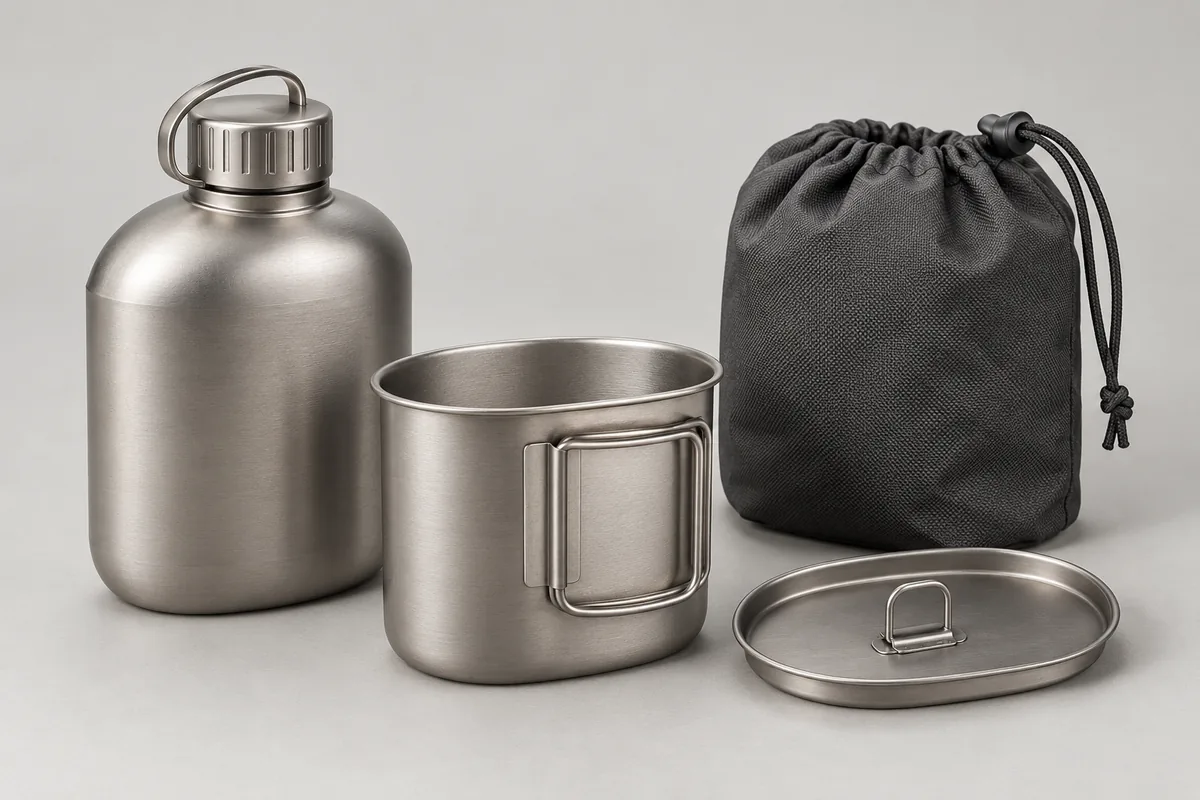
The titanium canteen cup set combines a reusable outdoor water container with a cup that nests around the lower body of the canteen. A fitted cup lid and compact pouch complete the reference system, while capacity, titanium grade, closure structure, handle geometry and packaging remain project decisions rather than unverified fixed claims.
This page is for outdoor brands, camping distributors, importers and private-label buyers evaluating a hydration-led product rather than another general tableware set. The buyer can use the reference configuration to define how water is carried, how the cup is packed, whether the cup may be used for heating, and which evidence must be approved before the finished SKU is released.
Titanium Canteen Cup Set: Buyer Information
| Buyer information | Reference direction | What must be confirmed |
|---|---|---|
| Product format | One canteen, one nesting cup, one fitted cup lid and one carry pouch | Final component count and whether the pouch is storage-only or part of the retail offer |
| Material direction | Titanium canteen and cup with a separate closure system | Titanium grade, wall construction, joining method, cap and seal materials, material evidence |
| Capacity and dimensions | Configured around the intended carry volume and cup use | Usable fill line, opening size, packed envelope, cup clearance and dimensional tolerance |
| Customization | Logo, surface finish, pouch color, information card and retail packaging | Artwork method, marking location, finish sample and approved color references |
| MOQ | Confirmed after the material route and customization scope are fixed | Quantity by finish, logo version, pouch color and packaging version |
| Sample route | Existing-component review, configured sample or newly developed structure | Which components can be sampled from an available platform and which require tooling |
| Testing | Defined for the finished canteen, closure, cup, pouch and destination market | Food-contact scope, leak method, closure cycle, dimensional and packaging checks |
| Packaging | Pouch, information card, sleeve, color box or presentation carton | Retail channel, protection level, labeling, barcode and export-carton requirement |
| Lead time | Sample and production schedules quoted separately | Material availability, tooling, decoration, test scope and packaging approval |
| Buyer input | Quantity, market, capacity target, use case, branding and delivery objective | A complete brief is needed before commercial confirmation |
What Makes This Canteen System Different?
The central product is a hydration container, not a lunch box, insulated bottle or multi-person dinnerware set. The cup is designed around the canteen profile so that it occupies the same packed footprint instead of becoming a separate loose component. That distinction gives the page a different buyer task from Naike’s existing titanium mug, cutlery, dining-set and mess-kit pages.
The reference system uses four accountable pieces: canteen, nesting cup, cup lid and pouch. The cap remains part of the canteen assembly rather than being counted as a separate retail item. If a second cup, stove, utensil or shoulder carrier is added, the buyer should treat it as a new configuration and recheck packed size, bill of materials and positioning.
| Configuration route | Best suited to | Primary approval risk |
|---|---|---|
| Canteen only | Hydration-focused programs and replacement bottle SKUs | Closure performance, grip, opening size and cleaning access |
| Canteen plus nesting cup | Hiking, bushcraft, field kits and compact outdoor retail | Nesting clearance, surface contact and cup handle interference |
| Full pouch system | Private-label gift sets and organized carry programs | Pouch fit, component count, labeling and retail pack protection |
Nesting Geometry Should Be Approved as a System
A cup that technically fits around a bottle can still fail in use if the clearance is too tight, the handles catch the pouch or the contact surfaces scuff during transport. The canteen body, cup profile, folded handles and lid must therefore be checked together. Buyers should request a packed sample rather than approving the components from separate drawings.
The bottom geometry of the canteen affects how deeply it enters the cup and how stable the nested unit feels. A shallow fit may create unnecessary packed height, while an overly close fit can make separation difficult after vibration or temperature change. The project drawing should identify critical diameters, radii, contact zones and an acceptable nesting gap.
The cup lid can be carried above the cup, inside the pouch or in another retained position. Each route changes the packed envelope and the chance of loose movement. If quiet carry is part of the buyer brief, the project should define how metal-to-metal contact is controlled rather than assuming the pouch alone will prevent noise.
Closure and Leak Review for a Titanium Canteen OEM Project
The cap is a small component with a large influence on the finished SKU. Thread engagement, seal material, compression, tether design and opening force should be evaluated with the selected canteen neck. A statement such as “leakproof” is not appropriate until the agreed test method, sample condition and acceptance threshold are documented.
Buyers should specify how the filled canteen will be transported and stored during the test. Upright bench checks, inverted holding, vibration, pressure change and repeated opening cycles answer different questions. The test scope should also distinguish leakage through the closure from moisture left on the threads after filling.
The mouth opening affects filling, drinking, cleaning and compatibility with brushes or water-treatment products. A larger opening may improve cleaning access but changes the neck, cap and seal design. These trade-offs should be settled before logo placement and retail packaging are finalized.
Cup Use, Handles and Heating Boundaries
The handled cup may be specified only as a drinking vessel or may be reviewed for direct heating in an outdoor program. Those are different approval routes. If direct heating is requested, the buyer must identify the heat source, fill condition, handle-use expectation, warning language and validation method before any suitability statement is published.
Fold-flat wire handles support compact packing, but their attachment points, spacing and movement need physical review. The handles should remain accessible when the canteen is removed and should not create sharp or unstable contact when folded. Cup rim finishing and lid fit should be checked at the same stage.
A single-wall titanium cup can transfer heat quickly. The page therefore makes no universal touch-temperature or insulation claim. Buyer instructions, product warnings and intended-use language must follow the approved construction and actual validation evidence.
Material, Finish and Branding Decisions
“Titanium” is not a complete material specification. A project should state the intended grade, material evidence, wall construction, surface treatment and which parts are titanium versus separate seal, tether or pouch materials. The specification should also identify any joining, welding or formed areas that require visual criteria.
Natural brushed, blasted and other finish directions change appearance, fingerprint visibility and how contact marks show after nesting. The buyer should approve the finish on formed parts rather than on a flat color chip. A consistent master sample is especially important when the canteen and cup are produced through different forming routes.
Logo positions can be reviewed on the canteen body, cup wall, cap or pouch label. Curvature, abrasion during nesting and direct contact with hands influence the marking method and usable artwork size. Final artwork should be checked on the actual product surface before production release.
Private-Label Packaging for the Complete System
The pouch can organize the product but should not automatically be described as insulated, waterproof or protective. Its textile, seams, drawcord, label and care requirement must be selected by project. If the pouch needs to carry damp components, drainage and drying expectations should be included in the brief.
Retail packaging may use a plain information card, printed sleeve, kraft carton, color box or presentation pack. The correct route depends on the sales channel, required component visibility and surface-protection risk. Export cartons should be engineered from the approved retail pack and verified product dimensions, not estimated from the concept images.
Barcode position, country-of-origin marking, care information and material statements should be coordinated before artwork approval. When multiple pouch colors or finish variants share a carton, the SKU identification and assortment plan also need to be clear.
Sample and Production Approval Route
The project begins with the expected order quantity, destination market, target capacity, use case and configuration. Naike can then assess whether an existing component platform can support the brief, whether a configured sample is practical, or whether a new neck, body, cup or closure requires development. MOQ and schedule are confirmed only after that route is defined.
The first physical sample should be used to review fill volume, closure operation, rim and opening finish, cup stability, handle movement, nesting clearance and pouch fit. Branding and retail packaging should follow after the underlying assembly is stable. Every revised part should carry a clear sample revision so that approvals do not mix old and new components.
Production release should reference the signed sample, bill of materials, controlled drawings, approved finish and packaging specification. Inspection points may include component count, critical dimensions, visible finish, closure assembly, marking position, pouch construction and pack-out. The final plan must match the actual product and market requirements.
Buyer Checklist for a Titanium Canteen Cup Set
| Check | Question | Why It Matters |
|---|---|---|
| Use case | Is the product for hiking, field use, bushcraft, gifting or general outdoor retail? | The use case controls capacity, closure, cup and pouch decisions. |
| Configuration | Does the SKU include a canteen, one cup, cup lid and pouch only? | A fixed component list prevents quotation and packing mismatches. |
| Material | Which titanium specification and supporting evidence are required? | Material name alone cannot release the finished SKU. |
| Closure | What leak-test method and opening-cycle expectation will be used? | Closure performance depends on the complete neck, cap and seal assembly. |
| Nesting | What packed envelope and release clearance are acceptable? | The canteen, cup, handles and lid must work as one system. |
| Cup use | Is the cup for drinking only, or must direct heating be evaluated? | Heating claims require a separate use definition and validation route. |
| Branding | Which product and pouch surfaces need logos? | Curvature and nesting abrasion affect marking location and method. |
| Packaging | Is a pouch sufficient, or is a retail sleeve, box or presentation pack needed? | Packaging changes protection, labeling and export-carton dimensions. |
| Market | Where will the final product be sold? | Testing and documentation follow the finished SKU and destination market. |
Frequently Asked Questions
Can the canteen capacity be customized?
Capacity can be reviewed as part of the project, but changing it may affect the body geometry, neck, cup fit, pouch and tooling route. Send the target usable volume and packed-size limit so feasibility can be assessed before quotation.
Is the titanium nesting cup suitable for heating?
No universal heating claim is made on this concept page. If direct heating is required, the heat source, cup construction, fill condition, handle behavior, warning language and test method must be defined and validated for the approved SKU.
Can the pouch color and material be changed?
Yes, pouch textile, color, closure and labeling can be reviewed. The buyer should also state whether the pouch is only for storage or must meet drainage, protection or retail-presentation requirements.
How is leakage checked during sampling?
The buyer and supplier should agree on orientation, fill level, holding time, vibration or cycling conditions and the acceptance threshold. Results apply to the tested canteen, cap and seal combination, not to every titanium bottle.
What information is needed for a comparable quotation?
Provide quantity, destination market, target capacity, required components, titanium and finish direction, closure expectation, logo artwork, pouch requirement, retail packaging and delivery objective. Reference links are useful when the buyer identifies which features should be retained or changed.
Send a Complete Canteen Project Brief
Share the intended quantity, market, capacity range, packed-size limit, use scenario, material evidence, branding and packaging direction. Naike Tableware can then review the available development route and confirm what must be sampled before MOQ, schedule, testing and quotation are finalized.