
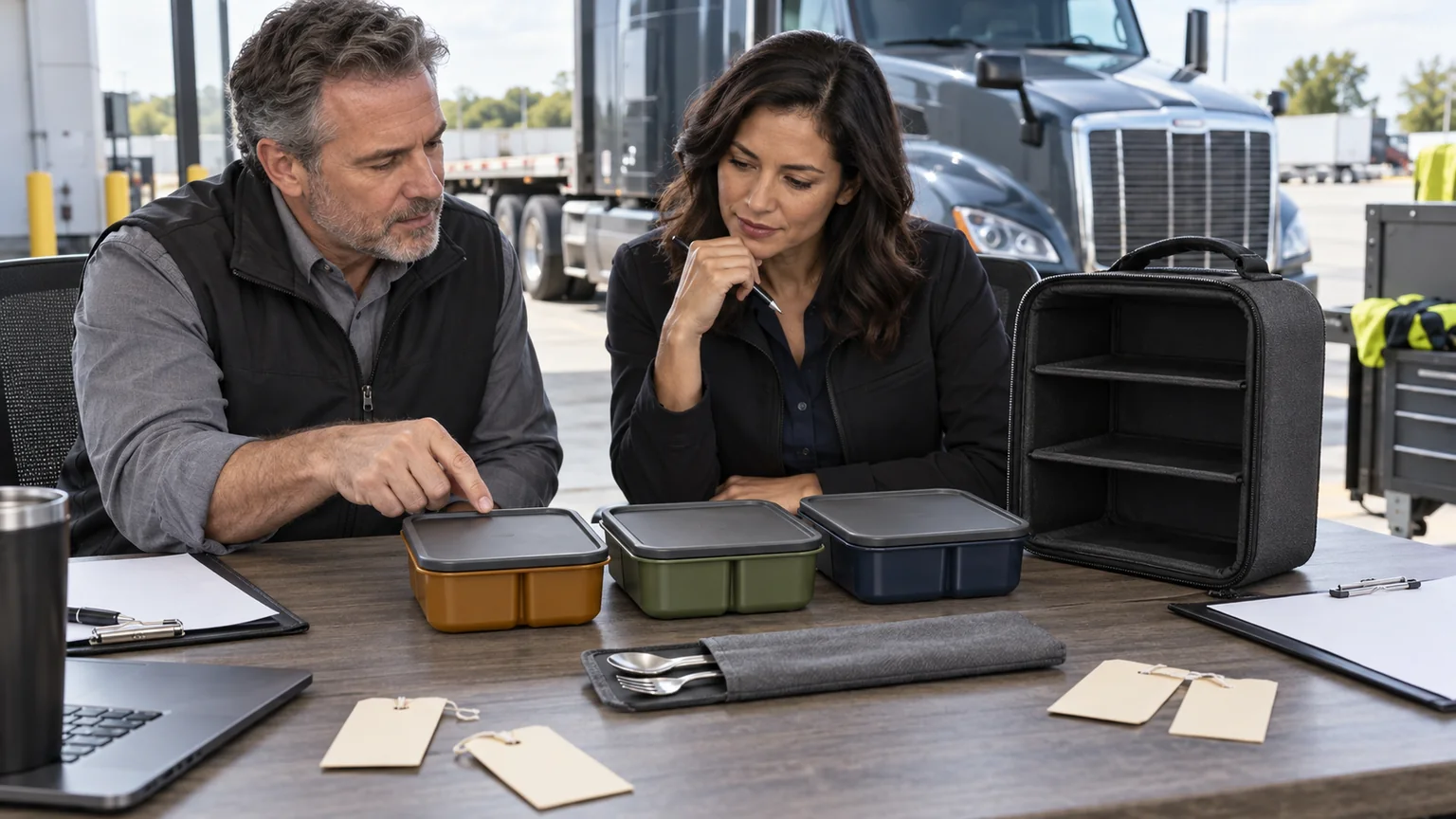
How should fleets specify a long-haul driver meal kit?
A long-haul driver meal kit should be specified around route duration, planned meal periods, parked-use conditions, truck-cab storage, component counting, cleaning, replacement, food-contact evidence and driver handoff. Define one controlled bill of materials, validate the physical kit in every cab layout, and test issue, storage, parked meal use, return and depot turnaround before approving production.
Driver meal equipment moves through several operating environments: a fleet depot, the truck cab, rest areas, customer sites and the return station. A box that appears compact on a catalog page may obstruct a drawer, slide in transit, fail to fit the fold-out table or create an incomplete return when lids and utensils are not counted separately.
Procurement should therefore connect tableware design with route planning and depot operations. This guide provides a neutral sourcing framework. It does not invent dimensions, temperature performance, dishwasher compatibility, food-contact compliance or service life. Any unverified field remains “To be confirmed for the project” until drawings, samples and evidence are approved.
Build the Long-Haul Driver Meal Kit Operating Brief
Start with route types rather than one generic driver profile. Record typical time away from the depot, planned stops, whether meals are prepared centrally or by the driver, and where clean and used components are stored. Note the truck makes and cab layouts in scope, including sleeper and day-cab differences.
Separate the meal periods. A morning, midday and evening meal may require different compartment layouts or simply three color-coded versions of one box. Color can help sequence use but should not replace written handling instructions or dietary identification. Define whether each box is issued empty, pre-packed by catering or used by the driver for self-prepared food.
Convert fleet inputs into controlled outputs
| Input | Buyer question | Controlled output |
|---|---|---|
| Route | How long is the driver away? | Meal-period plan |
| Cab | Where can the kit be stored safely? | Fit envelope and restraint route |
| Food | Which meals and conditions apply? | Box and process brief |
| Return | Who counts and cleans the components? | Turnaround procedure |
| Market | Which evidence is required? | Document request list |
Assign an owner to every decision. Fleet operations confirms vehicle constraints. Catering or program management defines food and handoff. Quality reviews materials and evidence. Depot teams approve cleaning and inspection. Brand teams approve colors and decoration. Procurement controls commercial assumptions and supplier exceptions.
Choose a Controlled Long-Haul Driver Meal Kit Configuration
A three-meal module can use three low-profile rectangular divided PP boxes with charcoal lids: muted amber for the first meal, olive green for the second and deep navy for the third. One stainless fork-and-spoon pair in a gray sleeve supports the complete sequence when the agreed cleaning or handling plan allows it. A vertical semi-rigid case uses three padded shelf positions to keep boxes separate and accessible.
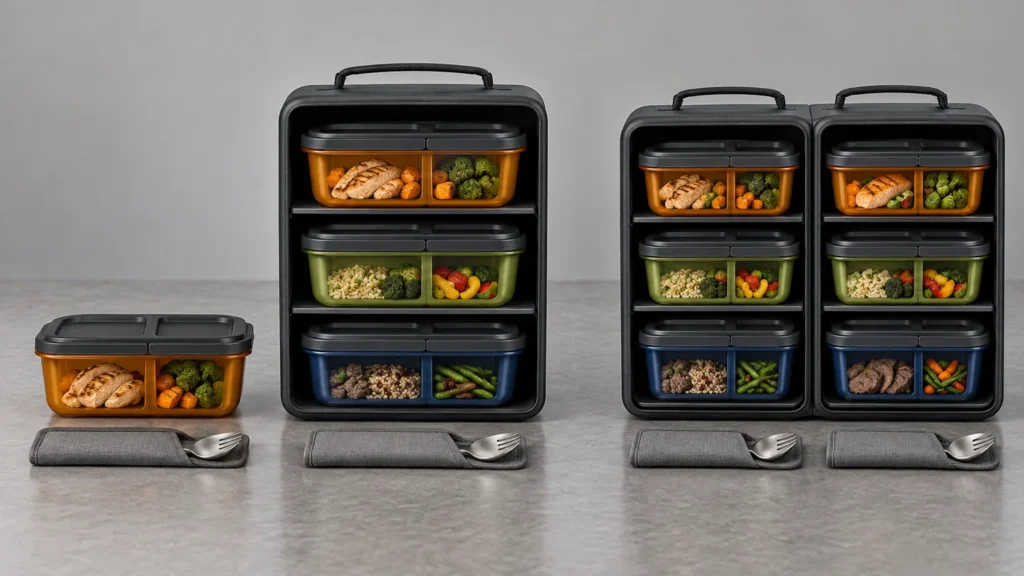
Configuration images are planning aids, not capacity or performance evidence. A short route may use one box. A longer duty cycle may use the complete three-box case. A two-driver team may use two individually assigned modules. Give every approved version its own configuration code, bill of materials, drawings, packing image and inspection reference.
The companion Three-Meal Driver Bento Kit With Cab Console Case demonstrates this concept. Final capacities, packed dimensions, loaded weight, vehicle compatibility, cleaning route, MOQ and lead time remain subject to confirmation.
Control substitutions and spare parts
Identify the box body, lid, divider, shelf, sleeve, utensil pair and case as separate replacement items. A visually similar lid is not automatically compatible. Recheck closure, stacking, pocket fit, color and evidence whenever a component changes. Spare stock should follow the same approved revision as the fleet kits.
Validate Passenger-Seat Console and Table Fit
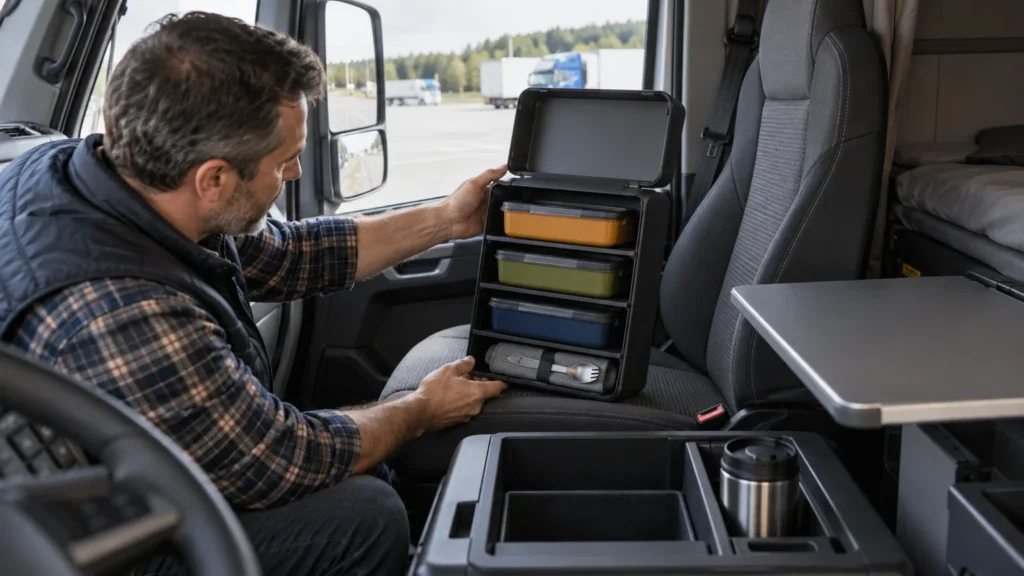
A long-haul driver meal kit must be evaluated in the parked cab and secured for travel. Measure the intended storage space, seat clearance, console area, sleeper storage and fold-out table. Include handles, zipper movement, door swing and finger clearance. Check whether the driver can remove one box without unloading the entire case.
Conduct trials only under the fleet’s approved safe procedure. The vehicle should be parked, secured and out of active driving operation. The kit must not obstruct controls, restraints, airbags, doors, visibility or emergency access. An image of a case on a seat does not prove that position is approved during vehicle movement.
Use a repeatable cab-fit review
- Measure the smallest storage position in every cab family.
- Load the complete approved kit and record the total packed condition.
- Open the case and remove each box while parked.
- Place one box and utensils on the intended meal surface.
- Repack the module and test the approved travel restraint.
- Record accepted positions with vehicle and kit revisions.
If the case is designed for a center-console or passenger-seat area, the operator must approve its position and restraint. The product supplier should provide dimensions and construction data, but vehicle integration remains a fleet decision.
Map Depot Issue Parked Use and Return
At issue, staff should verify three boxes, three lids, the utensil pair, sleeve, shelves and case. Record the kit revision and driver or vehicle assignment. If boxes contain prepared food, the catering team must control labeling, time, temperature and dietary information under its applicable plan.
During parked use, the driver removes only the intended color-coded box, places it on the confirmed surface and returns the closed component to its shelf afterward. Used and clean items should remain separated according to the program procedure. The case side pocket can be evaluated for approved non-food accessories, but its contents are not defined by this concept.
A padded or insulated-looking case does not establish temperature performance. Any hot, chilled or ambient holding method must be defined and validated with the exact food, time, equipment and operating conditions. Do not use catalog imagery as a substitute for a food-safety plan.
Design Return Cleaning Drying and Reissue
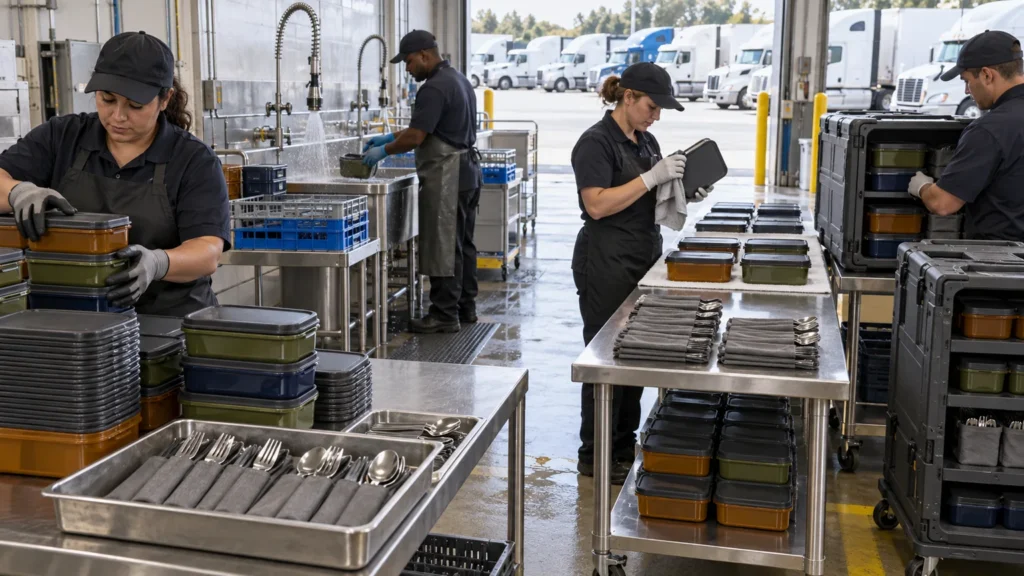
At return, count box bodies, lids, utensils, sleeve, shelves and case separately. Quarantine missing, cracked, distorted, stained or damaged pieces. Used food-contact components should follow the approved residue removal, washing, rinsing, drying and inspection process before reissue.
PP boxes, stainless utensils, textile sleeves and semi-rigid cases may require different cleaning routes. Do not assume the complete assembled kit can enter one wash cycle. Confirm chemistry, temperature, mechanical action and drying for each material and construction. Repack only when all required parts are dry and serviceable.
Track opening quantity, issued quantity, returned complete kits, loose parts, wash failures, quarantined items, replacements and closing inventory. Analyze loss by depot, route type and assignment method. Real records create a better reserve-stock policy than an arbitrary percentage.
Plan quantity from fleet cycles
Required quantity can be estimated from active vehicles or drivers plus kits in issue, cleaning, repair and quarantine, with a controlled reserve. Shared depots also need transfer time and local peak demand. Confirm the number after a representative pilot rather than relying on a single theoretical utilization rate.
Match Materials and Evidence to the Exact SKU
Food-grade PP may be considered for lightweight molded boxes and lids, stainless steel for reusable cutlery, and textile or foam constructions for the sleeve and case. Exact resin, additives, pigments, steel grade, fabric composition, padding, lining, coatings, thread and hardware remain project decisions.
For United States programs, review the FDA overview of food-contact substances. For European Union programs, review the European Commission framework for food-contact materials. These sources define frameworks and do not certify this concept, supplier or finished kit.
Request documents that identify the tested material or finished article, color, test method, conditions, result, laboratory and date. Match evidence to the selected component, intended food, time, temperature, cleaning process and destination market. Internal references include Food-Grade PP, Stainless Steel and Lunch Boxes and Bento Sets.
Plan Logo Pantone Case and Packaging Approval
Potential decoration routes include printed or molded marks on PP, laser marking on stainless steel, woven or printed labels on the sleeve and case, and graphics on paper bands or cartons. Each surface needs its own artwork area, process and durability review.
Pantone references guide development but do not replace physical approval. Amber, olive, navy, charcoal, graphite textile and kraft paper display color differently. Review samples under representative depot and cab lighting and retain the approved references with the product revision.
Packaging may use bulk master cartons, plain kraft inner cartons, recyclable paper bands or protective dividers. Define barcodes, component counts, handling instructions and market information before artwork approval. Trial the final pack because inserts change carton dimensions and unpacking time.
Compare Suppliers With One Fleet Scorecard
Issue the same RFQ to each supplier. Include route scenarios, cab families, configuration, quantity, color split, decoration, case construction, packaging, testing scope, sample stages and target schedule. Require suppliers to list every exception and unconfirmed field.
| Field | Evidence | Approval question |
|---|---|---|
| Configuration | Bill of materials and packing image | Are all components controlled? |
| Cab fit | Drawings and vehicle trial record | Does every cab family work? |
| Turnaround | Cleaning and inspection inputs | Can depots reissue reliably? |
| Materials | SKU-matched specifications and reports | Does evidence match intended use? |
| Commercial | MOQ, samples, tooling and lead-time assumptions | Are quotations comparable? |
Separate existing-component, modified-component and new-tooling routes. A standard box can reduce development work, while new tooling may address a fleet-specific storage envelope. Compare verified function, approval risk, replacement support and commercial assumptions.
Long-Haul Driver Meal Kit Buyer Checklist
- Routes, meal periods and driver assignment are documented.
- The three-box configuration and replacement parts are controlled.
- Cab storage, table use and travel restraint are physically reviewed.
- Issue, parked-use, return and reconciliation owners are assigned.
- Food-temperature controls remain in the applicable operating plan.
- Cleaning and drying routes are confirmed by material.
- Evidence matches each exact SKU and destination market.
- MOQ and lead time are confirmed after configuration approval.
Long-Haul Driver Meal Kit FAQ
What should the specification include?
Define route duration, meal periods, boxes, cab storage, parked-use workflow, cleaning, replacements, evidence, branding and approvals.
How is cab fit confirmed?
Use approved physical samples in every cab layout and check storage, restraint, access, tables, doors, controls and repacking.
Does the case prove temperature control?
No. Temperature controls must be validated for the exact food, time, equipment and process.
Which records should buyers request?
Request current evidence matching each exact component, material, color, intended use and market.
When are MOQ and lead time confirmed?
After configuration, colors, decoration, packaging, testing, quantities and approvals are defined.
Turn the Fleet Brief Into a Three-Meal Trial
Share route types, cab families, meal periods, storage limits, cleaning process, target markets, branding, packaging, quantity and schedule. Naike Tableware can compare existing-component and development routes and prepare a sample review.