
How should companies specify business travel tableware?
Business travel tableware should be specified around traveler duration, accommodation type, luggage and drawer fit, component count, meal-use surface, cleaning access, return ownership, replacement control, food-contact evidence and branding. Approve one controlled bill of materials, test a complete packed sample in representative rooms and luggage, and pilot issue, use, return and reissue before production.
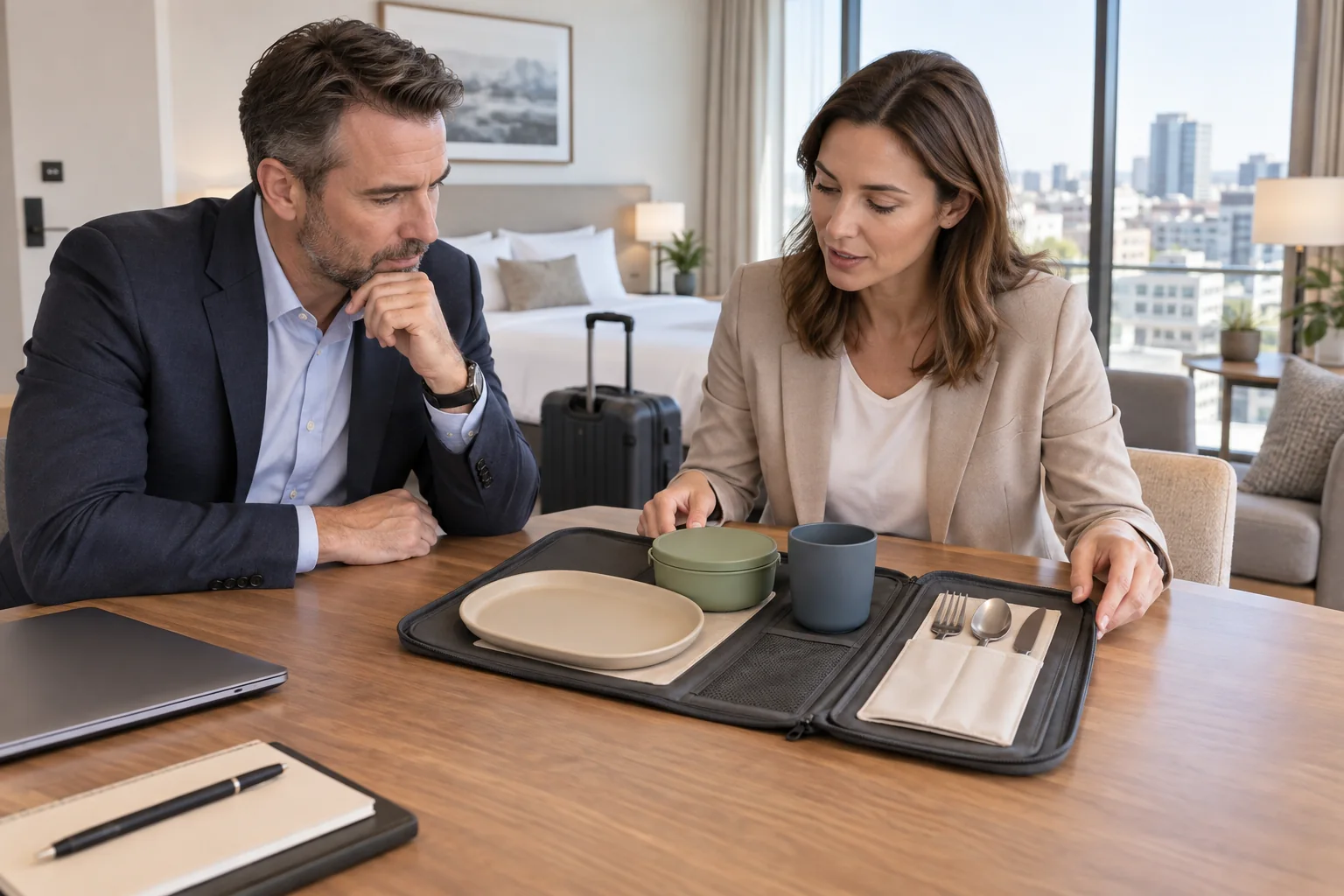
Relocation and extended-stay programs place reusable dining equipment in several environments: an employer or mobility hub, luggage, a serviced apartment, a hotel desk and a return station. A kit that looks compact in a catalog can still waste suitcase space, fail to fit a drawer or become incomplete when lids and utensils are not counted separately.
Procurement should connect product design with the travel program. This guide does not invent dimensions, leak performance, dishwasher compatibility, stain resistance, durability or food-contact compliance. Any unverified field remains “To be confirmed for the project” until drawings, samples and supporting evidence are approved.
Build the Business Travel Tableware Operating Brief
Start with traveler groups and length of stay. Record whether employees use hotels, serviced apartments or temporary housing, whether a kitchenette is available, and whether the kit travels in checked baggage, cabin baggage or a relocation carton. Note the smallest approved storage locations and likely dining surface.
Define ownership. The company may gift the kit, lend it for return, or place it permanently in accommodation. Each model changes identification, cleaning, inventory and replacement needs. State whether the kit is issued centrally, delivered by an accommodation partner or included in an onboarding pack.
| Program input | Buyer question | Controlled output |
|---|---|---|
| Traveler duration | Which meals and components are needed? | Approved place-setting module |
| Luggage | Where does the closed kit fit? | Maximum packed envelope |
| Accommodation | Where is it used and stored? | Room-use checklist |
| Ownership | Gift, loan or shared inventory? | Issue and return procedure |
| Destination | Which evidence applies? | Document request list |
Assign decision owners. Mobility teams define traveler journeys. Accommodation partners confirm room constraints. Quality reviews materials and evidence. Cleaning teams approve return procedures. Brand teams approve color and decoration. Procurement controls supplier exceptions, quantities, tooling and commercial assumptions.
Choose a Controlled Business Travel Tableware Configuration
A single-person reference module may contain one warm sand-beige oval PP plate, one sage-green lidded PP bowl, one smoky-blue PP tumbler, and a stainless fork, spoon and blunt table knife in an off-white washable sleeve. A slim graphite zippered folio opens flat into a washable placemat and uses a removable molded cradle, utensil loops, a tumbler pocket and a lid pocket.
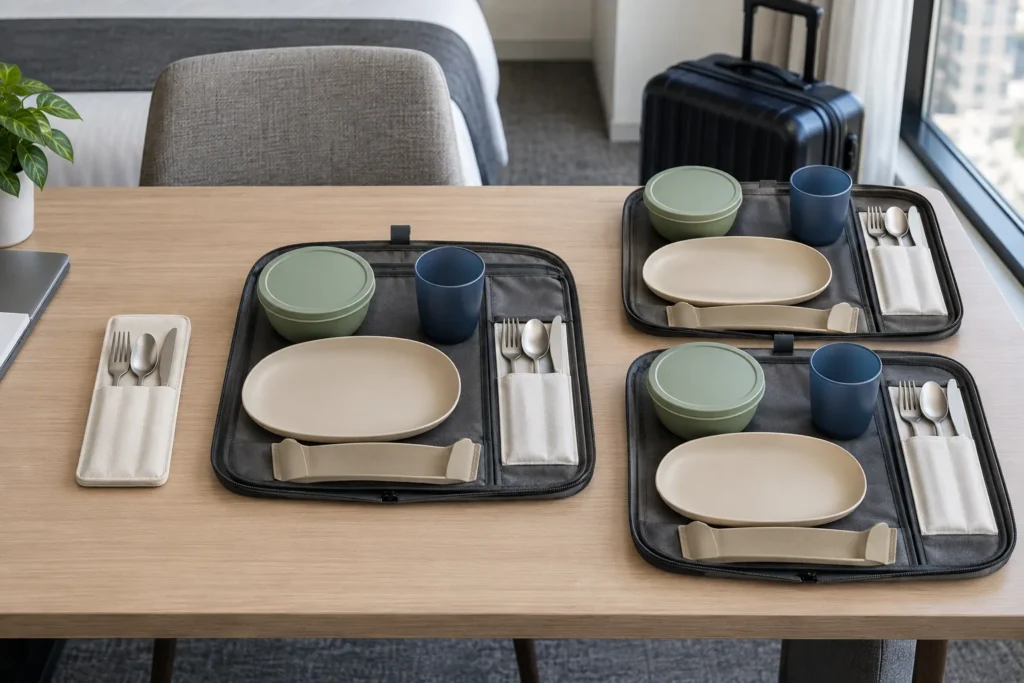
Use controlled options rather than removing parts informally. An utensil-only sleeve can support a short hotel stay when the program has approved that scope. One complete fold-out kit supports a single employee. Two individually assigned kits can serve dual-occupancy relocation. Each option needs its own code, bill of materials, packing image and inspection record.
The companion Single-Person Fold-Out Travel Dining Kit Organizer demonstrates the complete module. Final capacity, dimensions, weight, cleaning route, MOQ and lead time remain subject to project confirmation.
Control replaceable parts and substitutions
Identify the plate, bowl, lid, tumbler, fork, spoon, knife, sleeve, cradle and folio as separate service items. A visually similar bowl is not automatically compatible with the lid or cradle. Recheck nesting, pocket fit, zipper closure, color and evidence whenever a component changes.
Validate Luggage, Drawer and Desk Fit
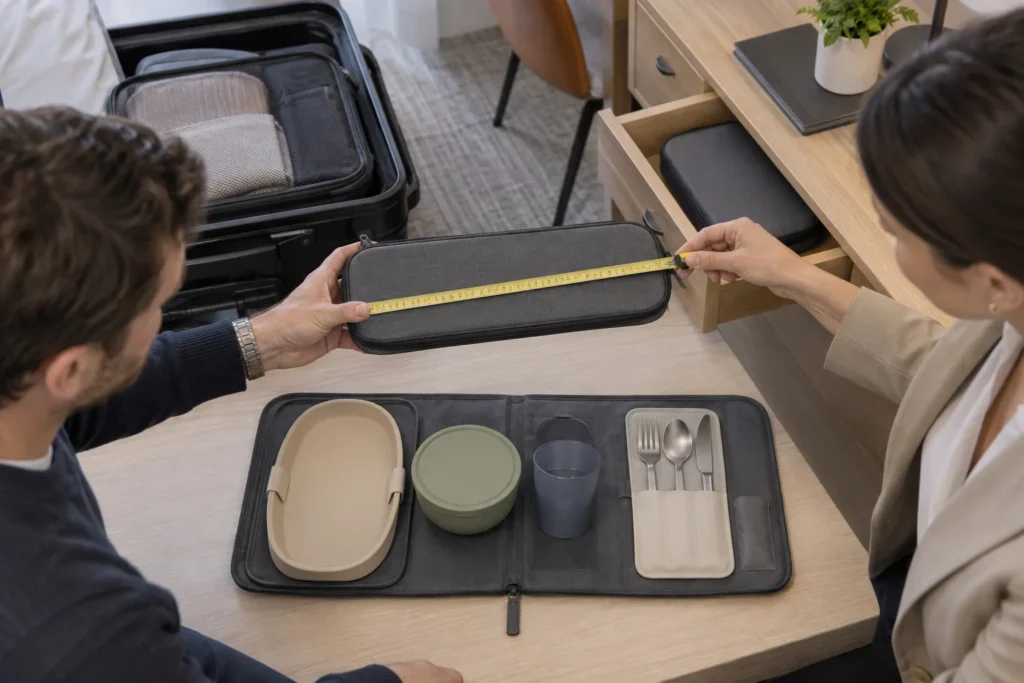
Measure the smallest suitcase zone, relocation carton, apartment drawer, kitchenette shelf and desk location in scope. Test the complete closed folio, not only the empty shell. Include handle height, zipper movement, corner radius, packed thickness and finger clearance. Check whether the kit can be removed without disturbing work equipment.
A folio stored in luggage should follow the traveler program’s packing rules and carrier limits. Product imagery does not prove cabin-baggage acceptance, leak containment or protection from heavy loads. If the kit shares luggage with clothing or electronics, define a separate cleanliness and containment procedure.
- Measure the smallest approved luggage and room locations.
- Load the exact bill of materials into the folio.
- Close the zipper without forcing the shell or components.
- Open the folio on the intended dining surface.
- Remove and replace every component.
- Record accepted conditions by program and kit revision.
Map Issue, Use, Return and Reissue
At issue, count one plate, one bowl, one lid, one tumbler, three utensils, the sleeve, cradle and folio. Record the kit revision and traveler assignment. Provide handling and cleaning instructions appropriate to the approved components and destination.
During use, the open folio can provide a defined placemat surface, while the molded cradle and pockets organize components. This arrangement does not prove food containment or sanitation. The traveler should follow the program’s food, cleaning and accommodation rules and should not place wet components into a closed textile folio.
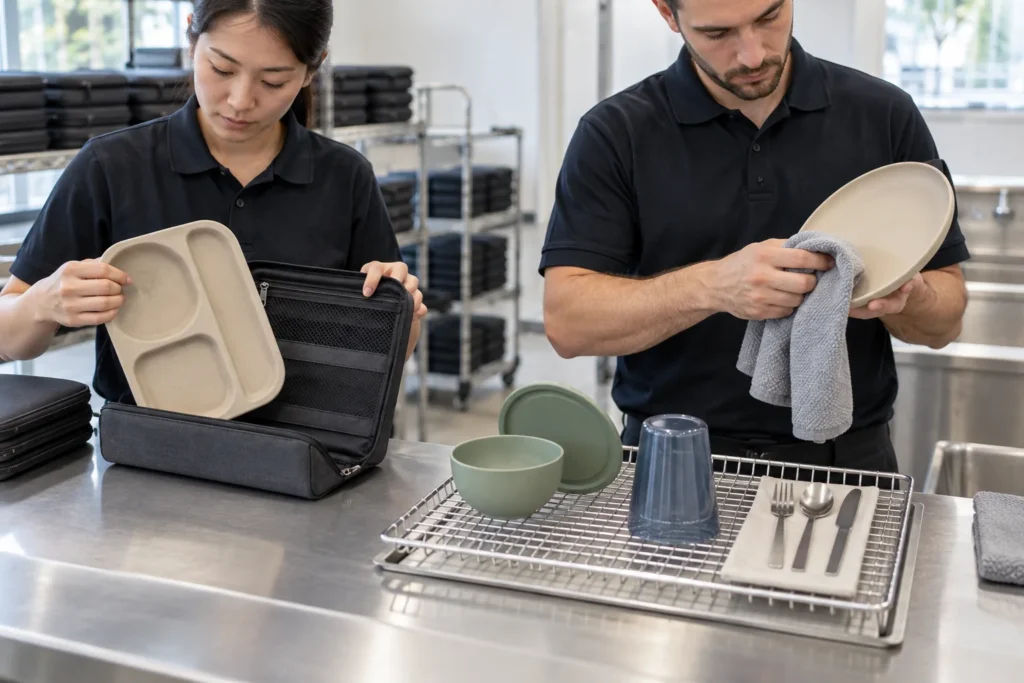
For returned kits, count bodies and accessories separately. Quarantine cracked, distorted, deeply scratched, stained, loose or missing items. Food-contact parts, sleeves, the molded cradle and coated textile folio may require different cleaning and drying routes. Confirm chemistry, temperature, mechanical action and drying for each construction.
Track issued kits, complete returns, loose parts, wash failures, quarantined pieces, replacements and closing inventory. Analyze loss by location, trip duration, issue partner and ownership model. Real records create a better reserve-stock policy than an arbitrary percentage.
Estimate program quantity
Required quantity begins with simultaneous travelers, then adds kits in transit, accommodation, cleaning, inspection, repair and redistribution. Add a controlled reserve after a representative pilot. Gift programs need a replenishment forecast; lending programs need turnaround capacity and reconciliation.
Match Materials and Evidence to the Exact SKU
Food-grade PP may be considered for lightweight molded tableware and the removable cradle, stainless steel for reusable utensils, and coated textile for the folio. Exact resin, additives, pigments, steel grade, finish, fabric composition, coating, reinforcement, zipper and thread remain project decisions.
For United States programs, review the FDA overview of food-contact substances. For European Union programs, review the European Commission framework for food-contact materials. These sources do not certify this concept or a supplier.
Request records identifying the exact material or finished article, color, method, conditions, result, laboratory and date. Match evidence to the selected component, intended food, time, temperature, cleaning route and destination. Internal references include Food-Grade PP, Stainless Steel and Portable Dining.
Approve Logo, Pantone and Packaging Separately
Potential decoration routes include printing or molded identification on PP, laser marking on stainless steel, and woven or printed marks on the folio and sleeve. Each surface needs its own artwork area, process and durability review. Do not assume one logo treatment performs equally on plastic, steel and coated textile.
Pantone references guide development but do not replace physical samples. Sand beige, sage, smoky blue and graphite may shift with resin, texture, coating and light. Review the complete kit under representative room and office lighting and retain approved references with the revision record.
Packaging may use a plain inner carton, recyclable paper band, molded-paper protection or a relocation master carton. Define barcodes, component counts, instructions and destination information before artwork approval. Trial the complete pack because inserts affect packed dimensions, weight, unpacking time and waste handling.
Compare Suppliers With One Scorecard
Send the same RFQ to each supplier: traveler profiles, configuration, packed envelope, quantity, colors, decoration, packaging, evidence scope, sample stages and target schedule. Require every exception and unconfirmed field to be listed. Separate existing-component, modified-component and new-tooling routes.
| Field | Required evidence | Approval question |
|---|---|---|
| Configuration | BOM and packing image | Can every part be counted? |
| Packed fit | Drawings and physical trial | Does the closed folio fit? |
| Return cycle | Cleaning and drying inputs | Can kits be reissued reliably? |
| Materials | SKU-matched specifications | Does evidence match intended use? |
| Commercial | MOQ, samples, tooling and timing | Are quotations comparable? |
Existing components may reduce development work, while custom molding can improve cradle fit or packed geometry. New tooling adds drawing, tolerance, tool-trial and validation stages. Compare verified function, replacement support, approval risk and total program cost instead of relying only on unit price.
Business Travel Tableware Buyer Checklist
- Traveler profiles and ownership model are documented.
- The complete packed configuration is controlled.
- Luggage, drawer and desk fit are physically tested.
- Issue, return, cleaning and replacement owners are assigned.
- Evidence matches every exact component and destination.
- Physical colors, decoration and packaging are approved.
- Unknown claims remain to be confirmed.
- MOQ and lead time follow final specification approval.
Business Travel Tableware FAQ
What should the specification include?
Define travelers, accommodation, packed fit, component count, workflow, cleaning, materials, evidence, branding, packaging and replacements.
How is packed fit confirmed?
Test the complete closed sample in the smallest approved suitcase zone, drawer and desk location.
Does a wipe-clean folio prove performance?
No. Cleaning, drying and material compatibility require validation for the exact construction and process.
Which documents should buyers request?
Request SKU-matched drawings, material records, test reports, color approvals, packing instructions and inspection criteria.
When are MOQ and lead time confirmed?
After configuration, colors, decoration, packaging, testing, quantity and sample stages are defined.
Turn the Travel Brief Into a Sample Trial
Share traveler profiles, accommodation types, luggage and storage limits, ownership model, cleaning route, target markets, branding, packaging, quantity and schedule. Naike Tableware can compare existing-component and custom-development routes.