

How should rental fleets specify a campervan travel dining kit?
A campervan travel dining kit should be specified as a controlled vehicle asset, not as a loose tableware bundle. Define the traveler count, menu range, plates, bowls, cups, utensils, organizer, storage location, travel restraint, issue and return process, cleaning capacity, replacement rules, material evidence, branding and approval stages. Test the approved physical kit in every vehicle layout and through a complete rental turnaround before production approval.
Rental fleets need dining equipment that works across vehicle handover, travel, meals, washing, inspection and the next booking. A visually attractive set can still fail if a plate blocks a drawer, cups rattle while driving, the organizer cannot hang in one layout, or cleaning staff cannot identify missing parts. Small inconsistencies become expensive when repeated across dozens of vehicles.
This guide treats tableware, storage and fleet operations as one sourcing problem. It does not assume dimensions, dishwasher compatibility, food-contact compliance, impact resistance or service life before the exact construction and use conditions are verified. Fields that have not been approved should remain “To be confirmed for the project.”
Build the Campervan Travel Dining Kit Operating Brief
Start with the fleet rather than the catalog. Record vehicle makes, conversion layouts, berth counts, dining table sizes, galley drawers, seatback structures and cleaning depots. List the minimum and maximum traveler count for each rental class. A two-person city van may need a different storage route from a four-berth touring vehicle even when both use the same plate and cup family.
Define how the kit is issued. It may be installed in the vehicle, handed over in a sealed module or offered as an optional rental accessory. Record whether customers are expected to wash pieces during the trip, how used items are returned, and whether the depot washes every component between bookings. These choices affect material, organizer construction, spare stock and inspection.
Assign ownership before requesting quotations
| Decision | Owner | Controlled output |
|---|---|---|
| Vehicle layouts | Fleet operations | Fit envelope and mounting rules |
| Traveler experience | Product or guest team | Component brief |
| Cleaning | Depot manager | Wash and drying route |
| Materials | Quality or compliance | Evidence list |
| Branding | Marketing | Artwork and color approval |
| Commercial terms | Procurement | MOQ and timing comparison |
Choose a Controlled Campervan Travel Dining Kit Configuration
Define one base place setting before multiplying quantities. A practical base may include one plate, one bowl, one cup, one fork, one spoon and a protective utensil sleeve. The two-person configuration duplicates the food-contact components and places them in one organizer. A four-person vehicle can use two identical two-person modules, which may simplify counting and replacement.
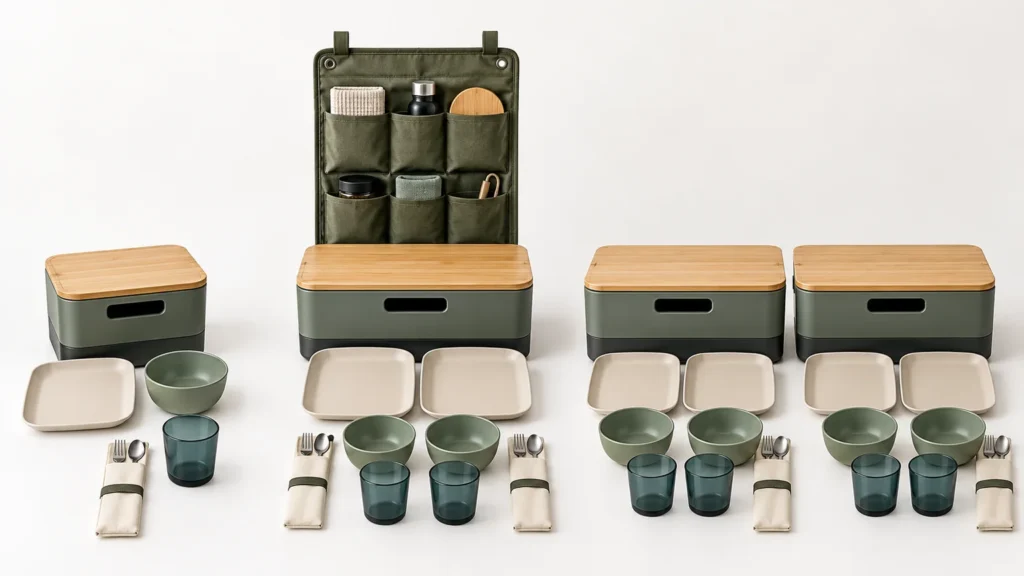
Module planning does not prove capacity or fit. Buyers should compare the complete physical set against each vehicle class. Give every accepted combination a configuration code and revision. Tie the code to the bill of materials, drawings, colors, organizer layout, packaging, inspection points and approved sample.
The companion Two-Person Campervan Dining Kit With Hanging Organizer shows one development direction: two sand-beige square PP plates, two sage-green bowls, two smoky-teal cups, two stainless fork-and-spoon pairs in cream sleeves and an olive six-pocket organizer that rolls closed. Final sizes, materials, load restraint and cleaning performance remain subject to project confirmation.
Separate required optional and replaceable parts
Required items create the standard guest experience. Optional items may support a specific rental package or menu. Replaceable items need individual part codes and reorder rules. If a supplier proposes a substitute cup or bowl, recheck nesting, pocket fit, drawer fit, color and evidence rather than accepting it as an equivalent by appearance.
Validate Drawer Seatback Table and Travel Fit
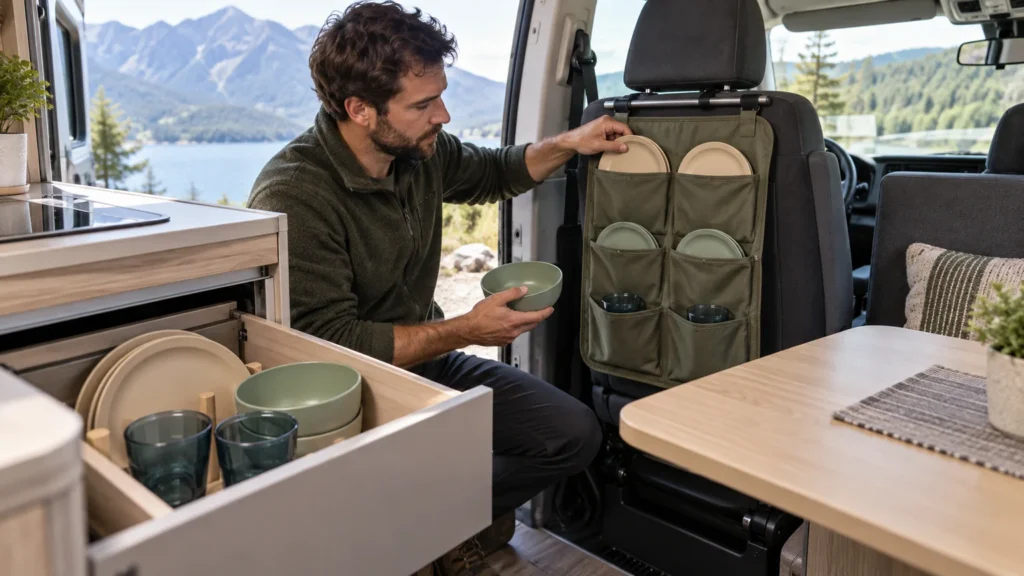
A campervan travel dining kit must fit while parked and remain controlled while the vehicle is moving. Measure the smallest drawer, shelf and table in scope. Check handles, catches, hinges and door swing, not only internal length and width. If the organizer hangs from a seatback or rail, verify that the attachment point is approved for the vehicle and does not interfere with passengers, belts, airbags, doors or driver visibility.
Run a vehicle fit trial with the complete approved sample. Remove every item from storage, set two places at the table, clear the meal, repack the components and close the organizer. Then secure the rolled module in its travel position. Repeat the sequence in each conversion layout because seat frames, cabinetry and access paths differ.
Record evidence from the fit trial
- Photograph the empty storage location with a reference scale.
- Record usable dimensions and any restricted clearance.
- Load the complete kit in the intended orientation.
- Open and use it at the smallest dining table.
- Check organizer hanging, access and removal.
- Secure the closed roll for travel and record the accepted position.
Do not present an image or drawing as proof of crash safety or vehicle-system compatibility. The rental operator remains responsible for approving installation and travel restraint using the applicable vehicle and operational requirements.
Design Return Cleaning Inspection and Reissue
The value of a reusable fleet kit depends on turnaround discipline. At vehicle return, staff need a count for plates, bowls, cups, forks, spoons, sleeves and the organizer. Missing, damaged or heavily soiled components should be separated before washing. The closing inventory for one booking becomes the opening inventory for the next.
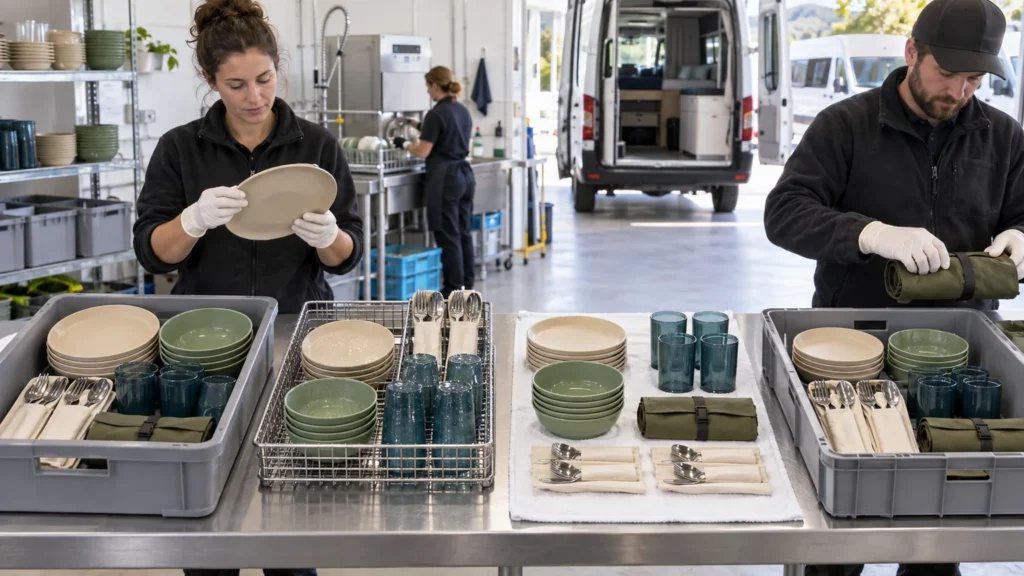
Define cleaning routes by material. PP components, stainless utensils and textile organizers may require different washing, drying and inspection processes. Do not assume the entire assembled kit can enter one machine cycle. Confirm cleaning chemistry, temperature, mechanical action and drying for the exact materials and construction.
Moisture control matters for textile pockets. An organizer should only be repacked after the accepted drying and inspection step. Record stains, odor, seam damage, strap damage, pocket distortion and closure operation. If the organizer cannot be returned to service, its components should remain traceable while it is replaced.
Use a simple reconciliation record
Track vehicle number, kit revision, opening count, returned count, loose components, wash failures, quarantined pieces, replacements and final serviceable count. Analyze loss by vehicle class and rental duration. Real loss data produces a better reserve-stock policy than a fixed percentage copied from another fleet.
Quantity planning can use the number of rentable vehicles plus kits in washing, repair or quarantine and a controlled reserve. Where several depots share stock, add transfer time and local peak demand. Confirm the final quantity after a pilot period.
Match Materials and Evidence to Intended Use
Food-grade PP may be considered for lightweight molded plates, bowls and cups; stainless steel may be selected for utensils; and a textile construction may form the organizer and sleeves. Exact resin, additives, pigments, steel grade, fabric composition, coatings, thread, webbing and hardware must be confirmed. Every component should have a traceable specification.
For United States programs, review the FDA overview of food-contact substances. For European Union programs, review the European Commission framework for food-contact materials. These sources describe frameworks and do not certify this concept or a supplier.
Request evidence that identifies the tested material or finished article, color, applicable method, test conditions, result, laboratory and report date. Match it to the selected SKU, intended food, time, temperature, cleaning process and destination market. Internal references include Food-Grade PP, Stainless Steel and Portable Dining Sets.
Plan OEM Color Logo Organizer and Packaging
Branding should help staff and guests identify ownership without replacing operational labels. Potential routes include molded or printed marks on PP, laser marking on stainless steel, woven or printed labels on textiles and graphics on paper bands or cartons. Feasibility depends on the selected surface and process.
Pantone references guide color development but do not replace physical approval. Sand beige, sage green, smoky teal, olive textile and kraft paper will display color differently. Approve each material under representative lighting and keep the accepted color sample with the specification revision.
Packaging may use bulk master cartons, plain kraft inner cartons, recyclable paper bands or protective dividers. Define barcode, care instructions, component count and market information before artwork approval. Trial the final pack because inserts change carton dimensions, unpacking time and depot waste handling.
Compare Suppliers Against One Fleet Scorecard
Issue the same RFQ to each supplier. State the vehicle classes, configuration, quantity, color split, decoration, organizer construction, packaging, testing scope, sample stages and target schedule. Require every exception and unconfirmed field to be listed directly.
| Field | Evidence to compare | Approval question |
|---|---|---|
| Configuration | Bill of materials and packing image | Are all parts controlled? |
| Vehicle fit | Drawings and fit-trial record | Does every layout work? |
| Turnaround | Cleaning and inspection inputs | Can depots reissue reliably? |
| Materials | SKU-matched specifications and reports | Does evidence match use? |
| Commercial | MOQ, samples, tooling and lead-time assumptions | Are quotes comparable? |
Separate existing-component, modified-component and new-tooling routes. A standard component may shorten development, while a new mold can address a fleet-specific envelope. Neither route is automatically better. Compare approved function, risk, lifetime support and commercial assumptions.
Campervan Travel Dining Kit Buyer Checklist
- Vehicle classes and traveler counts are documented.
- The base place setting and modular configurations are controlled.
- Drawer, table, organizer and travel positions are sample-checked.
- Return, washing, drying and inspection owners are assigned.
- Replacement parts have individual codes and acceptance criteria.
- Material evidence matches the exact SKU and intended market.
- Colors, decoration and packaging are physically approved.
- MOQ and lead time are confirmed after the configuration is locked.
Campervan Travel Dining Kit FAQ
What should the kit include?
Define the traveler count, tableware, utensils, organizer, storage position, cleaning route, replacements, evidence, branding and approvals.
How should quantity be calculated?
Start with rentable vehicles, then add stock in cleaning or repair and a controlled reserve based on turnaround and loss data.
How is vehicle fit confirmed?
Use approved physical samples in every layout and check drawers, seatbacks, tables, access, restraint and repacking.
Which compliance documents are needed?
Request current evidence matching the exact component, color, material, intended use and destination market.
When are MOQ and lead time confirmed?
After configuration, colors, decoration, packaging, testing, quantity and approval stages are defined.
Turn the Fleet Brief Into a Two-Person Trial
Share the vehicle classes, traveler count, storage limits, cleaning process, component priorities, target markets, branding, packaging, quantity and schedule. Naike Tableware can compare existing-component and development routes and prepare the next sample review.