
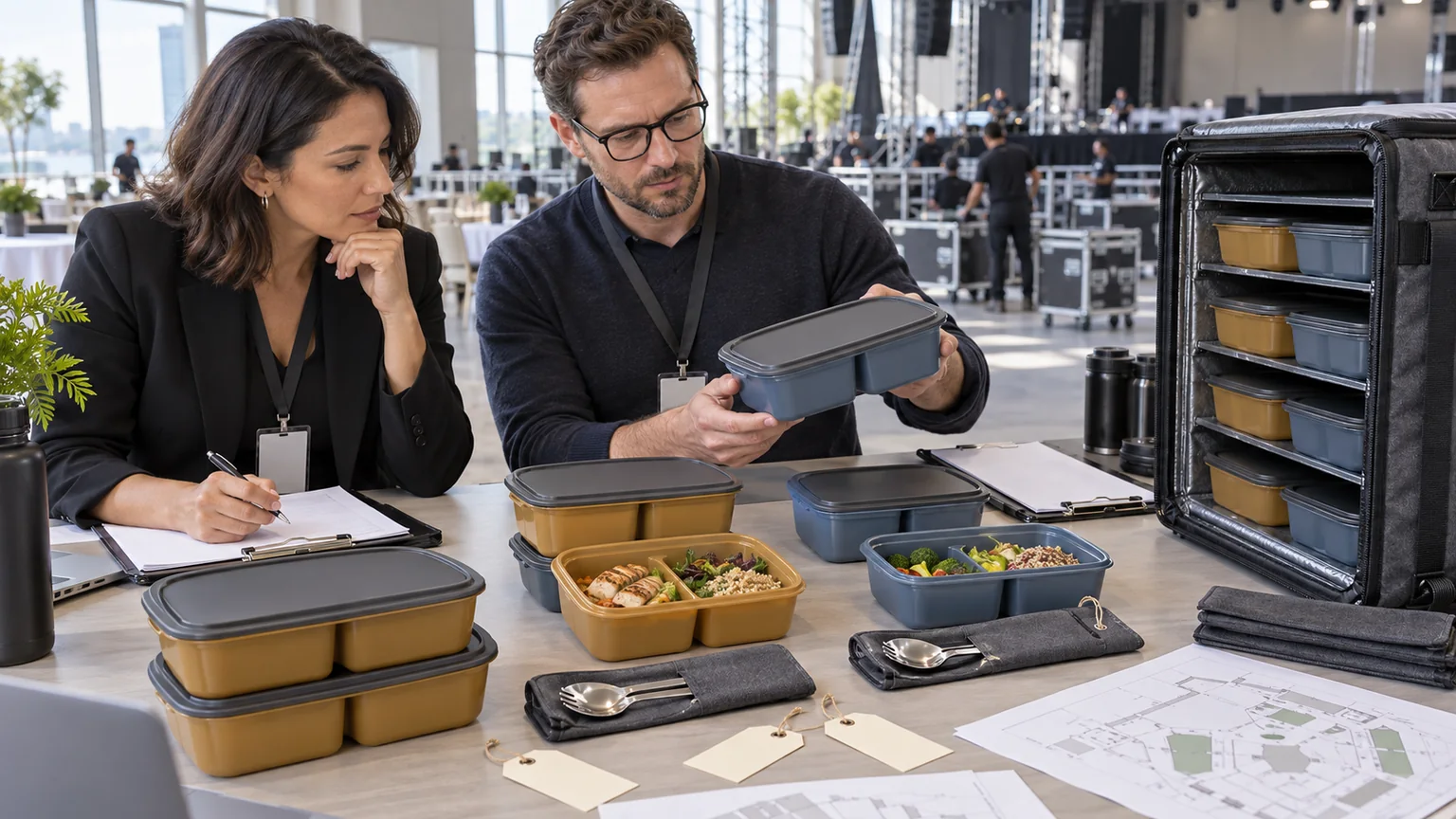
How should buyers plan event crew meal kit procurement?
Event crew meal kit procurement should begin with the operating cycle, not a catalog piece count. Define peak crew headcount, meal waves, menu types, dietary identification, distribution points, carry distance, return ownership, washing capacity, component replacement, material evidence, branding and approval stages. Convert those inputs into one controlled bill of materials and test the complete kit during a realistic event shift before approving production.
Event production teams often feed people in short windows while technical work continues. Stagehands, lighting teams, camera crews, security staff and catering workers may collect meals from different zones and return containers hours later. That makes a reusable kit an operational system. A box that performs well at a desk can still cause delays when lids are hard to identify, utensil sleeves are separated, carriers are overloaded or no one owns the return count.
A useful sourcing process connects the meal kit to call sheets, catering preparation, backstage access, food-safety controls, transport, collection and wash capacity. It also separates facts from assumptions. Dimensions, insulation performance, food-contact suitability, cleaning compatibility, MOQ and lead time must be confirmed for the exact project. The framework below helps buyers compare proposals without treating a visual concept as a tested production SKU.
Build the Event Crew Meal Kit Procurement Brief
Start with a one-page operating brief. Record the event type, venue pattern, indoor or outdoor use, expected crew range, shift length, catering origin and meal handoff points. Add the number and timing of meal waves because 120 meals served at once create a different requirement from 120 meals served across three rotations. Identify the decision owners for catering, operations, health and safety, sustainability, procurement, brand and finance.
Describe the menu families rather than one sample menu. Note wet and dry foods, sauces, cut fruit, snacks and any hot or chilled service plan. The component configuration should support the intended menu without promising leak resistance, temperature retention, microwave use or dishwasher compatibility before construction and test conditions are approved. Dietary identification must be handled with a controlled label, band, color code or digital check-out process that does not depend on memory.
Turn operating questions into controlled outputs
| Input | Buyer question | Controlled output |
|---|---|---|
| Headcount | What is the peak meal wave? | Issue quantity and reserve |
| Menu | Which compartments and accessories are needed? | Bill of materials |
| Venue | How far and through which access points will kits move? | Carrier and route plan |
| Return | Who counts, sorts and transports used pieces? | Reconciliation workflow |
| Market | Which evidence applies to intended use? | Document request list |
Size Event Crew Meal Kit Procurement by Meal Wave
Do not calculate quantity from total event attendance alone. Start with the largest simultaneous meal wave, then add stock that remains in transport, use, collection, washing, drying or inspection. Include a documented reserve for missing or quarantined components. If a program serves several venues, treat each distribution point as a small inventory location with its own opening count and return count.
A simple planning model is: required kits equal peak issue quantity plus turnaround inventory plus approved reserve. Every variable is project-specific. Validate the model during a pilot shift and record when a kit becomes available for reissue. Where same-day washing is not available, the program may need a full additional service cycle rather than a small percentage buffer.
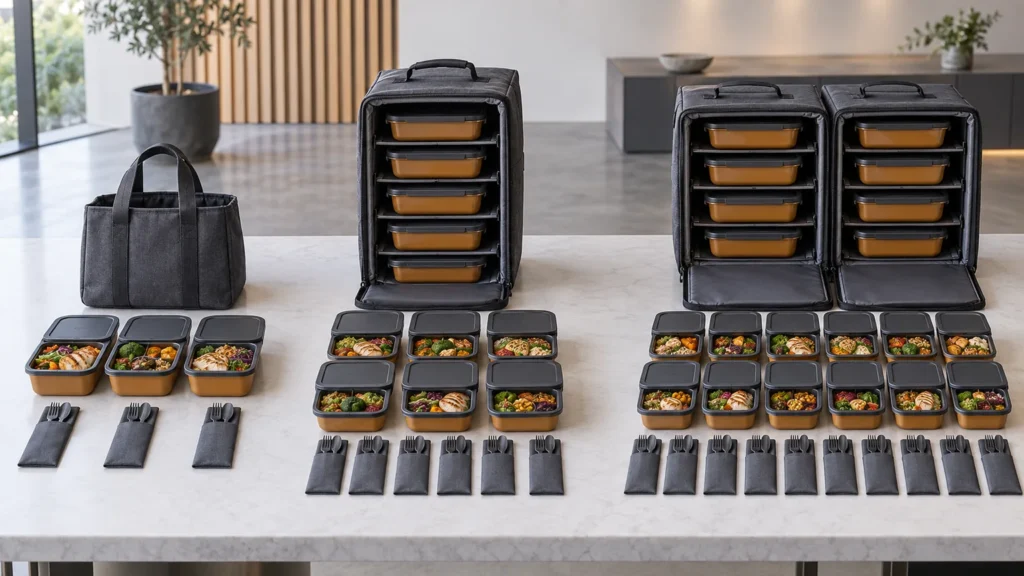
Use controlled configurations for different crew groups. A three-meal module can support a satellite team, a six-meal carrier can support one small department or handoff point, and two coordinated six-meal carriers can support a twelve-meal wave. These are planning modules, not fixed capacity claims. Final load, balance, shelf clearances and carry ergonomics must be confirmed using production-representative samples.
Lock the Box Utensils Sleeve and Carrier as One Configuration
The proposed system uses low-profile rectangular divided PP meal boxes, charcoal lids, stainless fork-and-spoon pairs, washable roll sleeves and a graphite insulated carrier with horizontal shelf positions. Buyers should identify every component as required, optional or replaceable. Give the accepted combination a configuration code and revision so a color change, lid change or alternate sleeve cannot enter production without review.
The companion Six-Meal Event Crew Catering Kit With Stackable Boxes shows one six-meal development direction. Three muted amber and three slate-blue boxes make visual grouping possible, while individual cutlery sleeves help keep accessories together. The concept still requires dimensional drawings, sample testing and project-specific evidence before approval.
Check fit at four levels
- Confirm the food fits the chosen compartments without obstructing lid closure.
- Confirm each closed box fits its shelf with finger clearance for loading and removal.
- Confirm six loaded positions keep the carrier balanced for the intended route.
- Confirm the closed carrier fits the vehicle, cart, rack and backstage holding point.
Record component dimensions, packed dimensions, weight and volume only after the physical configuration is approved. If data is not verified, mark it “To be confirmed for the project.” This makes supplier comparisons more reliable than copying nominal numbers from unrelated components.
Map Preparation Distribution and Handoff
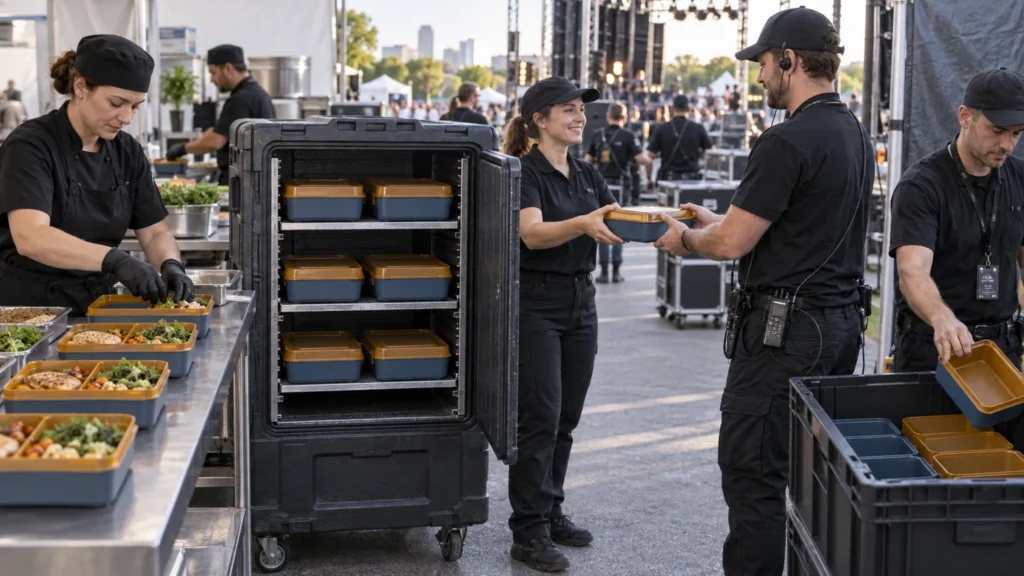
Event crew meal kit procurement succeeds when the handoff is repeatable. Catering should load meals in a defined order, close lids using the approved check, place utensils in their assigned sleeves and load shelves according to a visible plan. The distribution lead opens one controlled point, checks the recipient or department, issues the complete unit and records exceptions.
Separate meal identification from decorative branding. A removable band or label may carry dietary and time-sensitive information, while durable decoration identifies the asset owner. The selected marking route must suit the surface, cleaning cycle and local information requirements. Blank carriers can also receive a removable department card so the same hardware supports changing event teams.
Run a timed pilot
Simulate the busiest ten minutes with the expected staff, route and PPE. Measure carrier loading, travel, handoff and exception handling. Observe whether boxes tilt, shelves snag, lids are confused or utensils detach. Repeat the return process at the same scale. A short, realistic pilot usually reveals more than a showroom inspection because it tests people, space and sequence together.
Design Return Cleaning and Reconciliation Before Launch
Assign ownership for collection at every distribution point. Used boxes, lids, utensils, sleeves and carriers should have defined return containers and a safe route away from ready-to-eat food. Count complete kits and loose components separately. Missing items, damaged parts and contaminated textiles need quarantine rules rather than being silently returned to clean inventory.
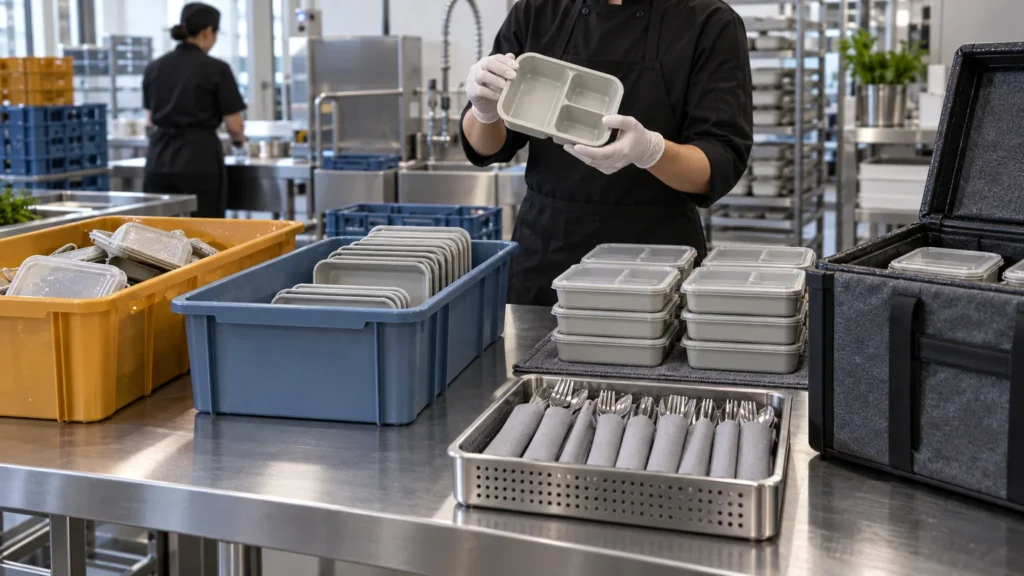
The washing plan should state where food residue is removed, which equipment and chemistry are used, how parts are oriented, how drying is verified and when visual inspection occurs. PP boxes, stainless cutlery, textile sleeves and insulated carriers may require different processes. Do not assume the complete assembled system can follow one wash cycle. Confirm cleaning compatibility for each material and construction.
Use a reconciliation record with opening quantity, issued quantity, returned complete kits, loose parts, quarantined parts and closing serviceable inventory. Trend losses by event zone and handoff point. Replacement stock should follow the same approved specification; an apparently similar lid or utensil can create fit, appearance or evidence inconsistencies.
Match Materials and Evidence to the Exact SKU
Food-grade PP can be considered for lightweight molded boxes and lids, stainless steel for reusable cutlery, and textile constructions for sleeves and the carrier. Exact resin grade, additives, pigments, steel grade, fabric composition, insulation, coatings and stitching remain project decisions. Buyers should link every material line to the intended food, time, temperature, cleaning and destination-market conditions.
For United States projects, review the FDA overview of food-contact substances. For European Union projects, review the European Commission framework for food-contact materials. These resources describe regulatory frameworks; they do not certify this concept or any untested finished product.
Request records that identify the tested component or finished article, material and color, applicable method, test conditions, result, laboratory and report date. Check that the evidence matches the selected SKU and intended use. Internal planning references include Food-Grade PP, Stainless Steel and Lunch & Bento products.
Plan OEM Color Logo and Packaging Approval
Decoration behaves differently on molded plastic, steel, textile and paper. Define logo size, location, color target and process for each surface. Pantone references guide development but cannot replace physical approval. Review color under representative venue lighting because amber, slate blue and graphite tones can shift beside stage lighting or outdoor daylight.
Packaging should protect the approved stack without adding unnecessary sorting work. Compare a plain kraft carton, recyclable paper bands, divider inserts and bulk master-carton packing. Confirm barcode, instructions and market information before artwork approval. Trial the real packaging because dividers and bands change external size, loading density and unpacking time.
Compare Suppliers With the Same Scorecard
Issue one RFQ with the controlled configuration, expected quantity, color split, decoration, packaging, testing scope, approval stages and target schedule. Ask suppliers to list every exception and unconfirmed field. Commercial quotes should separate existing-component, modified-component and new-tooling routes because their risk, MOQ and timing are not comparable.
| Scorecard field | Evidence to review | Decision |
|---|---|---|
| Configuration | Bill of materials and packing image | Complete and controlled |
| Operations | Pilot loading and return record | Practical at peak wave |
| Materials | SKU-matched specifications and reports | Suitable evidence route |
| Quality | Drawings, limit samples and inspection plan | Measurable acceptance |
| Commercial | MOQ, tooling, sample and lead-time assumptions | Comparable landed plan |
Event Crew Meal Kit Procurement Checklist
- Peak meal wave and distribution points are documented.
- Menu and dietary identification routes are defined.
- Every component has a controlled specification and revision.
- Box, shelf, carrier, vehicle and storage fit are sample-checked.
- Preparation, handoff, return and reconciliation are timed in a pilot.
- Cleaning and drying routes are confirmed by material.
- Evidence matches the exact SKU, intended use and market.
- MOQ and lead time are confirmed only after the configuration is locked.
Event Crew Meal Kit Procurement FAQ
What belongs in the procurement brief?
Define headcount, meal waves, menus, identification, distribution, returns, cleaning, components, evidence, branding and approvals.
How should program quantity be calculated?
Use the peak concurrent issue plus turnaround inventory and an approved reserve, then validate it in a realistic pilot.
Does an insulated carrier prove temperature performance?
No. Validate the selected food, time, temperature plan and exact carrier construction under the project controls.
Which documents should buyers request?
Request current records matching the exact component, color, intended use and destination market.
When are MOQ and lead time confirmed?
After configuration, color, decoration, packaging, testing, quantity split and approvals are defined.
Turn the Brief Into a Six-Meal Pilot
Share your crew count, meal waves, menu, venue route, cleaning process, target markets, branding, packaging, quantity and schedule. Naike Tableware can compare available-component and development routes, identify unconfirmed fields and prepare a sample review.