
How should schools plan field trip dining kit procurement?
Field trip dining kit procurement should start with student count, age range, route, transport storage, adult supervision, meal handoff, component counting, return ownership, cleaning capacity, replacement parts and food-contact evidence. Approve one controlled bill of materials, test the loaded carrier through the actual school-to-site route, and pilot issue, supervised use, return and reissue before production.
A reusable excursion system moves through classrooms, preparation areas, parked coaches, equipment carts, picnic tables and return rooms. Catalog photos do not show whether a carrier fits the approved luggage bay, whether staff can count every place setting quickly, or whether textile and food-contact parts dry before the next trip.
This guide provides a procurement framework, not a claim about a finished SKU. Dimensions, leak resistance, dishwasher compatibility, child suitability, backpack load, durability and regulatory compliance remain “To be confirmed for the project” until the school, supplier and qualified reviewers approve evidence and physical samples.
Build the Field Trip Dining Kit Procurement Brief
Record typical group sizes, age bands, adult-to-student supervision, trip duration, transport type and destination facilities. Note whether meals are prepared by the school, supplied by a caterer or brought separately. Define the smallest storage location on the parked coach, school cart and return room.
State who carries the module. A group carrier handled by an adult may use a different weight and access plan from individually assigned lunch bags. This concept is a four-place group backpack and does not establish a safe load for a child. The buyer must approve handling, supervision and transport procedures.
| Input | Buyer question | Controlled output |
|---|---|---|
| Group size | How many settings are issued? | Four-student module count |
| Transport | Where does the loaded backpack fit? | Maximum packed envelope |
| Supervision | Who distributes and counts parts? | Handoff procedure |
| Turnaround | How are components cleaned and dried? | Return-cycle instruction |
| Destination | Which evidence applies? | Document request list |
Assign owners. Trip leaders approve field handling. Transport teams approve storage. Food-service teams control meals. Quality staff review materials, evidence and inspection. Cleaning teams confirm processes. Procurement controls configuration, supplier exceptions, quantities and commercial assumptions.
Use Controlled Student Dining Modules
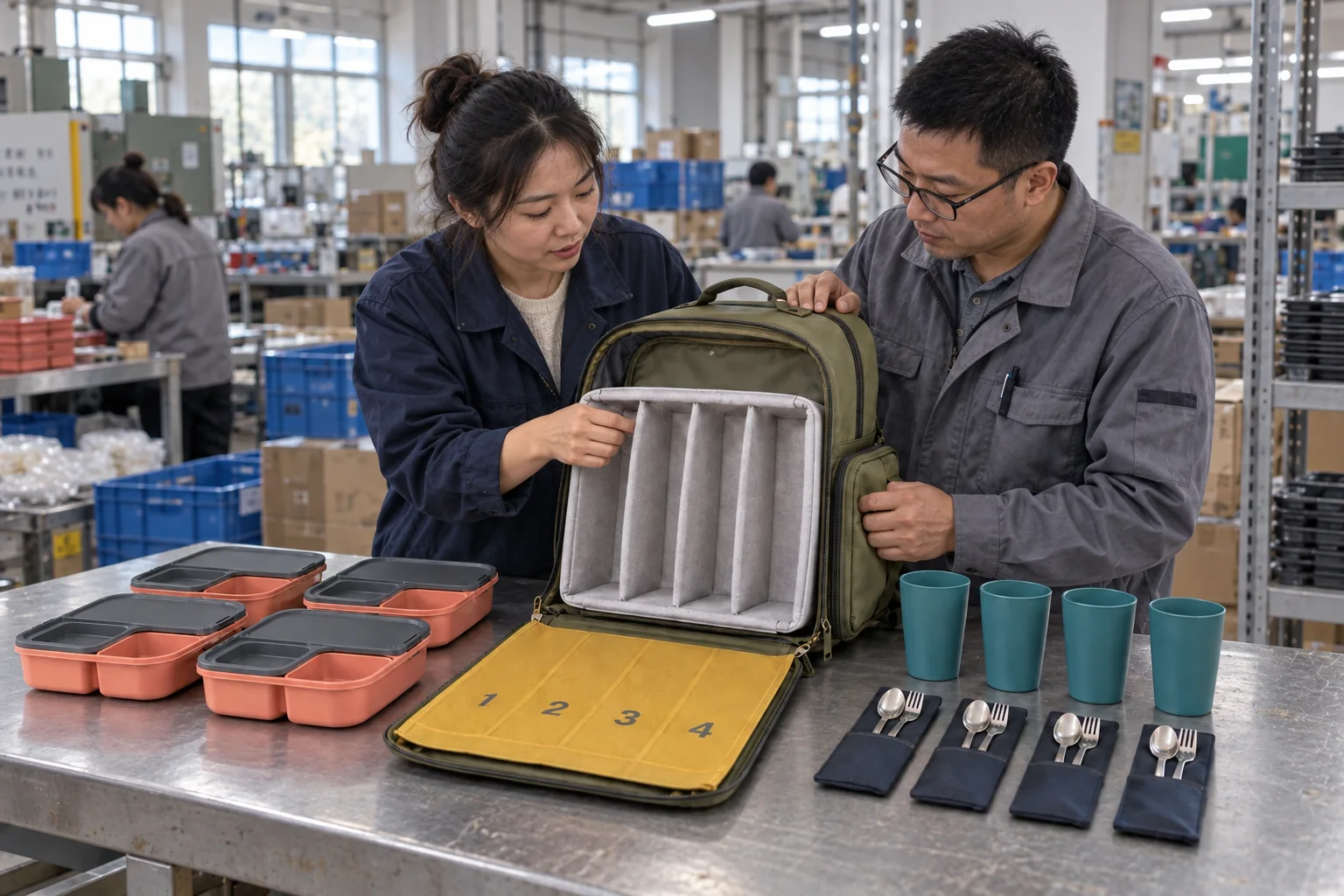
A four-student reference module can contain four muted coral divided PP trays with charcoal lids, four teal PP tumblers and four stainless fork-and-spoon pairs in navy washable sleeves. One olive clamshell backpack uses a removable light-gray four-slot insert and a mustard fold-out counting mat attached inside the front panel.
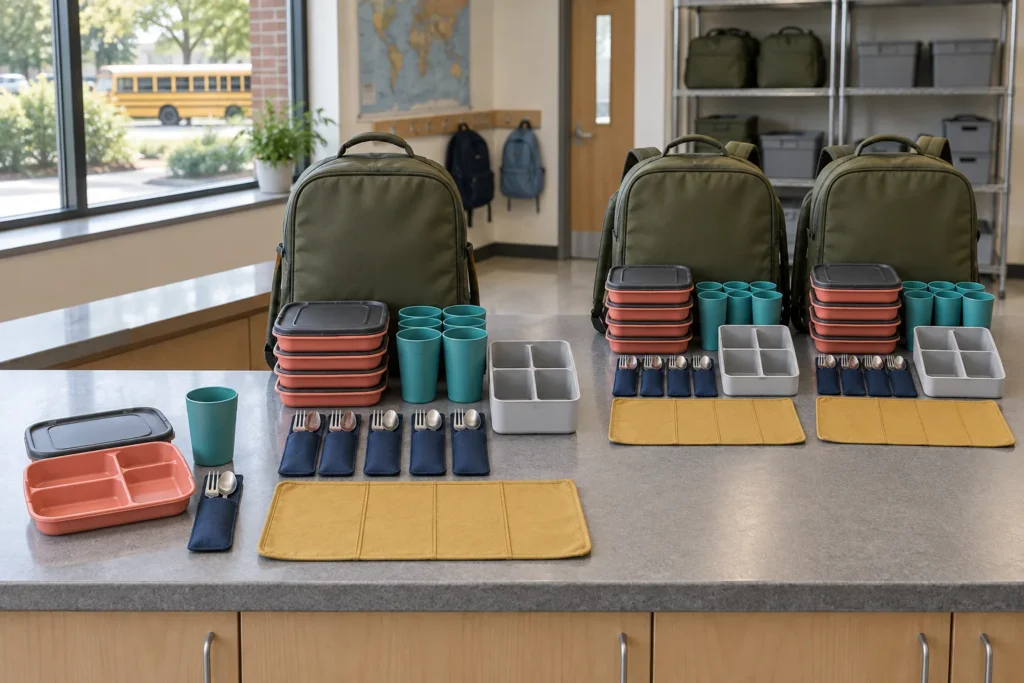
Use modules instead of loose component averages. One student setting is useful for inspection or replacement but is not a full group carrier. One complete backpack serves four assigned places. Two identical modules can serve eight places while keeping counts and responsibilities clear. Give each approved version a configuration code, bill of materials, packing image and inspection reference.
The companion Four-Student Field Trip Dining Kit With Backpack Organizer visualizes the four-place module. Final dimensions, loaded weight, cleaning route, carrying responsibility, MOQ and lead time require confirmation.
Control substitutions and replacement stock
Identify every tray body, lid, tumbler, fork, spoon, sleeve, insert and backpack as a separate replacement item. A visually similar lid may not fit. Recheck closure, nesting, slot clearance, color and evidence whenever a component changes. Replacement stock should match the accepted revision.
Validate Coach, Cart and Storage Fit
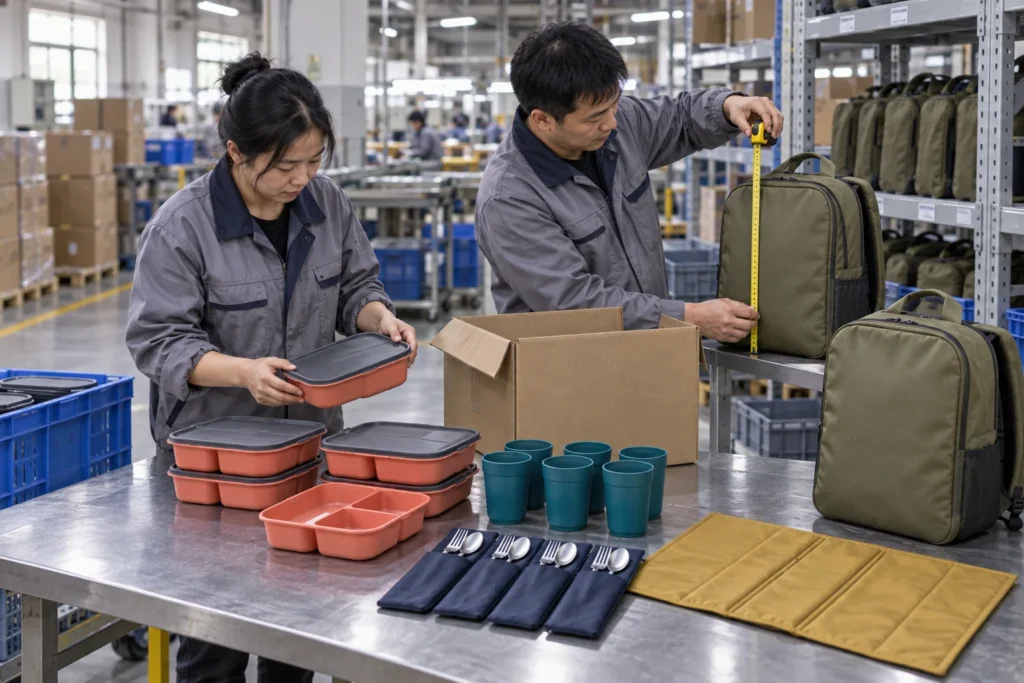
Measure the smallest approved coach luggage shelf, cart position, classroom cabinet and return-room rack. Test the complete loaded carrier, not only the empty backpack. Include shoulder straps, top handle, zipper movement, packed depth and finger clearance. Confirm adult staff can remove the carrier without unloading unrelated equipment.
Conduct transport trials only under the operator’s approved procedure with the coach parked and secured. The backpack must not obstruct aisles, exits, restraints, controls or safety equipment. Product imagery does not authorize placement during vehicle movement and does not prove impact or restraint performance.
- Measure the smallest approved storage position.
- Load the exact four-place bill of materials.
- Move the kit along the actual school-to-coach route.
- Open it on the intended distribution surface.
- Issue and recollect every component under supervision.
- Record accepted conditions by route and revision.
Map Issue, Supervised Use, Return and Reissue
Before departure, count four trays, four lids, four tumblers, four forks, four spoons, four sleeves, the insert, mat and backpack. Record the module and trip assignment. If food is prepared or packed, the applicable food-service team controls labeling, allergens, time, temperature and dietary communication.
At the destination, an adult can open the clamshell front panel, use the four-position mat as a count reference and distribute assigned settings. Color and layout can support counting but do not replace student identification, allergy controls or supervision. Used and clean items should be separated according to the approved procedure.
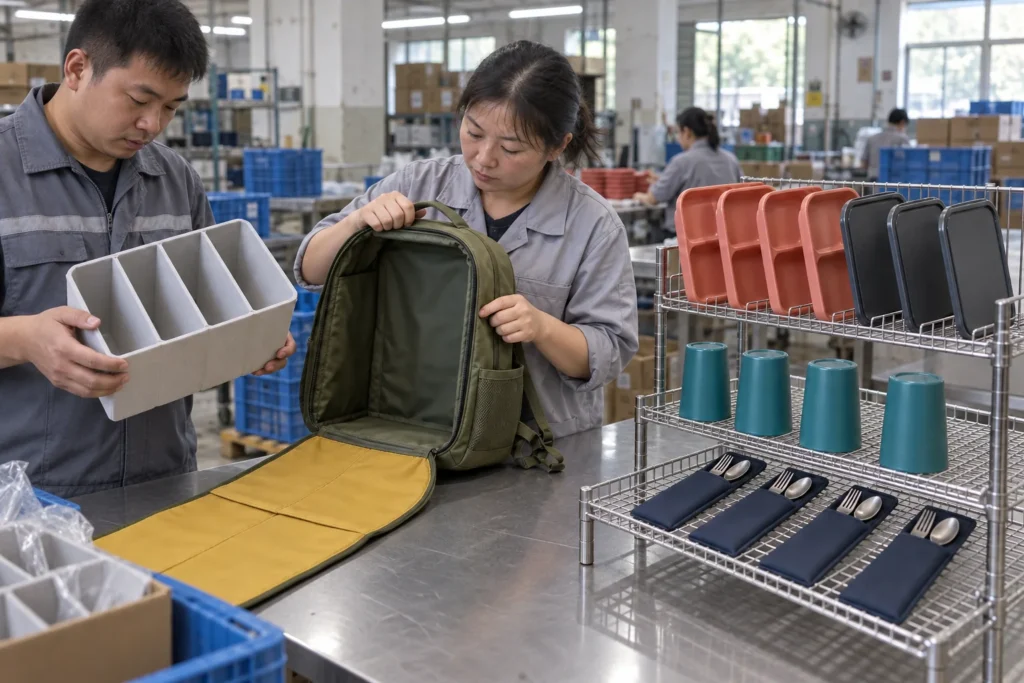
At return, count bodies and lids separately and quarantine cracked, distorted, deeply scratched, stained, loose or missing parts. PP components, stainless utensils, washable sleeves, rigid insert, counting mat and coated backpack may need different cleaning routes. Confirm chemistry, temperature, mechanical action and drying for each construction.
Do not close damp components inside the backpack. Repack only when required parts are dry and serviceable. Track opening stock, issued modules, complete returns, loose parts, wash failures, quarantine, replacements and closing stock. Analyze losses by trip, group and handoff point.
Estimate operating quantity
Start with simultaneous trips, then add modules in issue, transport, cleaning, drying, inspection, repair or transfer. Add a controlled reserve after a representative pilot. Different calendars, trip lengths and wash capacity mean one blanket reserve percentage is rarely reliable.
Match Materials and Evidence to the Exact SKU
Food-grade PP may be considered for lightweight molded trays, lids and tumblers; stainless steel for reusable cutlery; and coated textile for the backpack. Exact resin, additives, pigments, steel grade, finish, fabric, coating, foam, lining, zipper, thread and insert material remain project decisions.
For United States programs, review the FDA overview of food-contact substances. For European Union programs, review the European Commission framework for food-contact materials. These sources do not certify this concept.
Request documents identifying the tested material or finished article, color, method, conditions, result, laboratory and date. Match evidence to the exact component, intended food, time, temperature, cleaning route and destination. Internal references include Food-Grade PP, Stainless Steel and Family & Outdoor Sets.
Approve Logo, Pantone and Packaging Separately
Potential decoration routes include printed or molded identification on PP, laser marking on stainless steel, and woven or printed marks on the backpack, mat and sleeves. Each surface needs its own artwork area, process and durability review. Identification should be readable for staff without creating unapproved claims.
Pantone targets guide development but do not replace physical samples. Coral, teal, navy, mustard, gray and olive display differently on plastic, steel, woven textile and coated surfaces. Review components together under representative indoor and outdoor light and retain approved references.
Packaging may use bulk master cartons, plain inner cartons, recyclable paper bands or molded-paper dividers. Define component counts, handling, market information and any institutional requirements before artwork approval. Trial the complete pack because inserts affect size, weight and unpacking time.
Compare Suppliers With One School Scorecard
Send each supplier the same RFQ: student module, age range, transport and storage limits, materials, quantities, colors, decoration, packaging, evidence scope, sample stages and schedule. Require a list of exceptions and unconfirmed fields. Separate existing-component, modified-component and new-tooling routes.
| Field | Required evidence | Approval question |
|---|---|---|
| Configuration | BOM and packing image | Can staff count every part? |
| Transport fit | Drawings and physical trial | Does the loaded pack fit? |
| Turnaround | Cleaning and drying inputs | Can kits be reissued reliably? |
| Materials | SKU-matched specifications | Does evidence match use? |
| Commercial | MOQ, samples, tooling and timing | Are quotations comparable? |
Existing components may reduce development work. Custom molding may improve tray geometry or insert fit, but it adds drawings, tolerances, tooling trials and validation. Compare verified function, adult handling, replacement support, approval risk and total program cost—not only unit price.
Field Trip Dining Kit Procurement Checklist
- Student count, age range and supervision are documented.
- The four-place module and replacement parts are controlled.
- Coach, cart and school storage fit are physically tested.
- Food-service responsibilities remain in the applicable plan.
- Issue, return, cleaning and drying owners are assigned.
- Evidence matches each exact component and destination.
- Physical colors, decoration and packaging are approved.
- MOQ and lead time follow final specification approval.
Field Trip Dining Kit Procurement FAQ
What belongs in the brief?
Define students, transport, supervision, components, handoff, return, cleaning, materials, evidence and approvals.
How is transport fit confirmed?
Test the loaded backpack in every approved coach, cart and storage position.
Does coated textile prove performance?
No. Cleaning, drying, containment and durability require validation.
Which documents should buyers request?
Request SKU-matched drawings, material records, reports, packing instructions and inspection criteria.
When are MOQ and lead time confirmed?
After configuration, colors, decoration, packaging, testing, quantity and approval stages are defined.
Turn the Excursion Brief Into a Pilot
Share group sizes, age bands, trip routes, coach and storage limits, supervision, cleaning, target markets, branding, packaging, quantity and schedule. Naike Tableware can compare existing-component and custom-development routes.