
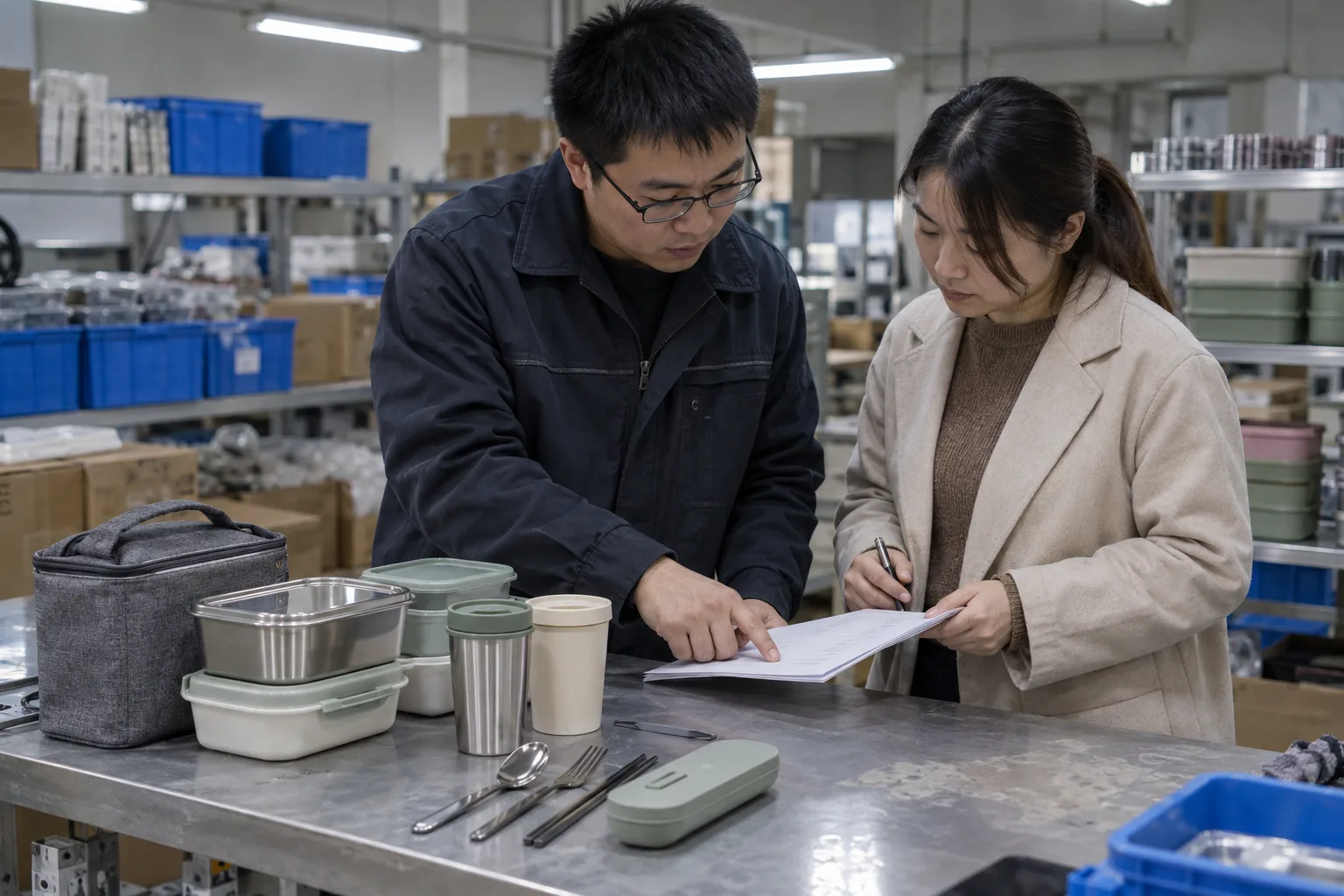
Portable Tableware RFQ: Short Answer
A useful portable tableware RFQ describes the complete sales unit, not just the lunch box or cup shown in a reference photo. Tell prospective suppliers who will use the set, what each component must do, how the pieces will fit and travel together, which market will receive them, and what the quotation must include. Mark undecided details as open questions. That gives each supplier a fair basis for proposing a configuration, explaining exceptions, and quoting against the same assumptions.
An RFQ is a request for quotation, not a final specification. Make unresolved container or bag choices visible.
Start With the Use Case and the Complete Sales Unit
Open with the commercial context in two or three sentences. Is the set for a company meal program, a travel brand, a retail collection or a distributor's private-label range? How many people should one set serve? Will it be carried daily, stored in a vehicle or shipped as a boxed retail unit? These answers affect component count, access, protection, packing and labeling.
State the destination market and sales channel. These affect packaging, barcode arrangements and evidence needs. Do not ask for a blanket “food-safe” or “leakproof” promise without specifying the component, condition and market.
Write a clear scope statement, such as: “Quote one two-person portable dining set containing two food containers with lids, two drinking vessels, two utensil pairs, two utensil sleeves, one carry case and one retail pack. Propose an arrangement that keeps the food-contact items separate from the carry fabric.” This is an illustrative RFQ example, not a description of a verified Naike stock SKU.
List what is outside scope. A supplier cannot produce a comparable price when one quotation includes the bag and printed carton while another covers only molded components.
Describe Each Component and the Fit Between Them
Give every part a line in the brief. A container and its lid should be treated as related but separate components; a carry case should be specified around the packed set rather than chosen from a photograph. If you have a reference sample, identify what is to be copied, what may change and what must not be copied for intellectual-property or brand reasons.
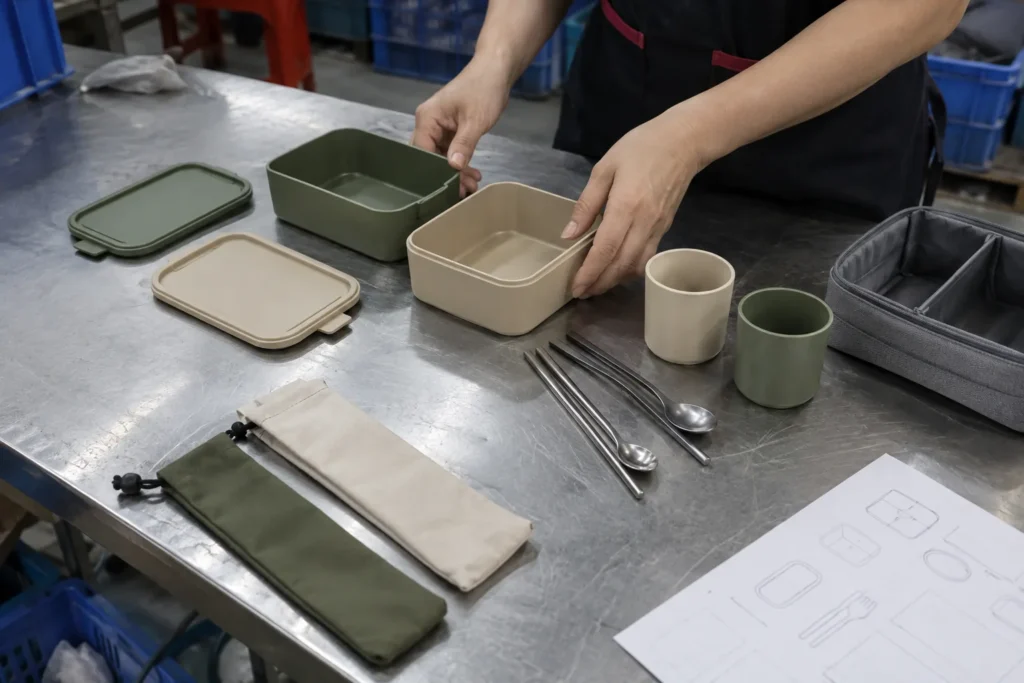
For each component, provide what is already known:
- Food containers and lids: intended portion or volume range, approximate outer dimensions, compartment needs, opening method, lid-to-body fit, nesting preference and any seal concept.
- Cups or bottles: intended capacity range, drinking edge, handle or lid needs, and the place each item occupies in the packed set.
- Cutlery: piece count, preferred material direction, edge and finish expectations, and how the utensils will be separated or sleeved.
- Carry bag or case: opening direction, handle or strap, inner divider concept, cleaning expectations and maximum packed envelope.
- Retail and transit pack: unit-pack format, protective insert, label or barcode owner, master-carton constraints and any display requirement.
Then describe the interfaces. Can the filled case close without pressing a lid loose? Can utensils move against a food-contact surface? Will cups still fit after a lining or divider is added? Ask suppliers to show these interactions in a bill of materials and packout drawing.
If exact dimensions are unavailable, use ranges and priorities. Ask the supplier to flag requirements that existing components cannot meet.
Separate Material Preferences From Performance Claims
Name material preferences without treating labels as proof of performance. Ask suppliers to compare appropriate container or cutlery materials and identify the exact grade or formulation in the proposal. For a bag, describe the handle, lining and cleaning route before choosing a fabric by appearance.
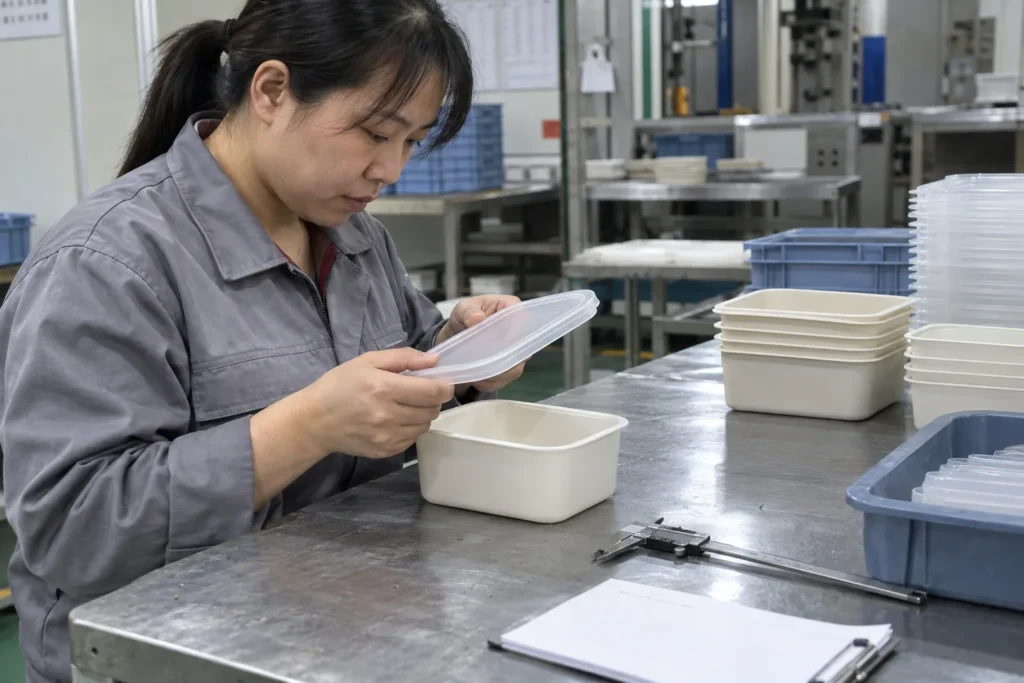
Performance requirements should state both the claim and the condition under which it matters. If leak resistance is important, identify the container, fill type, orientation, handling and proposed acceptance method. If microwave or dishwasher use is desired, specify the parts, temperatures or cycles that matter and ask what SKU-specific validation would be needed. Do not extend one component's result to the whole set.
Ask for an evidence plan rather than assume every document already exists. Which final item will a report cover? Will color or material changes affect that coverage? Which revision and conditions will the result refer to? Documentation depends on the product, destination, claims and agreed scope.
For a broader way to evaluate supplier responses, read how to choose a custom portable tableware manufacturer. That guide explains why the responsible production route and project-level evidence matter as much as the catalog image.
Specify Customization Without Leaving the Quote Open-Ended
Identify the logo artwork you can provide, desired position, approximate size, colors and whether the decoration must survive a stated cleaning process. Ask suppliers to recommend a feasible method for each substrate instead of assuming one printing process works on plastic, metal and textile. If color matching matters, say whether a digital reference is only a starting point and when a physical sample must be approved.
Clarify what level of development you are requesting. These are different quotations:
- Use existing components with a logo and standard packaging.
- Change colors, selected components or the carry layout while keeping the main structures.
- Develop new container geometry, tooling, bag pattern or a complete proprietary set.
Ask each supplier to identify which route its quote covers, what is standard, what requires a new sample, and which tooling or design decisions remain open. Tool ownership, design-file access, revision allowances and exclusivity should be discussed before development starts where they matter to the buyer. Do not infer these terms from the word “OEM” or “ODM.”
Packaging deserves its own line. Specify whether the supplier should quote a plain unit pack, branded sleeve, printed carton, insert, instruction sheet, barcode application and export carton. Ask who supplies final artwork and who approves the packing sequence. If the pack is not finalized, request separate options rather than a single unexplained number.
For proprietary drawings or a new tool, decide early how the parties will handle design ownership, permitted use and confidentiality. WIPO's guidance on supplier IP agreements explains why those terms should be made explicit; the RFQ should flag the issue, while the binding terms belong in the project agreement.
Give Quantity and Timing as Assumptions, Not Promises
Provide an estimated total quantity, number of designs, number of colors and expected split by variant. A project with one color and one set configuration can have a different purchasing and setup profile from the same total quantity divided among several colors and component choices. Ask for MOQ by configuration, color, logo process and packaging route where applicable.
Give a target date for receiving a physical sample and a separate target for finished goods. State whether the delivery point is the factory, a port or your warehouse, and ask suppliers to define what starts the quoted production period. The supplier's answer should distinguish sampling, approvals, possible tooling, material procurement, production, inspection and transport. No universal MOQ, price or lead time should be inferred from this guide; these must be quoted for the chosen configuration.
If export paperwork is in scope, identify who will prepare or issue each document rather than asking the factory generically for “all certificates.” The U.S. International Trade Administration's overview of common export documents distinguishes the commercial invoice from the packing list; the actual document set depends on the route, destination and agreed responsibilities.
If you have a target price, say whether it is a ceiling or a working objective and what it includes. Ask suppliers to show uncertain items separately instead of burying them in the unit price.
Ask for a Defined Sample and Approval Route
A proposal should define the pre-production approval route: available component samples, packout mockup, functional complete-set sample, then approved color, decoration and packaging. New tooling may require additional drawing and trial stages.
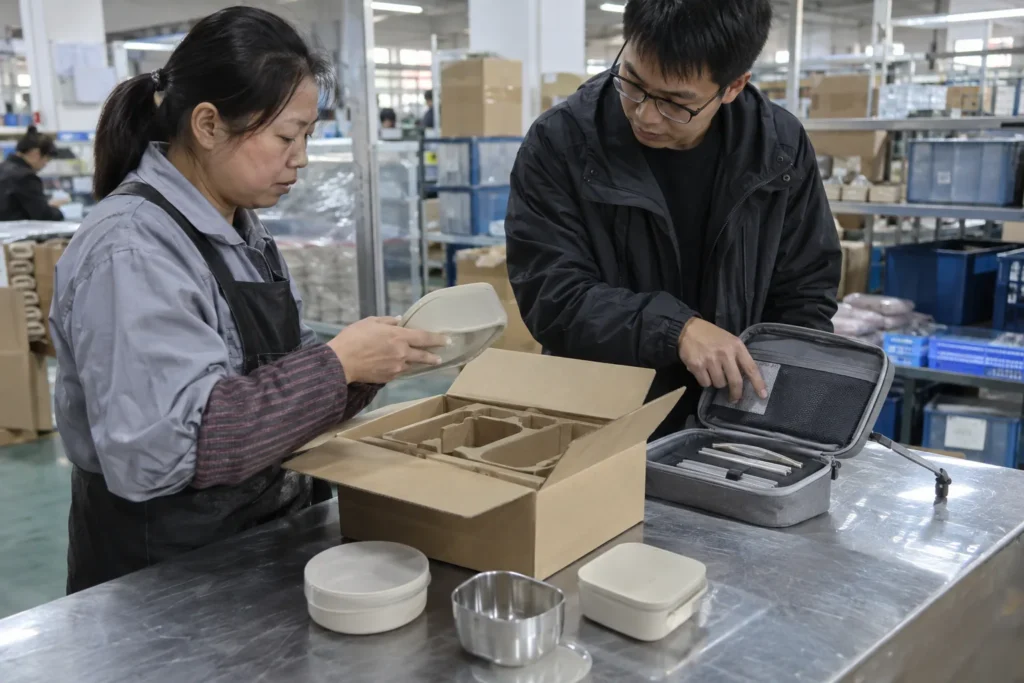
Ask for a revision identifier on the container, lid, cutlery, case and retail pack. The approved sample should represent the complete sales unit, not just the most visible component. Measure and weigh the physical assembled set, check access and closures, confirm component count, and test the agreed use conditions. If a material, size or logo position changes, record whether another approval is required.
The two-person portable tableware sample set concept shows how a buyer can discuss component count and carry layout. Its images are conceptual illustrations, not proof of an available SKU, confirmed dimensions or tested performance. Use a physical, revision-controlled sample for final approval.
Require Suppliers to Return the Same Quote Structure
An RFQ is only comparable when the replies cover the same scope. Ask each supplier to return the following headings, even if an answer is “to be confirmed”:
- Proposed component list and exceptions to the requested set
- Material and construction proposal for each component
- Existing-component route versus new-development requirements
- Sample stages, approval points and any sample charges
- Tooling or design charges and their proposed ownership terms
- MOQ by set, color, material and branding route where relevant
- Unit packaging, master carton and packout scope
- Testing or document plan for the intended market and claims
- Quotation basis, currency, delivery term and exclusions
- Assumed production start condition and stage-based timing
Score answers separately for completeness, technical fit and unresolved risk. “Can quote after drawing approval” may be a responsible answer when geometry is still open. “Yes, any material, any size, immediate delivery” is not a useful response without a defined route and evidence.
Copy This Portable Tableware RFQ Brief
Use the following as a fill-in framework. Delete fields that do not apply, but do not leave an important decision invisible.
Project and buyer. Company and contact: [ ]; intended users and sales channel: [ ]; destination market: [ ]; intended use conditions: [ ].
Complete set. Number of people served: [ ]; container and lid count: [ ]; cups: [ ]; cutlery: [ ]; sleeves: [ ]; carry case: [ ]; retail pack: [ ]; items excluded: [ ].
Key constraints. Target capacities or portion ranges: [ ]; maximum packed envelope: [ ]; required access or nesting behavior: [ ]; must-have versus preferred features: [ ]. Attach drawings or reference photographs and mark their purpose.
Materials and claims. Preferred materials by part: [ ]; intended food and temperature conditions: [ ]; cleaning method: [ ]; claims requiring validation: [ ]; destination-specific documents requested: [ ].
Customization. Logo files and position: [ ]; color references: [ ]; structural changes: [ ]; packaging artwork owner: [ ]; barcode and label responsibilities: [ ]; tooling or exclusivity questions: [ ].
Commercial assumptions. Estimated total units: [ ]; colors and split: [ ]; sample target: [ ]; finished-goods target: [ ]; requested delivery term and named place: [ ]; desired quotation currency: [ ]; price scope and exclusions to identify: [ ].
Supplier response requested. Proposed BOM and packout: [ ]; existing versus new parts: [ ]; exceptions: [ ]; sample and approval plan: [ ]; evidence plan: [ ]; MOQ and cost breakdown: [ ]; stage-based schedule: [ ]; validity period of quotation: [ ].
Show what is fixed, what is flexible and what the supplier must resolve. A marked-up drawing and an honest list of unknowns are more useful than a mood board without a component count.
Send a Brief That Can Be Quoted
If you are ready to discuss a set, use Build Your Set to define the configuration, then send the brief through the independent Request a Quote page. Ask the team to identify the proposed production route, sample stages, open technical decisions and quote assumptions for your exact project. Do not treat a concept image or a general company description as a substitute for a project-specific sample and written response.
Frequently Asked Questions
Can I request a quote without a final drawing?
Yes. Provide the use case, component list, target market, quantity range and the constraints you already know. Ask the supplier to state which prices are provisional and which drawings or samples are needed before a firm production quote.
Should I send one RFQ to every supplier?
Send the same baseline scope to each candidate so the replies are comparable. You can discuss alternative constructions afterward, but ask suppliers to label changes and exclusions clearly.
Is a product photograph enough to specify the set?
No. A photograph can communicate appearance, but it rarely defines part count, material grade, packed dimensions, interfaces, packaging, testing or ownership of custom development. Pair it with written requirements.
When should I ask about MOQ and lead time?
Include estimated quantity and target dates in the first RFQ. Treat the response as conditional until the configuration, colors, materials, packaging, sample and production route are defined.
What is the most common reason two quotes cannot be compared?
Different scope. One supplier may include the carry case, printed unit pack or testing plan while another quotes only containers. Require an itemized scope and explicit exclusions before comparing unit prices.
Do I need to request every possible test report?
No. Define the intended market, materials, use conditions and claims. Then agree which SKU-specific evidence is relevant and when it must be available. A report for another product should not be presented as proof for the final set.