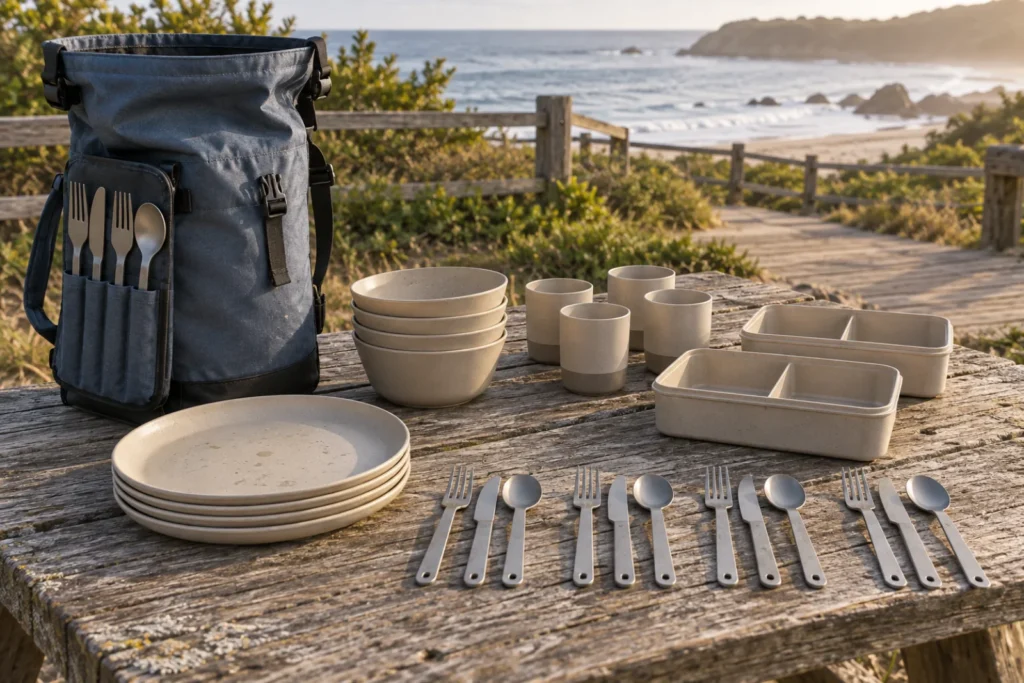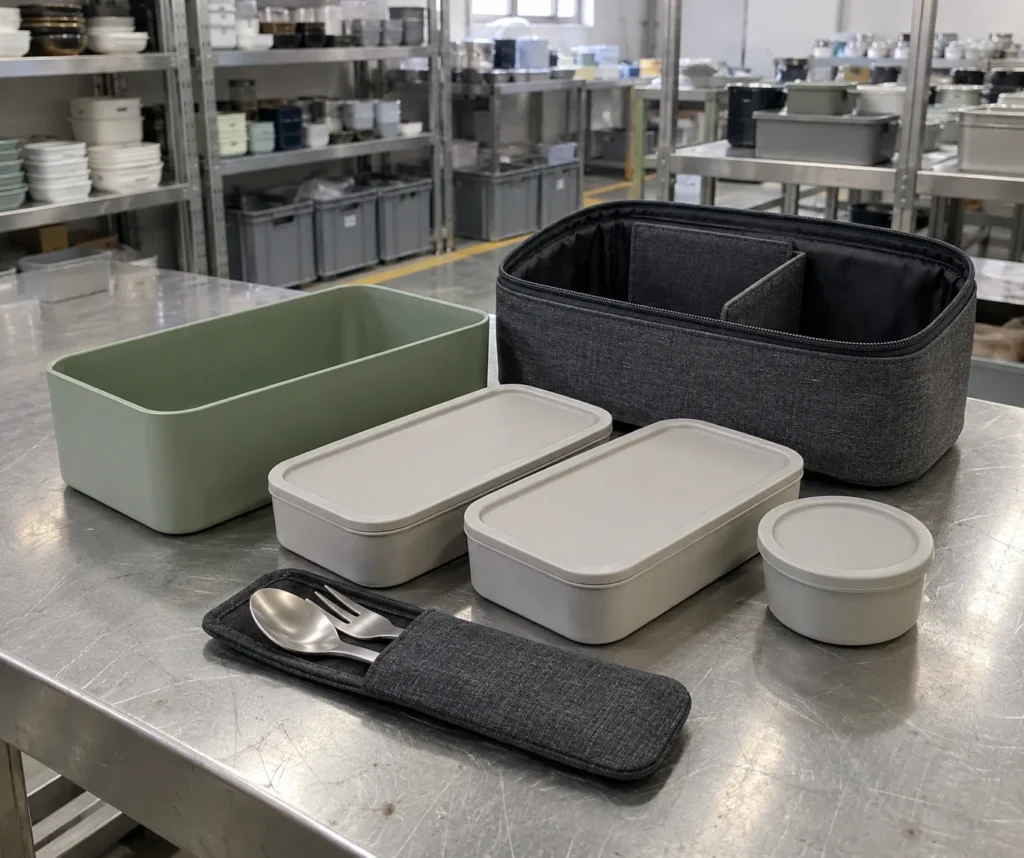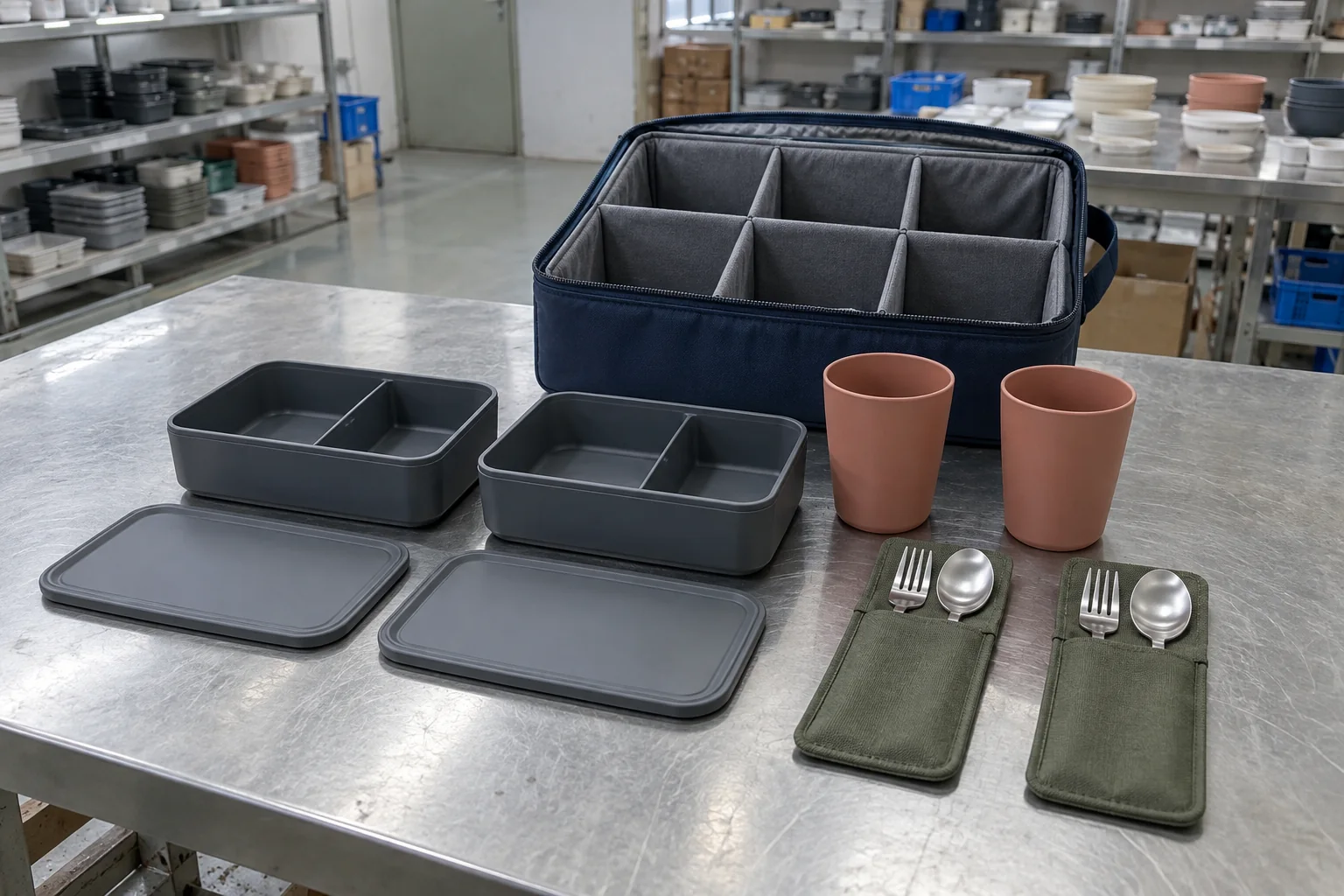
This portable tableware sample set is a two-person development concept for B2B evaluation. All gallery and in-page images are AI-generated conceptual illustrations, not photographs of Naike’s factory, actual stock, an approved prototype or a customer order. The proposed appearance and component arrangement must be validated with a physical sample. No certification, food-contact result, performance rating, packed dimensions, weight, MOQ or lead time is claimed here.
The Two-Person Portable Tableware Sample Set With Partitioned Case brings two divided charcoal-gray lunch boxes with lids, two muted terracotta tumblers and two brushed stainless fork-and-spoon pairs in olive sleeves into one deep navy semi-rigid carry case. Removable partitions make the proposed layout easy for buyers to discuss, revise and approve as a complete set.
Portable Tableware Sample Set Contents
Portable Tableware Sample Set Designed for B2B Review
This portable tableware sample set is designed for a brand, importer or procurement team comparing a two-person meal configuration. It is not presented as a retail-ready, stock-keeping item. Buyers can use the component plan to discuss geometry, color, material, carry format, decoration and retail packaging before deciding which existing parts or new tooling route deserves sampling.
Two-person portable dining development review.
Supplier qualification, buyer sample review, private-label planning and packout approval.
Two boxes and lids, two cups, four utensils, two sleeves, one insert and one case.
Component compatibility, protection, access, count and revision control.
The use scenario is a Chinese manufacturing sample room or business procurement review, not a consumer lifestyle claim. A successful sample must be physically handled, packed and inspected; an illustration can communicate intent but cannot prove food-contact suitability, leak resistance or durability.
Set Configuration and Structural Difference
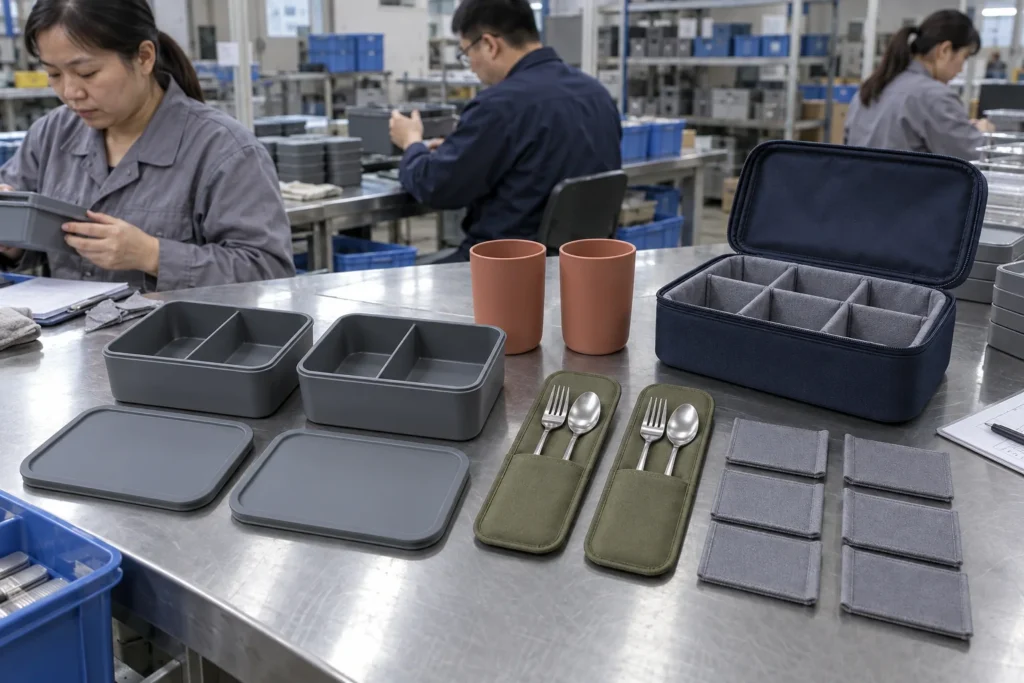
The proposed charcoal rectangular boxes use internal food divisions and matching flat lids. Each person receives one muted terracotta tumbler and one brushed stainless fork-and-spoon pair in an olive fabric sleeve. A gray removable partition system separates rigid parts from utensils inside a navy semi-rigid rectangular case.
The structural distinction is the coordinated case layout rather than the material claim. A buyer can review the box-to-lid interface, cup clearance, sleeve location, handle orientation and closure path as one system. The exact number and shape of partitions are subject to engineering; concept images may show slightly different trial layouts and should never substitute for an approved packing drawing.
Before Packing → Packed → Carrying
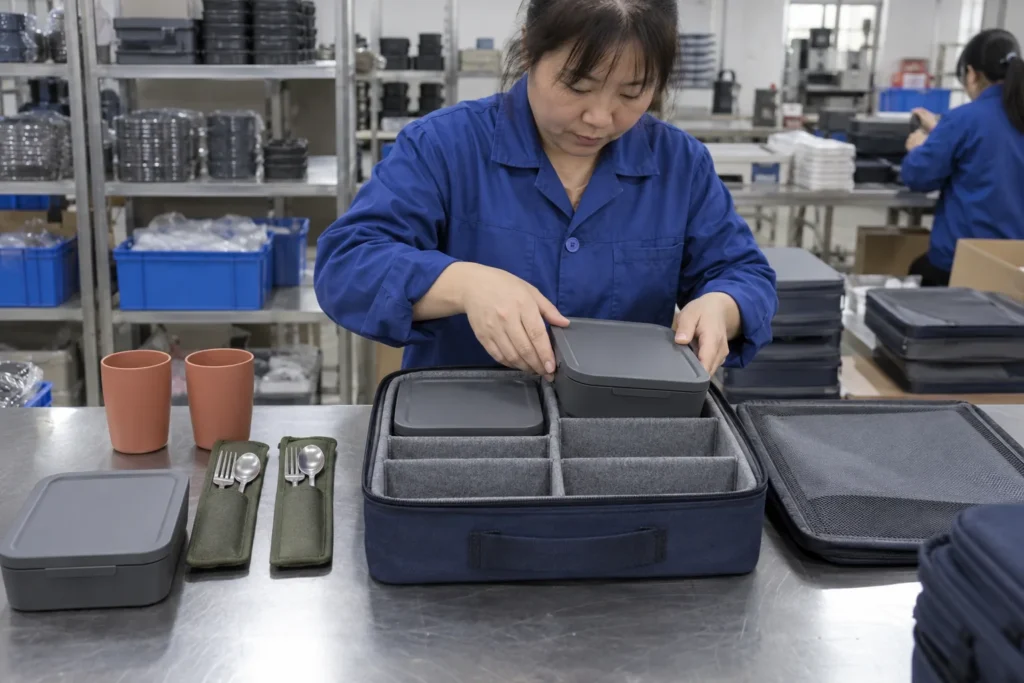
Before packing, count the two box bodies and lids, cups, forks, spoons, sleeves, insert and case. Confirm that the selected food-contact parts and carry textiles are clean and dry under the buyer’s approved process. Place heavier boxes against supportive partitions, position cups without rim pressure and keep utensils in their own sleeves.
In the packed state, a physical sample should reveal whether the zipper closes without force, whether the case walls bulge and whether pieces rattle or abrade one another. In the carrying state, test the handle, lift angle, access after opening and fit inside the buyer’s transport carton or shelf. A photograph of the case cannot prove these outcomes.
Packed Size, Weight, Volume and Stackability
| Service count | Proposed two-person configuration. |
|---|---|
| Component count | Two divided boxes and lids; two tumblers; two forks and spoons; two sleeves; removable insert; one case. |
| Packed size | To be measured on the complete approved physical sample. |
| Complete weight and volume | To be measured after final material, wall, insert and packaging decisions. |
| Stackability / nesting | To be tested for box contact, scuffing, release, lid retention and full case closure. |
| Retail and export cartons | To be defined after packed envelope, labeling and transport trials. |
Stackability may help reduce case height, but a stack must still release without damaging the rim or contacting food surfaces in an unacceptable way. If the two boxes nest only when empty, that may not describe the packed retail configuration. Record both individual-component and complete-set measurements.
Carry Bag Internal Layout and Replaceable Components
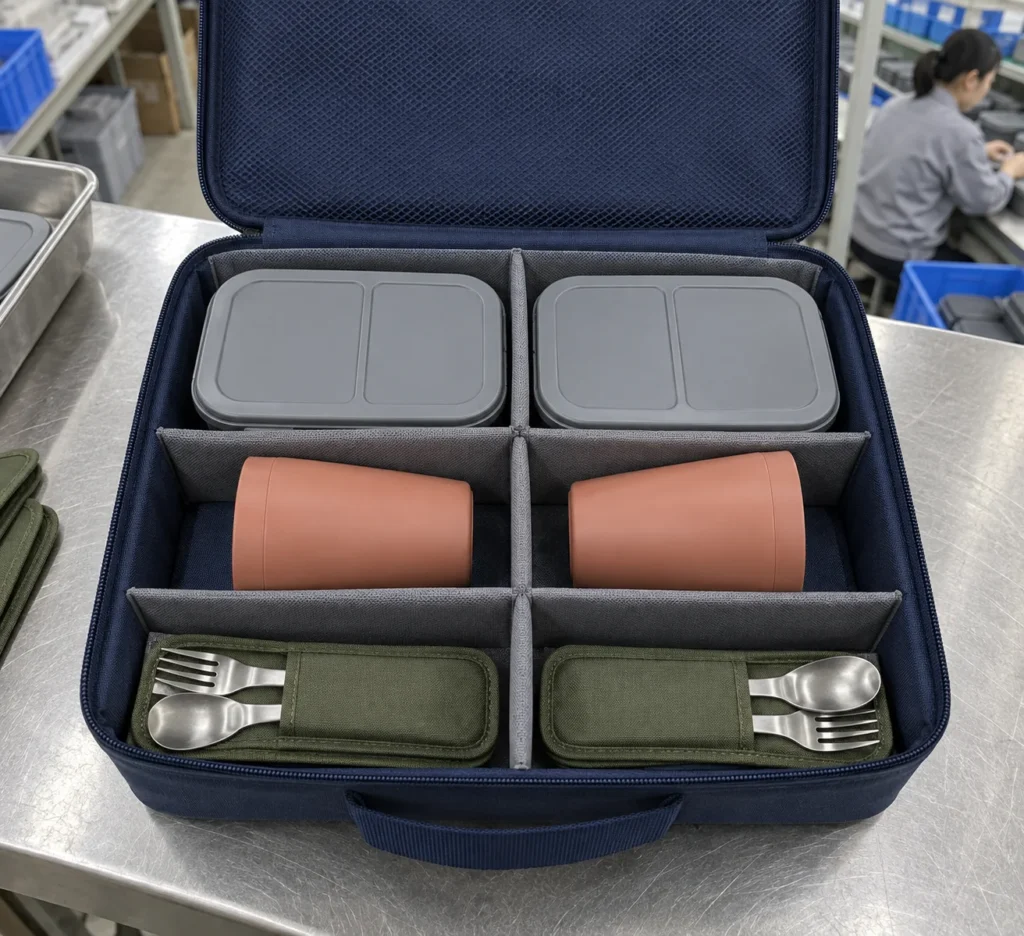
The proposed navy case uses coated textile, semi-rigid walls, a zipper, handle and removable gray partitions. Textile, coating, reinforcement, lining, thread, foam, hardware and wash-care route are not finalized. An inner pocket is optional and must be included in the approved drawing if it is part of the quoted version.
Part numbers should be assigned to the two box bodies, matching lids, cups, four utensils, sleeves, insert pieces and case. Replacement lids require compatibility checks against the body revision. An insert revision can alter cup restraint and case thickness even when the rigid components remain unchanged.
Material Selection and Use Boundaries
PP is a proposed route for the boxes, lids and tumblers; stainless steel is proposed for the fork-and-spoon pairs; coated textile is proposed for the sleeves and case. Exact resin formulation, pigment, steel grade, finish, fabric, coating, foam and adhesive must be selected and documented. The appearance of a component does not establish its grade.
Food-contact, dishwasher, microwave, freezer and leak-resistance statements require SKU-specific validation for the destination and intended conditions. This page makes none of those performance promises. The project brief should identify food type, temperature, duration, cleaning process and market before the evidence plan is agreed.
Logo, Pantone, Packaging and Custom Tooling
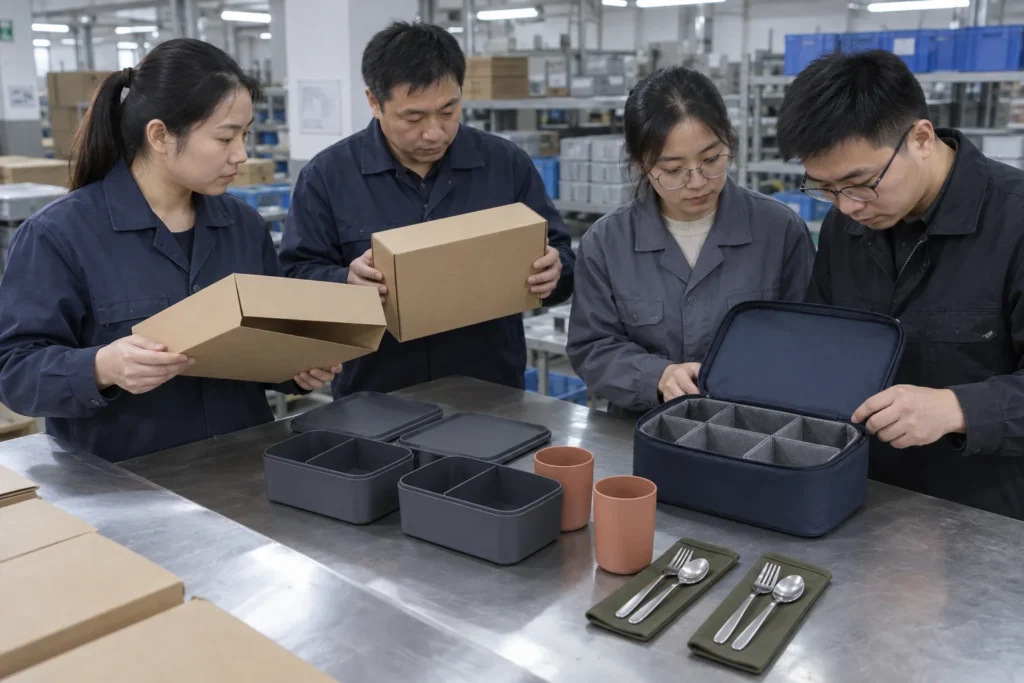
Potential logo positions include the plastic lid or body, a discreet metal engraving position, a textile label and the outer retail pack. The actual process may be printing, molded marking, laser engraving or a sewn label, subject to material and trial results. Pantone targets should be evaluated on physical resin, metal, textile and paper samples rather than assumed from screen color.
A plain kraft sleeve or carton is one packaging direction. Artwork, barcodes, warnings, instructions, inner protection and export carton layout should be approved as a complete sales unit. Existing components may be the fastest evaluation route; altered box geometry or case fit may require a tooling and pattern-development review. Ownership, cost, trial stages and lead time are quoted after drawings and quantity are known.
MOQ, Sampling and Lead Time
| MOQ | To be quoted for the chosen configuration, color split, logo, packaging and manufacturing route. |
|---|---|
| Sampling | Proposed stages: component selection, packout mockup, functional sample, color and decoration approval, signed complete set. |
| Lead time | To be confirmed after sample, testing, tooling, quantity, packaging and shipping requirements. |
| Custom mold | Reviewed only if existing components cannot meet the approved brief. |
SKU-Level Quality, Testing and Supplier Evidence
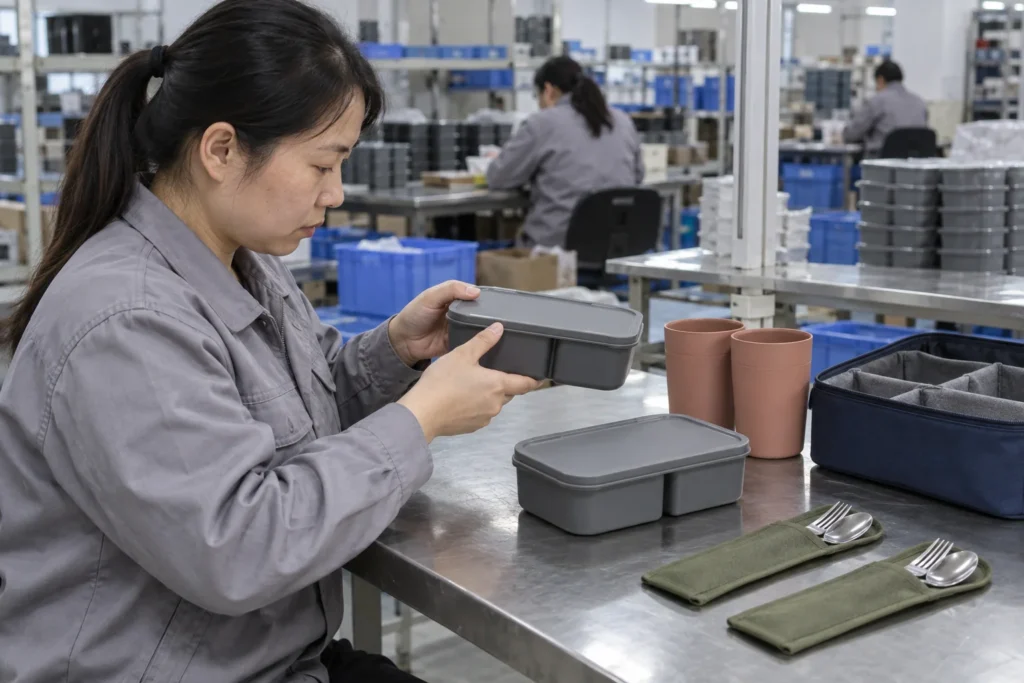
Inspection criteria should cover count, box and lid dimensions, visual finish, fit, cup rim, utensil edges, sleeve seams, partition attachment, zipper operation, handle reinforcement, case closure, color reference, logo position and carton packout. Keep the approved physical sample, bill of materials, drawings, artwork and packing instruction on one revision.
Any food-contact declaration or test report must be reviewed against the exact final SKU and destination. No illustrated test instrument, person or setting on this page is a record of actual validation. For a broader decision method, read how to choose a custom portable tableware manufacturer, then request a project-specific evidence and sample plan.
Is this sample set a verified in-stock SKU?
No. It is a configurable concept. The images are AI-generated illustrations, and availability depends on the chosen components, sample approval and quotation.
What is in the proposed two-person set?
Two divided boxes and lids, two tumblers, two fork-and-spoon pairs with washable sleeves, a removable case insert and a navy carry case.
Are packed size and weight confirmed?
No. Measure and weigh the complete approved physical sample; the concept illustrations are not a specification.
Can the materials and colors change?
The proposed materials and decoration routes can be reviewed against the project brief, but final choices require engineering and sample approval.
What are the MOQ and lead time?
They are quoted after configuration, colors, logo method, packaging, testing, quantity and production route are specified.
Explore portable dining sets, carry solutions and materials for adjacent routes.
Build a Similar Portable Tableware Sample Set
Send your target users, component list, packed-size limit, materials, colors, logo references, packaging, market, estimated quantity and desired schedule. The team can compare existing-component and custom-development options for a physical sample.
Open the Sample Set Inquiry