
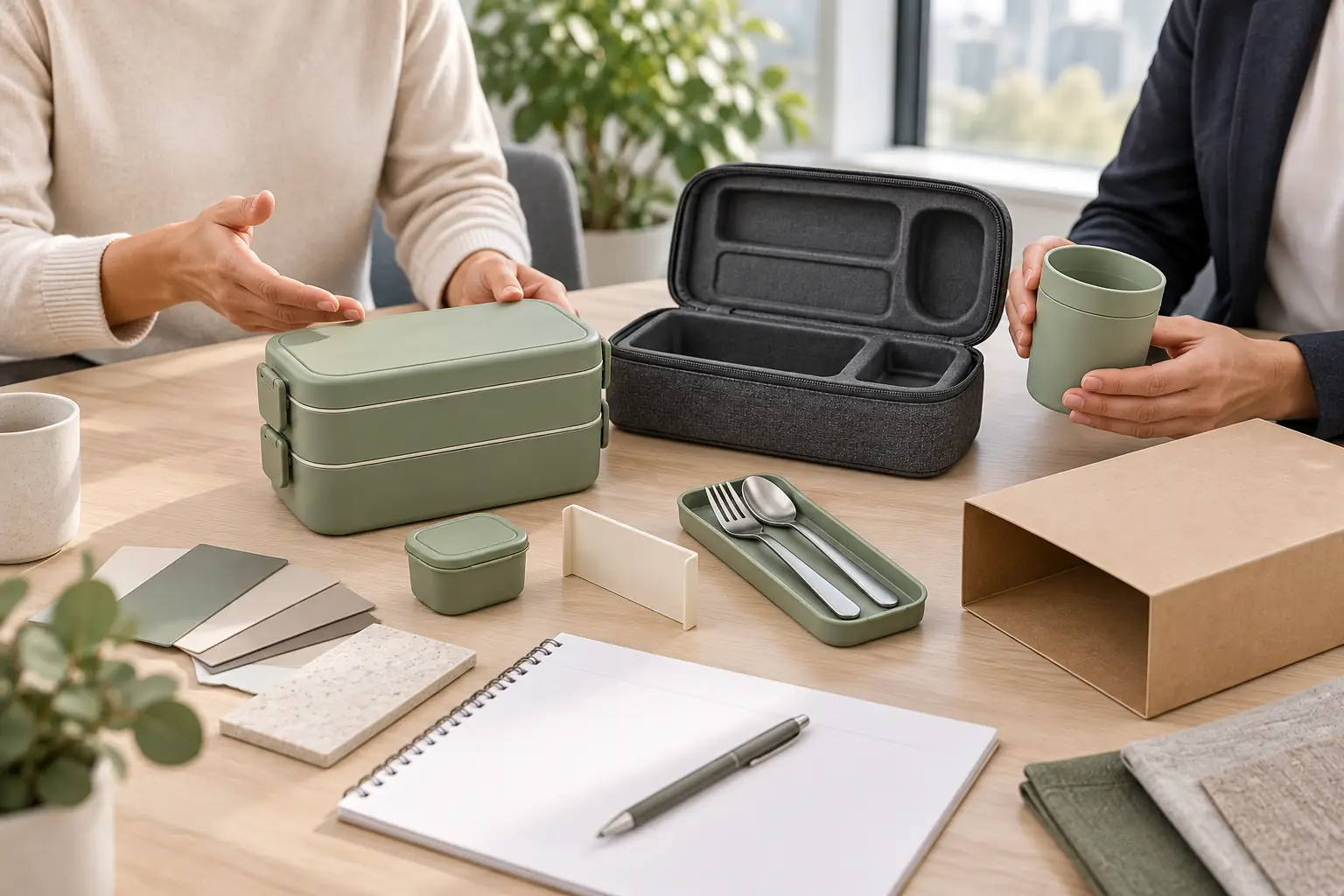
How should buyers specify modular office lunch kits?
Specify modular office lunch kits as one controlled employee-gift system: define the user, meal pattern, required components, packed dimensions, material route, case layout, branding, packaging, evidence and approval stages before requesting quotations. Compare suppliers against the same written configuration, not against piece count alone, and keep every unverified dimension or commercial term subject to project confirmation.
Modular office lunch kits procurement checklist
- Define employee profile, meal and distribution route
- Separate essential, optional and replaceable components
- Record stacked dimensions, weight and packing order
- Validate case fit with real approved samples
- Map materials and evidence to each finished component
- Approve logo, color and packaging on the complete set
Employee lunch gifts look simple from the recipient side, but they combine food-contact products, closures, accessories, a carry format and presentation packaging into one procurement program. A weak brief leaves suppliers to make different assumptions about capacity, piece count, materials, color, case construction and packing. The resulting quotations may appear comparable while describing materially different products.
A modular specification reduces that ambiguity. For procurement teams, modular office lunch kits need a stable core and controlled options so the same product platform can serve different employee groups, regional offices or price positions without losing version control. This guide focuses on the decisions that make a modular office lunch kit quotable, sampleable, inspectable and repeatable.
Start Modular Office Lunch Kits With the Program Brief
The first decision for modular office lunch kits is not the number of pieces. It is the employee and distribution context. A kit shipped individually to remote staff has different packaging and damage-control requirements from a kit distributed at one office. A daily commuter may value a compact case and predictable packing order, while an onboarding gift program may place more weight on presentation and brand consistency.
Record the intended meal, transport duration, storage environment and cleaning route without converting assumptions into performance claims. If leakage resistance, microwave use, dishwasher use or temperature exposure matters, state the expected condition and the validation method. Do not assume that a material name or a supplier description proves the finished product is suitable for every use.
Define the decision owner for each requirement
Human resources may define the gift occasion and recipient experience. Procurement may own quantity, quotation and supplier controls. Brand teams may approve color, logo and packaging, while quality teams review materials, evidence and inspection criteria. Put these decisions into one approval table so a late packaging change does not silently invalidate the case fit or shipping carton.
| Program Input | Question to Resolve | Controlled Output |
|---|---|---|
| Recipients | Who will receive and use the kit? | User profile and required accessibility |
| Meal | What food and portion pattern is expected? | Container and divider brief |
| Transport | How will the kit be carried and distributed? | Case and shipping requirements |
| Brand | Which surfaces and colors need approval? | Artwork map and physical samples |
| Market | Where will the finished SKU be supplied? | Applicable evidence and labeling review |
Choose an Essential Standard or Expanded Configuration
Modular office lunch kits are useful only when every option has a clear role. The essential configuration normally starts with the main food container and a protected utensil solution. A standard configuration can add a removable divider, sauce pot or cup where those parts support the expected meal. An expanded gift configuration may add a fitted case and enhanced packaging when the program needs a more complete presentation.
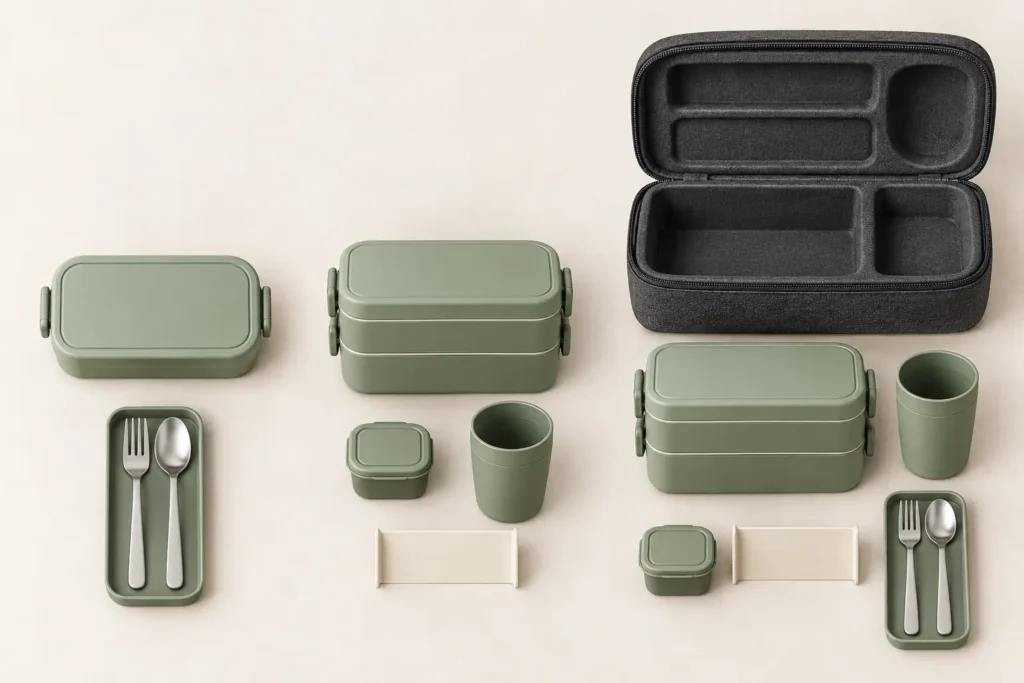
Do not compare an essential kit from one supplier with an expanded kit from another as if the piece counts represent quality. Compare like with like. Ask each supplier to identify included pieces, optional pieces, material by component, proposed construction, packed arrangement and every item that still requires confirmation.
Protect replaceability without creating uncontrolled variants
A modular program may allow one cup, sauce pot or utensil sleeve to be removed or replaced. Each substitution still changes weight, packed layout, packaging and possibly the evidence set. Use a configuration code and revision date for each approved combination. The approved bill of materials should match the packing instruction and inspection reference.
The companion Modular Stackable Office Lunch Set With Carry Case shows a configurable product direction built around a two-tier PP container, divider, sauce pot, cup, stainless-steel cutlery and fitted case. It is an OEM development concept, so final dimensions, compatibility and performance remain subject to drawings and approved project samples.
Engineer Stacking Packing and Carrying Together
The closed set must be treated as a three-dimensional system. For modular office lunch kits, record the dimensions and weight of every component, the stacked container, the packed case and the retail pack. Also record the packing orientation, lid clearance, divider position, contact surfaces and the order in which the user removes and replaces items.
A case selected from external length and width alone may leave components free to move or make the zipper difficult to close. Fitted recesses, elastic retention or dividers should be reviewed with the actual approved component samples. Compatibility to be confirmed by project sample and drawing.
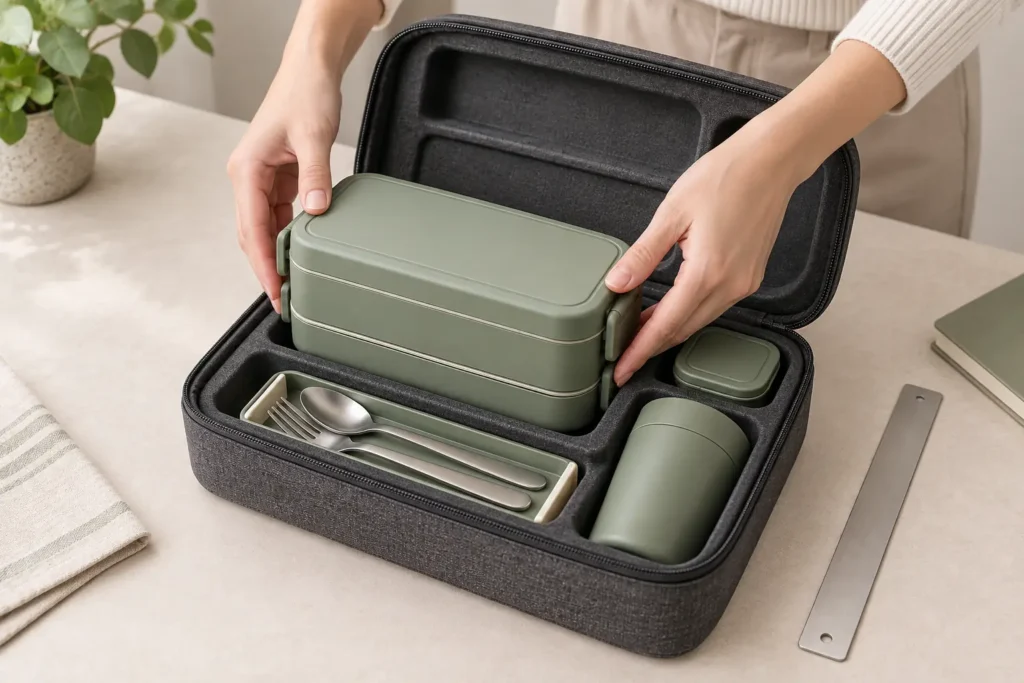
Use a repeatable pack-fit review
- Photograph and measure the approved components before packing.
- Place them in the proposed order without forcing lids or case walls.
- Check access, utensil separation, movement and closure.
- Carry and reopen the case, then repeat the sequence.
- Record the accepted orientation in the packing instruction.
Any volume or weight shown before the final sample is approved should be labeled as provisional. The product page therefore uses “To be confirmed for the project” where exact dimensions, weight, MOQ, sample timing or lead time are not yet verified.
Map Materials and Evidence to Each Component
Material maps for modular office lunch kits can include more than one material because each component has a different job. Molded food-grade PP may be proposed for container bodies and accessories, bio-composite may be considered for seals, stainless steel may be used for cutlery, and textile materials may form the carry case. The final material grade, formulation, color and construction must be confirmed for the exact SKU.
For United States programs, buyers can review the U.S. Food and Drug Administration’s overview of food-contact substances. For European Union programs, the European Commission explains the framework for food-contact materials. Packaging teams should also review the applicable scope and transition provisions of the EU Packaging and Packaging Waste Regulation.
These sources define regulatory frameworks; they do not certify a supplier or the concept shown here. Buyers should request documents that identify the tested material or finished article, applicable standard, test conditions, result, laboratory and report date. The evidence scope must match the selected material, construction and destination market.
Use the Food-Grade PP, Stainless Steel and food-contact testing guide as internal starting points, then define a project-specific evidence list.
Approve Branding Color and Gift Packaging on the Full Set
Branding across modular office lunch kits behaves differently on molded PP, stainless steel, woven labels and paper packaging. Define the intended logo method and artwork area for each surface. Pantone references are a starting direction, not a substitute for physical color approval, because resin, texture, thickness, coating and lighting can change appearance.
Employee gifting also creates a presentation sequence. The recipient may first see the shipping carton, then a retail sleeve or gift box, then the case and finally the components. Decide which layer carries mandatory information and which carries the main brand message. Keep blank space for market-specific labeling until the final requirements are confirmed.
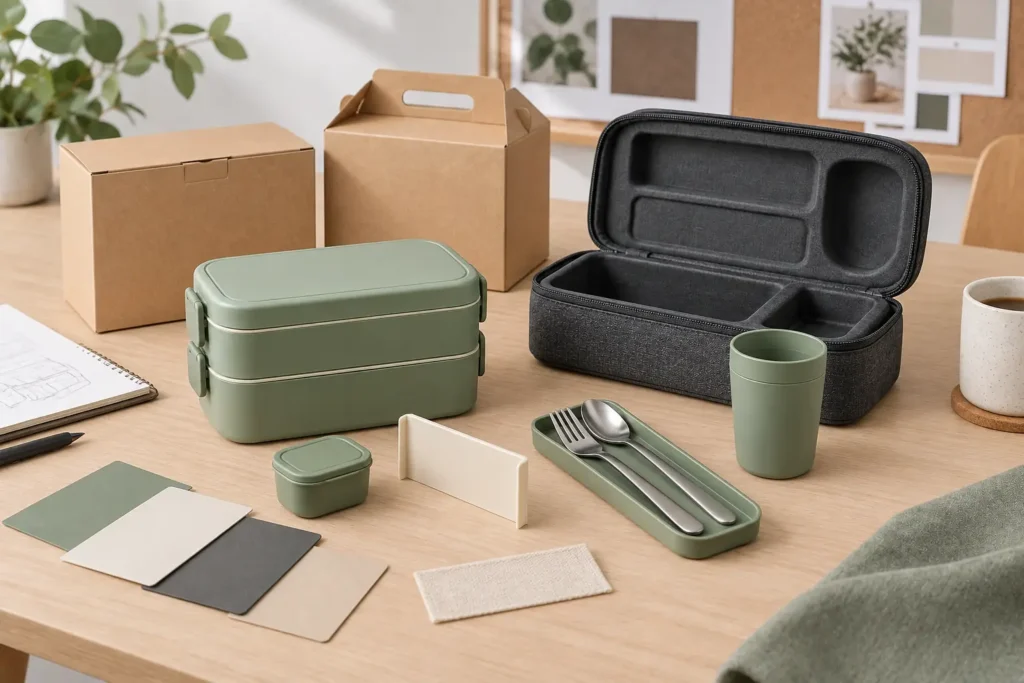
Packaging must be trialed with the final set. A pulp insert, paper divider or sleeve can change external dimensions and carton efficiency. If the set is shipped to individual recipients, verify protection through the actual distribution route rather than relying on a display-only gift box.
Compare Suppliers Against One Written Specification
A useful request for quotation for modular office lunch kits separates confirmed requirements from supplier proposals. Mark required components, optional components, target materials, approved colors, branding positions, packaging route, destination markets, quantities and schedule. Ask suppliers to identify exceptions and unconfirmed fields directly instead of filling gaps with assumptions.
| Comparison Field | Supplier Response Required | Buyer Risk if Missing |
|---|---|---|
| Configuration | Included pieces and substitution options | Non-comparable quotations |
| Packed system | Provisional and sample-verified dimensions | Case or carton mismatch |
| Materials | Material by component and evidence scope | Unsupported compliance assumptions |
| Branding | Method, artwork area and sample stage | Inconsistent logo or color |
| Commercial terms | MOQ and lead time by approved route | Schedule and budget changes |
| Quality control | Inspection points and accepted sample | Unclear production standard |
Use Set Engineering when component geometry, nesting or tooling must change. Use Packaging and Private Label to organize artwork and pack approval. The Office Lunch solution provides the broader application route.
B2B Buyer Checklist
| Check | Question | Why It Matters |
|---|---|---|
| User and meal | Are the employee profile and meal pattern defined? | Controls capacity and component choice |
| Configuration | Are required, optional and replaceable pieces separated? | Prevents hidden quotation differences |
| Packed size | Will dimensions be confirmed on the final sample? | Controls case, packaging and logistics |
| Compatibility | Has the real set been packed and reopened repeatedly? | Reduces fit and usability risk |
| Evidence | Does each document apply to the selected SKU and market? | Prevents unsupported claims |
| Branding | Are artwork areas and physical color samples approved? | Aligns parts and packaging |
| Inspection | Is the accepted sample tied to written criteria? | Creates a production reference |
Modular Office Lunch Kits FAQ
What should be included in a modular office lunch kit?
Start with the required food container and protected cutlery. Add a divider, sauce pot, cup or fitted case only when each component supports the meal, transport route, employee profile or gift-program objective.
How should buyers compare employee lunch gift configurations?
Compare the same written brief across suppliers, including component list, materials, packed dimensions, branding surfaces, packaging, sample stages, inspection points and destination-market evidence.
Can one office lunch kit use several materials?
Yes. A project may combine PP containers, bio-composite seals, stainless-steel cutlery and a textile case, but each material and finished component needs its own applicable specification and evidence review.
When should the carry case be developed?
Develop the case after the component dimensions and packing order are stable. Validate the real sample stack, movement control, access and closure before approving the case for production.
What information is required for a quotation?
Provide target users, meal scenario, quantities, component list, material route, colors, logo method, packaging, destination market, required evidence, sample expectations and target schedule.
Turn the Office Lunch Kit Into a Controlled Project
A successful employee lunch gift is not defined by the greatest number of components. It is a coherent set with a documented user, configuration, packed format, material map, brand approval path and production reference. Modularity should make decisions clearer, not create invisible variants.
Share the intended recipients, meal routine, component priorities, quantity, market, branding and delivery plan. Naike Tableware can compare existing-component and development routes, identify fields that remain to be confirmed and prepare the next sample discussion.