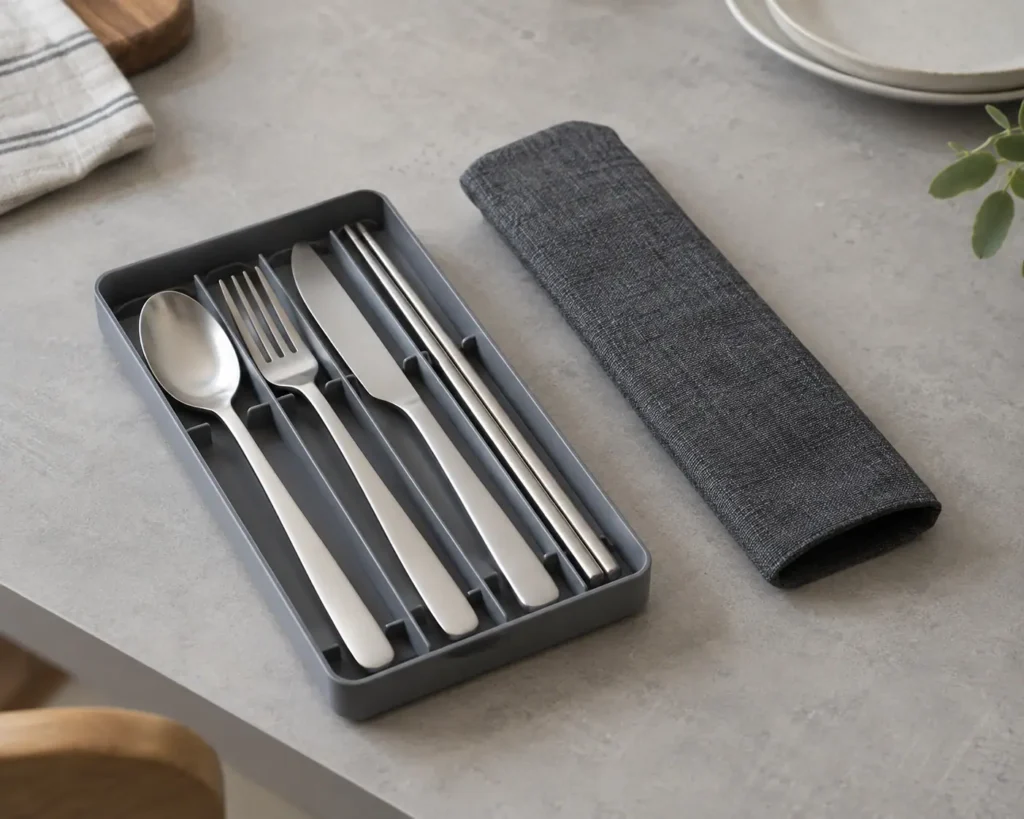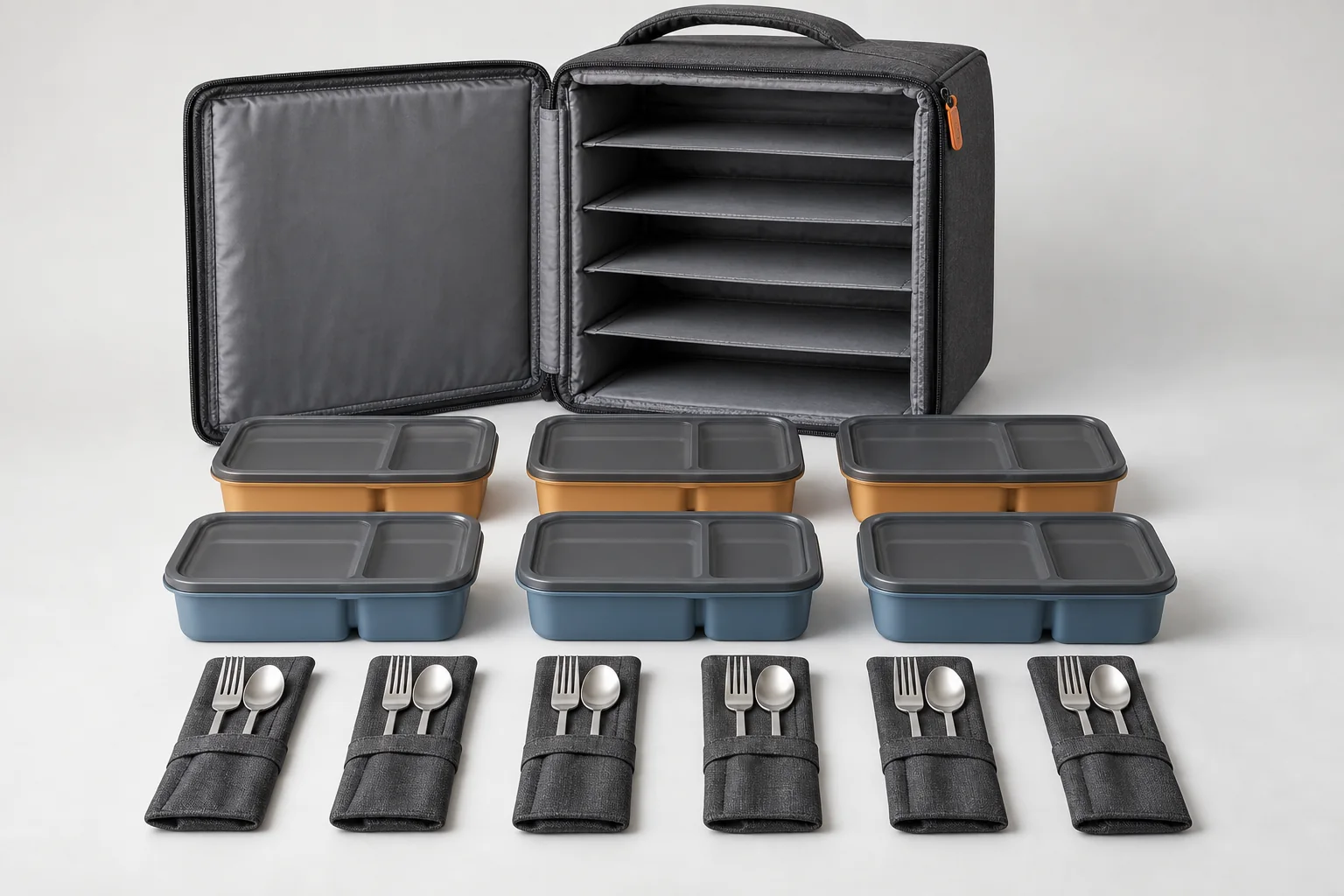
This event crew catering kit is a configurable B2B concept for sourcing discussion. The original images visualize a consistent six-dining set; they are not evidence of a verified production SKU, certification, customer order or performance result. Final dimensions, materials, insulation, compatibility, weight, volume, tooling, MOQ, sampling and lead time are to be confirmed for the project.
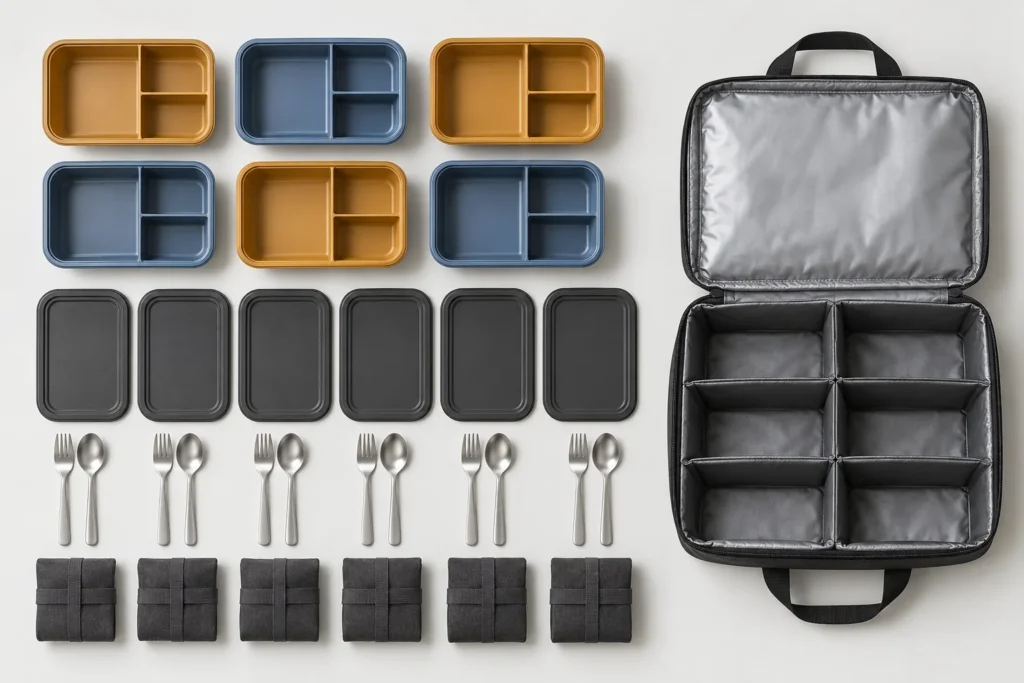
The Six-Meal Event Crew Catering Kit With Stackable Boxes combines exactly six low-profile divided meal boxes—three muted amber and three slate blue—with charcoal lids, six stainless fork-and-spoon pairs, dark-gray roll sleeves and a graphite insulated carrier with six horizontal padded shelf positions. It is designed as a controllable handoff module for backstage, production, festival, venue and crew catering programs.
Product Contents
Event Crew Catering Kit Applications
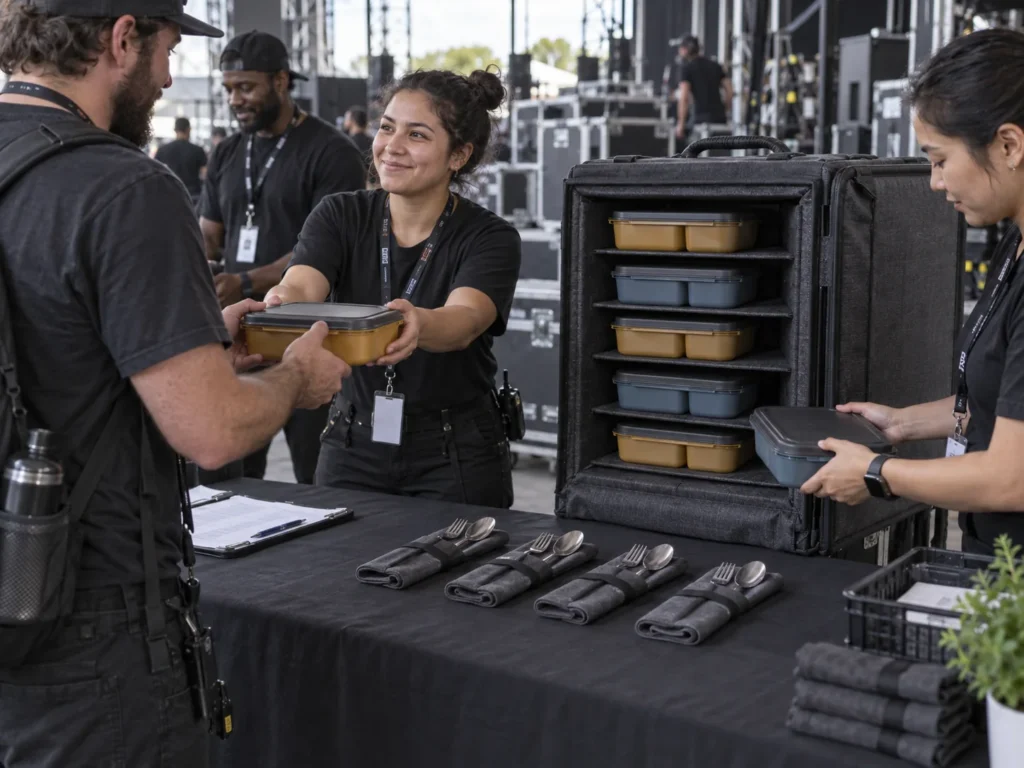
The event crew catering kit is intended for one small team, department handoff point or meal distribution lead. Potential scenarios include backstage production, technical rehearsals, touring crews, festivals, corporate events, sports operations, location shoots and security teams. The six-meal module may be coordinated with additional carriers when a larger wave is required.
Actual use depends on the confirmed menu, food-safety plan, travel time, venue access and cleaning route. No universal leakproof, temperature-retention, microwave, freezer, dishwasher or drop-performance claim is made. Validate the final construction under the buyer’s intended conditions.
Event Crew Catering Kit Configuration
The core configuration has six divided PP meal boxes and six charcoal lids. Three amber and three slate-blue bodies allow teams to create controlled groupings, but color should not be the only dietary identifier. Six stainless fork-and-spoon pairs sit in separate dark-gray textile roll sleeves. The graphite carrier uses six horizontal padded shelf positions so operators can load and remove boxes individually instead of building one unsupported stack.
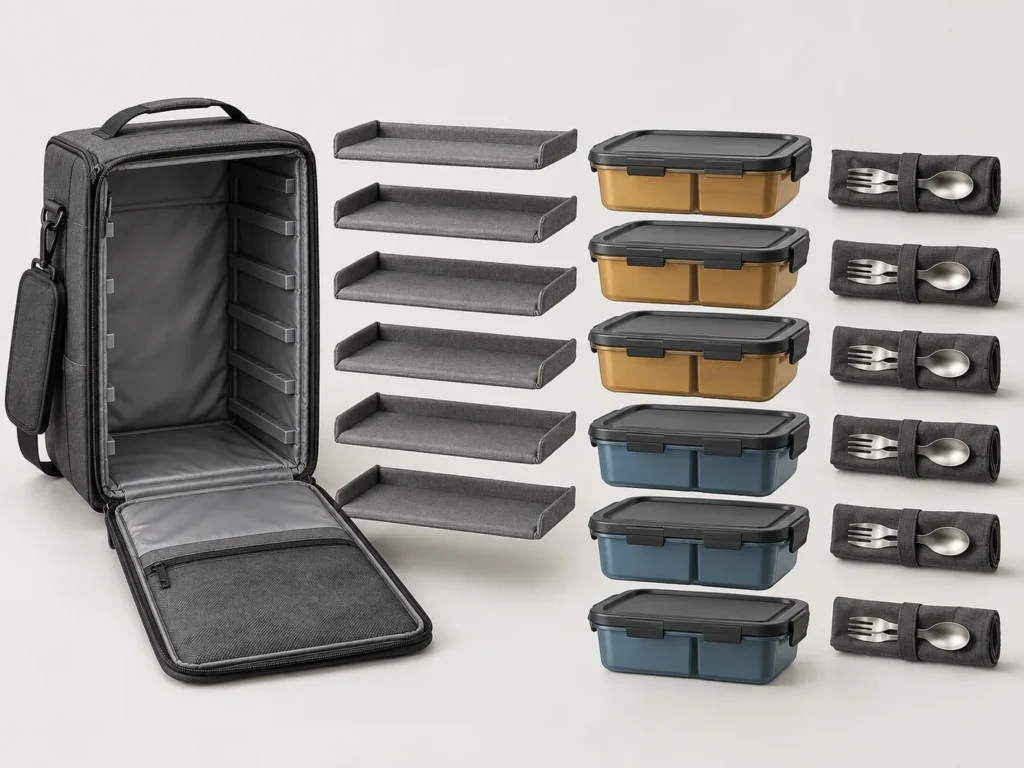
Six crew meals at one handoff point.
Six boxes and lids, six utensil pairs, six roll sleeves and one shelf carrier.
Three muted amber and three slate blue boxes with charcoal lids.
Repeatable loading, distribution, return counting and component replacement.
Every approved set should have a bill of materials, drawing revision, color reference, artwork, packing instruction and inspection checklist. If a box, lid, sleeve or shelf changes, repeat the compatibility review. Physical fit must be confirmed by project sample and drawing.
Before Packing → Loaded → Distributed → Returned
Before packing, verify the quantity and condition of boxes, lids, utensil pairs and sleeves. Load each closed meal box into its assigned shelf without forcing the side walls or zipper. Store the sleeves in the dedicated organizer position or issue them with each box according to the approved workflow. Close the carrier, lift it using the defined method and trial the actual backstage route.
At distribution, remove one box at a time, match any dietary identifier and record exceptions. At return, count boxes, lids, utensils and sleeves separately, then move used components through the approved sorting and cleaning route. The carrier should not contact clean food-contact items again until its own inspection or cleaning requirement has been completed.
Product Parameters and Packed Size
| Meal-box format | Low-profile rectangular divided body with rounded corners and charcoal lid; final geometry to be confirmed. |
|---|---|
| Set quantity | Six boxes, six lids, six fork-and-spoon pairs, six sleeves and one carrier. |
| Proposed materials | Food-grade PP, stainless steel and textile/insulated carrier construction; exact specifications to be confirmed. |
| Packed size | To be confirmed for the project after final box, shelf and carrier approval. |
| Weight and volume | To be confirmed from the approved physical sample and loading method. |
| Stackability | Box and lid alignment, contact surfaces and stability to be confirmed by sample and drawing. |
| Temperature performance | To be defined and verified under the buyer’s food, time and test conditions. |
Insulated Carrier Internal Layout
The proposed graphite carrier has six horizontal padded shelf positions and a separate organizer area for rolled utensils. The shelf approach is intended to limit vertical pressure and improve access to individual meals. Final shelf pitch, wall structure, insulation, lining, zipper, handle, orange pull, cleaning method and load rating must be confirmed with an approved carrier sample.
Review the closed carrier inside the relevant vehicle, cart, storage rack and backstage holding area. Check doorways, stairs, temporary flooring and the actual distance between catering and handoff. Carry ergonomics depend on the loaded mass and route, so weight and handling instructions cannot be finalized from an empty concept image.
Materials and SKU-Level Evidence
Food-grade PP is proposed for the divided boxes and lids, stainless steel for the fork-and-spoon pairs, textile for the roll sleeves and a multilayer textile/insulation construction for the carrier. Exact resin, pigments, additives, steel grade, fabric composition, foam, lining, coatings, thread and hardware are to be confirmed. Each component needs its own specification.
Food-contact evidence should apply to the selected component, color, intended use and destination market. Buyers can use the FDA food-contact substances overview and European Commission food-contact materials framework when defining their document list. These links do not certify this concept.
OEM Logo Pantone and Packaging Options
Potential decoration routes include printing or molded identification on PP, laser marking on stainless steel, woven or printed textile labels and printed paper bands or cartons. Feasibility depends on the selected surface and process. Pantone targets require physical sample approval because plastic, steel, textile and kraft paper show color differently.
Packaging can be reviewed as bulk master cartons, plain kraft inner cartons, recyclable paper bands or divider inserts. Define the barcode, instructions and market information before artwork approval. Trial the complete packed configuration because inserts change carton dimensions and unpacking time.
Replaceable Components and Custom Development
Boxes, lids, utensils, sleeves, shelves and carriers can be reviewed as replaceable modules. Existing components should be evaluated first. Modified geometry or new tooling may be considered when menu capacity, compartment layout, stacking or carrier fit cannot be achieved with available parts. Tooling feasibility, cost and schedule are to be confirmed after drawings and expected volume are available.
MOQ Sampling and Lead Time
| MOQ | To be confirmed by configuration, color split, decoration, packaging and assembly route. |
|---|---|
| Sampling | To be confirmed after the operating brief, drawings and approval stages are defined. |
| Lead time | To be confirmed after samples, testing, quantity, packaging and shipping plan are approved. |
| Custom tooling | Reviewed after drawings, tolerances and expected volume are available. |
Quality Inspection and Approval Controls
Potential inspection points include component count, dimensions, visual condition, lid fit, shelf clearance, box removal, loaded balance, zipper and handle operation, utensil finish, sleeve construction, logo position, color reference, packaging and complete-set verification. The final plan must follow the approved design and intended use.
Keep the accepted sample, drawings, bill of materials, artwork, packing instruction, evidence list and inspection criteria on one revision. Unknown fields remain “To be confirmed for the project” until documented approval. Read the event crew meal kit procurement guide for quantity, workflow and supplier-scorecard logic.
Event Crew Catering Kit FAQ
What is included?
Six divided PP meal boxes and lids, six stainless fork-and-spoon pairs, six textile roll sleeves and one insulated shelf carrier.
Are dimensions and weight confirmed?
No. They are confirmed from the final configuration, drawings and approved sample.
Can colors, logos and packaging be customized?
Yes, subject to material and process feasibility, artwork review, sample approval and commercial confirmation.
What are the MOQ and lead time?
They are confirmed after configuration, colors, decoration, packaging, testing and quantity are defined.
Compare Lunch & Bento products, review Food-Grade PP and see the Modular Stackable Office Lunch Set for another structured meal format.
Build a Similar Event Crew Catering Kit
Share the meal wave, menu, component priorities, route, cleaning process, branding, packaging, target markets, quantity and schedule. The B2B team will identify available-component and custom-development routes.
Open the Project Inquiry
Event Crew Catering Kit Visual Review
Use the complete visual sequence to review component count, carrier loading, handoff and OEM packaging before the approval sample is locked.