
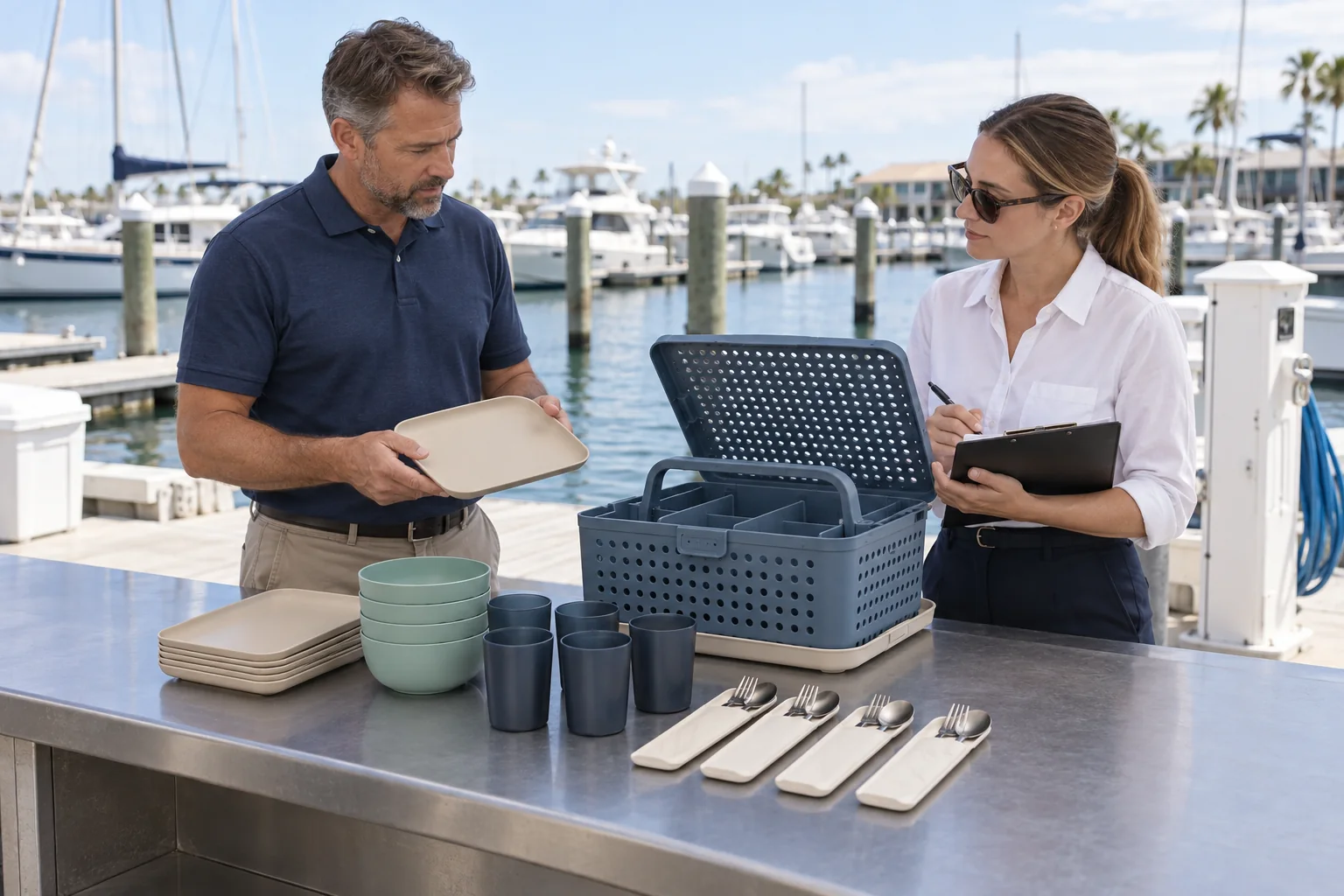
How should operators plan marina dining kit procurement?
Marina dining kit procurement should start with passenger capacity, vessel layouts, dockside issue and return, component counting, rinse and drying routes, replacement control, food-contact evidence and branding. Approve one controlled bill of materials, test the complete loaded caddy on every vessel family while docked, and pilot the full handoff-to-return cycle before placing production orders.
A day-charter dining system moves between a marina store, a preparation counter, a docked vessel, a guest table and a return station. Catalog dimensions alone do not show whether the carrier fits a narrow shelf, remains countable during a fast turnaround, or dries fully before the next departure. The purchasing decision therefore connects tableware design with an operating workflow.
This guide provides a sourcing framework rather than a claim about a finished SKU. Dimensions, drainage, dishwasher compatibility, corrosion resistance, stability, service life and regulatory suitability remain “To be confirmed for the project” until drawings, samples and supporting evidence are approved.
Build the Marina Dining Kit Procurement Brief
Record the vessel families, licensed passenger limits, typical party sizes and service model. Note whether tableware is placed aboard before boarding, handed to crew at the dock, or stored on each vessel. Map the smallest galley shelf, dry counter, locker opening and return-cart footprint. Include handle clearance and the path from store room to dock.
Define who counts clean components, who places them aboard, who collects used items and who approves reissue. Separate the food-service plan from the equipment brief. The kit supplier can specify materials and construction, but the operator remains responsible for food handling, allergen controls, sanitation and vessel procedures.
| Input | Procurement question | Controlled output |
|---|---|---|
| Passenger load | How many settings are issued? | Two-, four- or eight-person module |
| Vessel layout | Where can the loaded caddy fit? | Maximum packed envelope |
| Turnaround | How are used parts counted and dried? | Return-cycle work instruction |
| Destination | Which evidence applies? | Document request list |
| Brand program | Which surfaces and packs change? | Artwork and sample plan |
Assign decision owners. Operations approves vessel placement and handling. Quality approves material evidence and inspection. Cleaning teams approve chemistry, equipment and drying. Brand teams approve physical color and decoration. Procurement controls commercial assumptions, tooling decisions and supplier exceptions.
Use Modular Marina Dining Kit Procurement Logic
A four-person reference module can contain four sand-beige low rectangular PP plates, four seafoam bowls, four smoky navy tumblers and four stainless fork-and-spoon pairs in off-white sleeves. One slate-blue rigid perforated PP caddy uses four separator bays, a removable sand-beige drip tray, a fold-down handle and a ventilated cover.
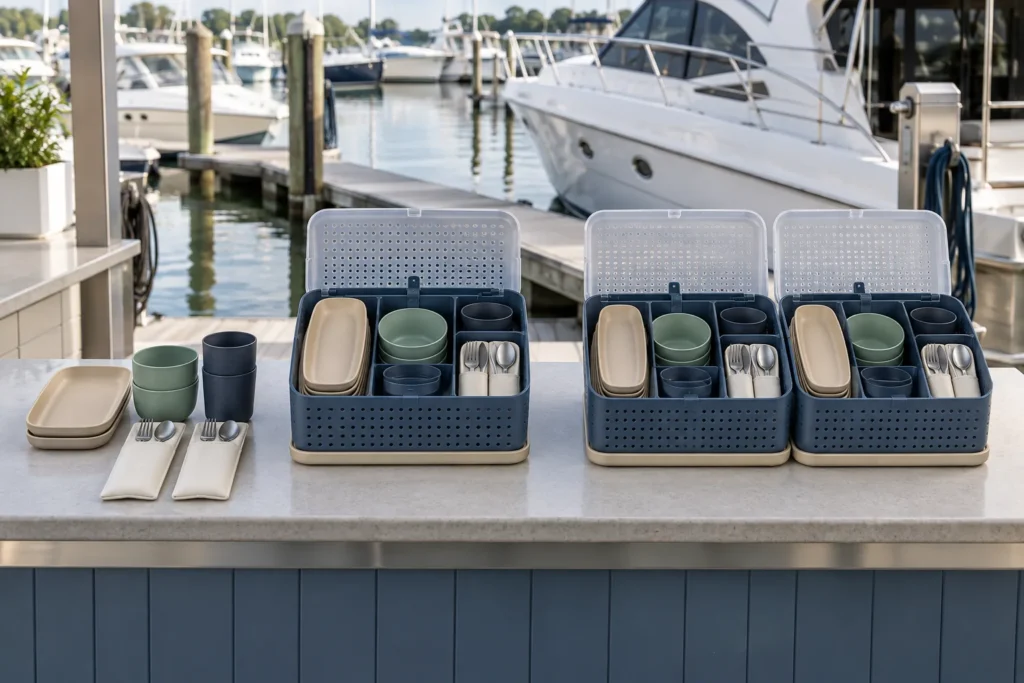
Use passenger modules instead of loose averages. A two-person departure may use a half module only if its bill of materials and carrier arrangement are separately approved. A four-person party uses one complete caddy. An eight-person party may use two identical caddies, preserving count and replacement logic. Give every approved version its own code, packing image and inspection record.
The related Four-Person Marina Dining Kit With Drainable Deck Caddy illustrates the four-person concept. Final capacity, dimensions, weight, drainage, cleaning route, MOQ and lead time still require confirmation.
Control replacements and substitutions
Identify plates, bowls, tumblers, fork, spoon, sleeve, divider, cover, handle and drip tray as individual service parts. A visually similar bowl or divider is not automatically compatible. Recheck nesting, bay fit, cover closure, color and evidence whenever a component changes. Replacement stock must follow the approved revision.
Validate Vessel Fit While Docked
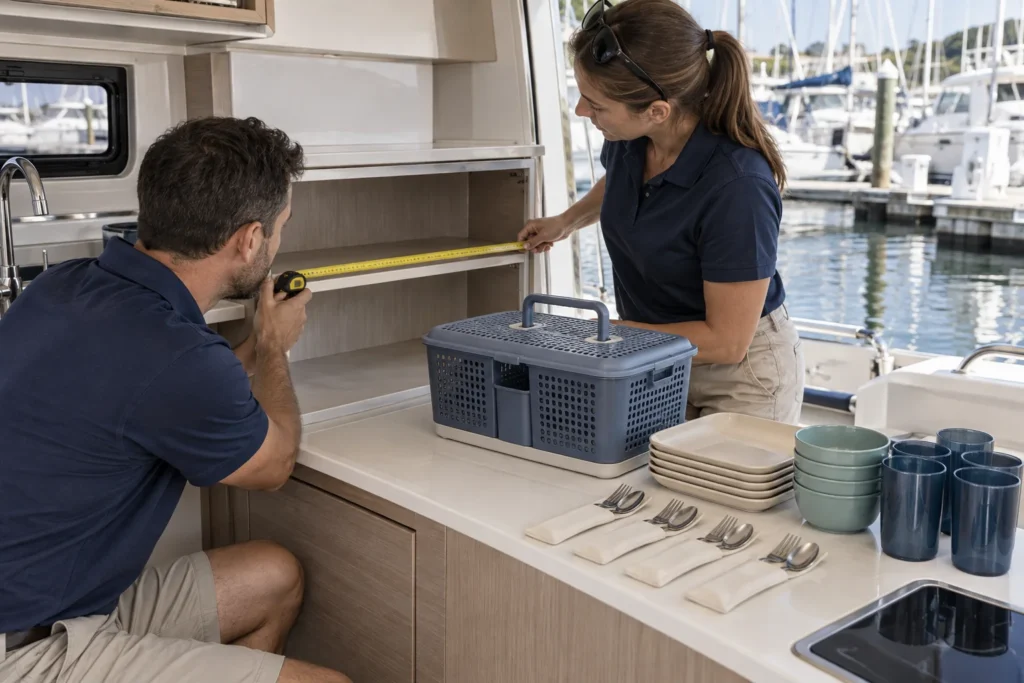
Measure the smallest shelf, locker opening, galley counter and service-cart position in every vessel family. Check the complete loaded caddy, not only its empty shell. Include the raised and folded handle, cover latches, drip tray edge and finger clearance. Confirm that crew can remove one component group without unloading the entire carrier.
Trials should follow the operator’s approved procedure while the boat is docked and secured. The kit must not obstruct controls, access routes, emergency equipment or safe movement. Product imagery does not establish an approved storage location or authorize use while a vessel is underway.
- Measure the smallest approved storage location.
- Load the exact bill of materials and record the packed condition.
- Carry the kit along the real dock-to-vessel route.
- Open, serve and repack it at the intended counter.
- Check cover, handle, divider and tray access.
- Record accepted locations by vessel and kit revision.
Map Issue, Guest Use, Return and Drying
Before issue, count four plates, four bowls, four tumblers, four fork-and-spoon pairs, four sleeves, the caddy body, dividers, cover, handle and drip tray. Record the kit revision and vessel or booking assignment. If prepared food is provided, keep food labeling and temperature controls in the operator’s applicable plan.
At return, count bodies and accessories separately. Quarantine cracked, distorted, deeply scratched, stained, loose or missing components. Food-contact items should follow the approved residue removal, washing, rinsing, drying and inspection process. The rigid caddy, removable tray, cover, dividers and sleeves may need different cleaning routes.
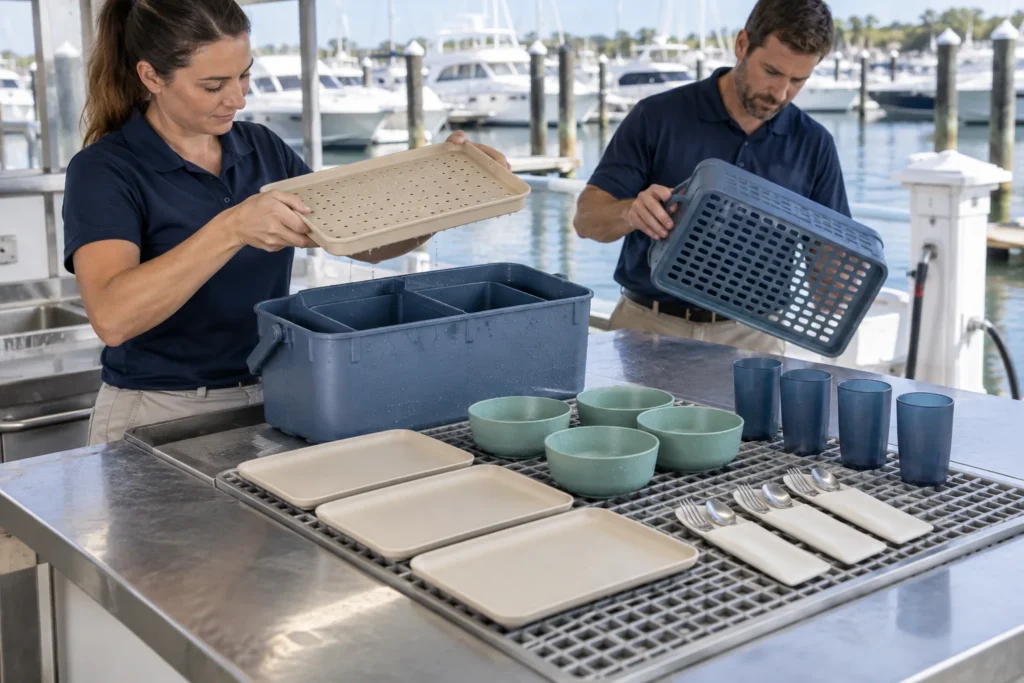
Ventilation holes and a removable tray can support drainage and inspection, but their appearance does not prove drying time, dishwasher compatibility or hygienic performance. Validate the exact geometry, cleaning chemistry, temperature, mechanical action and rack position. Repack only when every required component is dry and serviceable.
Track opening stock, kits issued, complete returns, loose parts, wash failures, quarantined pieces, replacements and closing stock. Review loss by vessel, route, crew team and booking type. These records produce a defensible reserve quantity and reveal whether identification or training needs improvement.
Calculate operating quantity
Start with simultaneous departures, then add kits in cleaning, drying, inspection, repair or transfer. Add a controlled reserve based on pilot loss and turnaround data. Do not apply an arbitrary percentage across every marina; departure peaks, staffing and wash capacity change the requirement.
Match Materials and Evidence to the Exact SKU
Food-grade PP may be considered for molded tableware and the rigid caddy, while stainless steel may be considered for reusable cutlery. Exact resin, additives, pigments, steel grade, finish, sleeve composition and any coatings remain project decisions. Salt air, sunscreen residues and cleaning chemicals may affect materials differently, so define representative test conditions.
For United States programs, review the FDA overview of food-contact substances. For European Union programs, review the European Commission framework for food-contact materials. These sources do not certify this concept or any supplier.
Request records that identify the tested material or finished article, color, method, conditions, result, laboratory and date. Match every record to the selected component, intended food, time, temperature, cleaning route and destination. Internal references include Food-Grade PP, Stainless Steel and Portable Dining.
Approve Logo, Pantone and Packaging as Separate Controls
Potential decoration routes include printing or molded marks on PP, laser marking on stainless steel, identification on washable sleeves and graphics on paper bands or cartons. Each surface needs an artwork area, process, durability review and physical approval. Do not assume one mark transfers unchanged across plastic, steel and textile.
Pantone references guide development but do not replace molded samples. Slate blue, sand beige, seafoam and smoky navy may shift with resin, texture and light. Review components together under representative marina and indoor lighting. Retain the approved sample with the revision record.
Packaging may use bulk master cartons, plain inner cartons, recyclable paper separators or component-count cards. Define barcode, quantity, handling and market information before artwork approval. Pack a full trial carton because protective inserts change dimensions, weight, unpacking time and waste handling.
Compare Suppliers With One Scorecard
Send every supplier the same RFQ: passenger modules, vessel envelope, bill of materials, quantities, colors, decoration, packaging, evidence scope, sample stages and schedule. Require an explicit list of exceptions and unconfirmed fields. Separate existing-component, modified-component and new-tooling routes.
| Field | Required evidence | Approval question |
|---|---|---|
| Configuration | BOM and packing image | Can every part be counted? |
| Vessel fit | Drawings and docked trial | Does the loaded caddy fit? |
| Return cycle | Cleaning and drying inputs | Can crews reissue reliably? |
| Materials | SKU-matched specifications | Does evidence match use? |
| Commercial | MOQ, samples, tooling and timing | Are quotations comparable? |
Existing components may reduce development work. Custom tooling may solve a specific bay, handle or packed-envelope requirement, but it adds drawing, tolerance, tooling and validation stages. Compare verified function, replacement support, approval risk and total program cost—not only unit price.
Marina Dining Kit Procurement Checklist
- Passenger modules and vessel families are documented.
- The loaded caddy envelope is validated while docked.
- Issue, return, cleaning, drying and counting owners are assigned.
- Every replaceable component has a controlled code.
- Food-service controls remain in the operator’s plan.
- Evidence matches the exact SKU and destination.
- Physical colors, decoration and packaging are approved.
- MOQ and lead time are confirmed after specification approval.
Marina Dining Kit Procurement FAQ
What belongs in the brief?
Define passenger capacity, vessel fit, handling, counting, cleaning, materials, evidence, branding, packaging and approvals.
How is caddy fit confirmed?
Measure the smallest approved locations and test a complete loaded sample on every vessel family while docked.
Does perforation prove performance?
No. Drainage, cleaning, stability and durability require validation for the exact construction and conditions.
Which documents should buyers request?
Request SKU-matched drawings, material records, test reports, color approvals, packing instructions and inspection criteria.
When are MOQ and lead time confirmed?
After configuration, colors, decoration, packaging, testing, quantity and approval stages are defined.
Turn the Operating Brief Into a Dockside Pilot
Share vessel families, passenger loads, storage limits, issue and return routes, cleaning process, target markets, branding, packaging, quantity and schedule. Naike Tableware can compare existing-component and custom-development routes for a controlled sample review.