

How should hotels plan a resort picnic kit lending program?
A resort picnic kit lending program should be managed as a repeatable hospitality operation rather than a one-time merchandise purchase. Define the guest use case, controlled kit configuration, issue and return points, identity method, cleaning route, inspection standard, replenishment stock, branding and approval stages before suppliers quote. Validate the full process with physical samples under actual resort conditions.
Resort teams often focus first on attractive colors and bag styling. Those decisions matter, but a lending program succeeds only when the set can be issued, carried, used, returned, checked, cleaned, dried, replenished and reissued without ambiguity. A buyer therefore needs both a product specification and an operating specification.
Start the Resort Picnic Kit Lending Program With a Service Brief
Write down where guests receive the kit, the expected group size, typical foods and drinks, permitted use areas, normal carrying distance, return point, operating hours and the team responsible for inspection. Record whether the set is complimentary, reserved, rented or included with another service. These choices affect identity, packaging, stock level and guest instructions.
Define exclusions as carefully as requirements. If microwave use, dishwasher exposure, hot liquids, freezer use, spill resistance or transport temperature has not been validated, mark it “To be confirmed for the project.” The supplier quotation should not turn an untested assumption into a performance promise.
Questions for the operating brief
- Who issues the kit and records the transaction?
- Which guest groups and locations are in scope?
- How long can the kit remain outside operations control?
- Where are used sets returned and separated?
- Which parts are replaced individually and which require a complete set change?
Choose a Controlled Two-Person or Four-Person Configuration
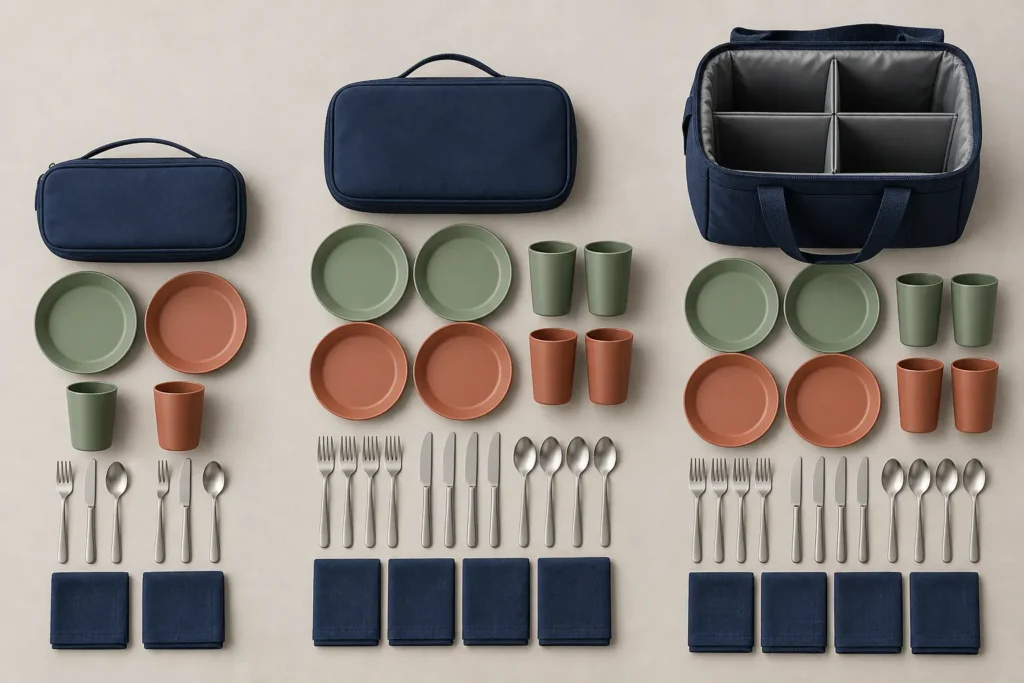
A two-person set may be easier to carry and useful for couples, while a four-person set can reduce the number of bags issued to families. The right choice depends on booking patterns, guest behavior, menu format and return logistics. Avoid mixing configurations under one SKU unless each variant has a clear bill of materials and packing instruction.
| Configuration | Best planning use | Control point |
|---|---|---|
| Two-person compact | Couples and short garden use | Confirm whether shared service pieces are needed |
| Four-person standard | Families and group reservations | Check carrying comfort and total component count |
| Four-person divided tote | Premium lending with controlled return | Approve nesting order and divider layout |
The companion Four-Person Resort Guest Picnic Kit shows one concept direction with alternating sage and terracotta PP tableware, stainless-steel cutlery, navy sleeves and a sand-beige divided insulated tote. It is a visual development concept; exact dimensions, weight, capacity, performance, MOQ and lead time remain subject to approved samples and project specifications.
Map Issue Carry Return and Reconciliation
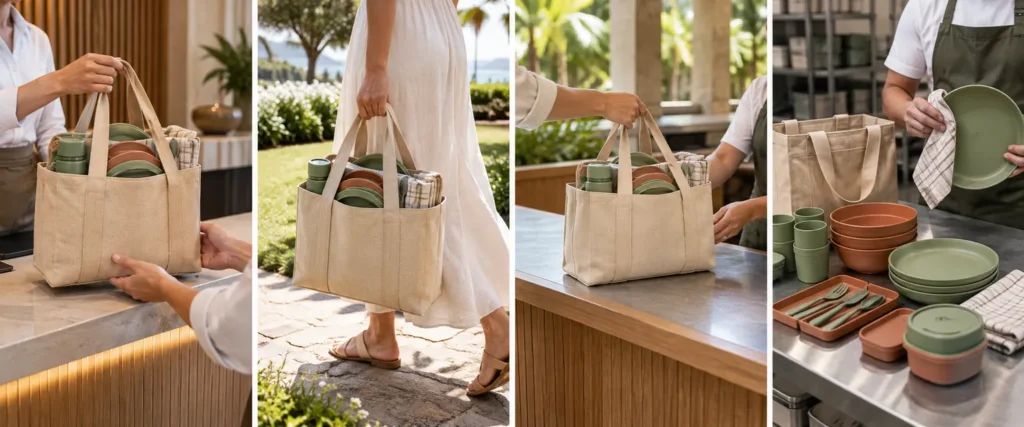
Build the workflow before choosing decoration. At issue, the team should compare the packed set with a visual standard and record the responsible reservation or service point. The guest should be able to carry the kit without loose components. At return, used items should enter a defined collection route rather than go directly back into clean inventory.
Reconciliation means checking the returned kit against the approved component list. Color families can help staff sort parts, but color alone is not an inventory system. Use a controlled photo, packing diagram or internal checklist. If a piece is missing or damaged, the program needs an approved replacement SKU and a rule for when the remaining set can return to service.
Identity options to evaluate
Potential routes include a discreet molded mark, laser mark on metal, woven tote label, removable inventory tag or controlled internal code. The best method depends on the material, cleaning exposure, brand guidelines and whether the buyer wants item-level or set-level control. Final durability is to be confirmed with the selected process.
Design Cleaning Drying and Return Inspection Together

Separate food-contact items, textile sleeves, removable dividers and the insulated tote in the cleaning plan. PP, stainless steel and textiles may require different handling. The buyer’s operations and compliance teams should define acceptable washing, drying and storage conditions for the exact materials and construction. A generic “dishwasher safe” statement is not adequate without applicable validation.
Inspection should cover component count, visible soil, odor, staining, cracks, deformation, sharp edges, utensil condition, sleeve condition, divider fit, zipper operation, handle attachment and packaging readiness. Record which findings require cleaning again, individual replacement, repair or retirement of the complete kit.
| Turnaround stage | Decision | Evidence to retain |
|---|---|---|
| Return intake | Complete, incomplete or damaged | Controlled component list |
| Cleaning | Method by material and part | Approved operating instruction |
| Drying and inspection | Release or quarantine | Visual acceptance standard |
| Repacking | Correct nesting and tote layout | Packing reference |
Match Materials and Evidence to the Exact Final SKU
PP can support coordinated colors and nested molded forms; stainless steel can provide familiar reusable cutlery; textile construction can organize and carry the system. Exact resin, additives, color, steel grade, coatings, fabric composition, insulation, thread, zipper and divider construction must be defined for the project. Recycled-content or sustainability statements require evidence relevant to the actual supply chain and finished claim.
For United States projects, buyers can review the FDA overview of food-contact substances. European buyers can review the European Commission framework for food-contact materials. These official resources describe regulatory frameworks; they do not certify this concept or replace project-specific assessment.
Request documents that identify the tested material or finished article, applicable conditions, laboratory, report date and result. Match each record to the selected SKU, color and destination market. Internal planning references include Food-Grade PP, Stainless Steel and the food-contact testing guide.
Approve Branding Packaging and Guest Instructions as One System
Potential branding areas include molded or printed marks on PP, laser marks on cutlery, woven or printed textile labels, hangtags, paper bands and cartons. Pantone references are starting points rather than proof that plastic, textile, steel and paper will look identical. Approve physical samples under the lighting conditions relevant to the resort.
Guest-facing instructions may need to explain permitted use areas, return location and care restrictions. Operational inventory information can be separate from guest communication. All artwork, barcodes, languages and market information are to be confirmed. Avoid placing critical instructions only on disposable packaging when the kit will circulate repeatedly.
Compare Suppliers Against One Written Program Specification
Ask every supplier to quote the same component list, materials, color route, decoration, tote construction, divider layout, packaging, evidence scope, sample stages and inspection plan. Separate existing-component options from new-tooling options. A lower price is not comparable if it excludes sleeves, dividers, packaging, tests or assembly work included elsewhere.
| Buyer check | Question | Why it matters |
|---|---|---|
| Configuration | Is every required and optional part identified? | Prevents incomplete quotations |
| Fit | Has the complete set been packed in the approved tote? | Controls nesting and carrying |
| Replacement | Can individual parts be reordered by controlled SKU? | Supports lending-program continuity |
| Evidence | Do records apply to the exact materials and market? | Reduces compliance gaps |
| Approval | Which samples and documents release production? | Creates a traceable decision path |
Plan Replenishment Stock and Component Retirement
A resort picnic kit lending program needs a replenishment policy before launch. Estimate the number of active sets from expected simultaneous reservations, turnaround time and contingency needs, then identify which components can be held as spare stock. Do not assume every molded or textile part will remain interchangeable after a later production change. Control color, dimensions, material, decoration and revision at component level.
Define a retirement rule for damaged parts and complete sets. A cracked plate, deformed cup, bent utensil, stained sleeve, failed zipper or damaged divider may have a different disposition. Operations staff need a simple escalation route and an approved place to quarantine items that cannot immediately return to service. The resort picnic kit lending program should also define how retired items are recorded and how replacement demand reaches purchasing.
Supplier discussions should cover spare-part MOQ, color consistency between batches, packaging for replacements and how long the approved tooling or component route is expected to remain available. These points are commercial planning inputs, not guarantees, and must be confirmed in the final agreement.
Run a Pilot Before the Resort Picnic Kit Lending Program Launch
A pilot should reproduce the complete operating loop with the proposed physical set. Issue the resort picnic kit lending program sample through the intended guest-services point, carry it over the normal route, arrange it in the actual use area, return it through the designated collection point and complete the planned cleaning and inspection steps. Record handling problems instead of relying only on a tabletop product review.
Include staff from guest services, food and beverage, housekeeping or stewarding, purchasing and compliance where relevant. Each team should review only the decisions within its responsibility, then combine the results into one approval record. The pilot can expose missing instructions, awkward bag access, unstable nesting, unclear return ownership or a component count that takes too long to reconcile.
Release the resort picnic kit lending program only after the buyer approves the configuration, pack reference, operating instruction, visual acceptance standard, material and evidence list, branding, packaging and replenishment route. Any unresolved dimension, performance condition, quantity or timing remains “To be confirmed for the project.”
Resort Picnic Kit Lending Program FAQ
What should the program control?
Control configuration, issue and return, identity, cleaning, inspection, replenishment and approval records.
Should the resort choose two-person or four-person kits?
Use actual guest and reservation patterns, then validate carrying and turnaround with physical samples.
How are missing components handled?
Check returns against a visual inventory standard and use documented replacement SKUs.
Which compliance records are required?
Request evidence applicable to the exact material, finished item, intended use and destination market.
When are MOQ and lead time confirmed?
After the complete configuration, decoration, tote, packaging, testing and quantity are defined.
Move From Concept to a Controlled Guest Trial
Share the guest profile, reservation model, use areas, menu, preferred group size, issue and return points, cleaning process, component priorities, quantity, markets, branding and schedule. Naike Tableware can compare existing-component and development routes, identify unconfirmed fields and prepare a structured sample review.