
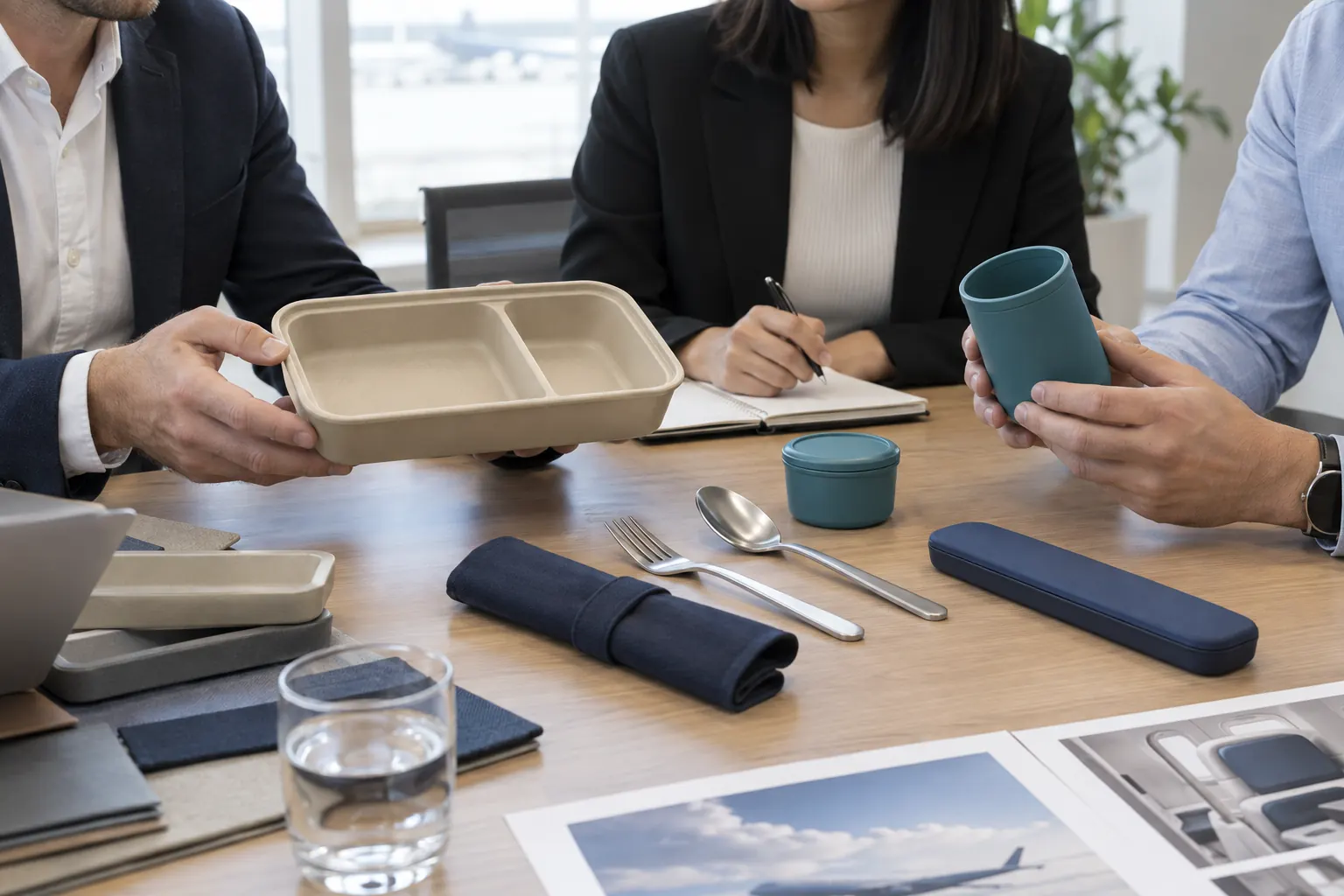
How should operators specify reusable rail meal kits?
Specify reusable rail meal kits as a controlled service system, not as a loose list of tableware. Lock the passenger use case, menu format, tray envelope, component sequence, carry or return method, cleaning process, material evidence, branding and approval stages before suppliers quote. Test the approved physical set on the actual seat tables and service carts, and label every unverified dimension or performance condition as subject to project confirmation.
Passenger meal equipment joins food-contact components, restricted service space, handling routines and brand presentation. A set that looks compact in a catalog can fail operationally if a cup blocks the tray, utensils move during service, the case cannot be reopened efficiently or the cleaning route does not match the chosen materials. Quotations also become misleading when suppliers assume different component counts or packing formats.
Reusable rail meal kits reduce disposable-item dependence only when the complete operating loop is practical. Procurement teams need to connect product geometry with loading, service, collection, washing, drying, inspection and redistribution. This guide provides a neutral framework for comparing proposals without inventing capacities, durability claims or regulatory conclusions before samples and evidence are reviewed.
Start Reusable Rail Meal Kits With the Service Brief
The first input is the service model. Record whether the kit supports a reserved-seat meal, sleeper service, premium carriage, charter route, crew meal or retail food offer. Define who sets the menu, where food is loaded, how long the set remains in service and where used components are collected. Different routes create different priorities for compactness, access, presentation and return handling.
Separate passenger requirements from operator requirements. Passengers need comfortable access and an understandable sequence. Catering teams need a repeatable assembly order. Train crews need safe movement through aisles and predictable collection. Cleaning teams need component identification, disassembly guidance and a documented inspection reference. A single written brief keeps these needs visible during sourcing.
Assign an owner to every decision
Commercial teams may own service level and presentation. Catering teams approve menu compatibility. Fleet or operations teams confirm seat-table and cart constraints. Quality teams review food-contact evidence and inspection criteria. Brand teams approve colors and decoration. Record the owner, approval sample and revision date for each decision so a late branding or packaging change does not silently alter the packed system.
| Input | Buyer question | Controlled output |
|---|---|---|
| Route | Where and how is the set served? | Service scenario |
| Menu | Which foods and drinks are included? | Component brief |
| Space | Which tables, carts and racks are used? | Dimensional envelope |
| Return | How are used pieces collected? | Return sequence |
| Market | Which rules and evidence apply? | Document list |
Choose Essential Standard or Expanded Configurations
Reusable rail meal kits should have a stable core and clearly controlled options. An essential route may combine a low-profile meal tray and protected cutlery. A standard route may add a cup and sauce pot when the menu needs them. An expanded route may add a roll-up sleeve, fitted case or presentation packaging for premium or charter service. The best configuration is the smallest set that supports the defined service without creating hidden handling steps.
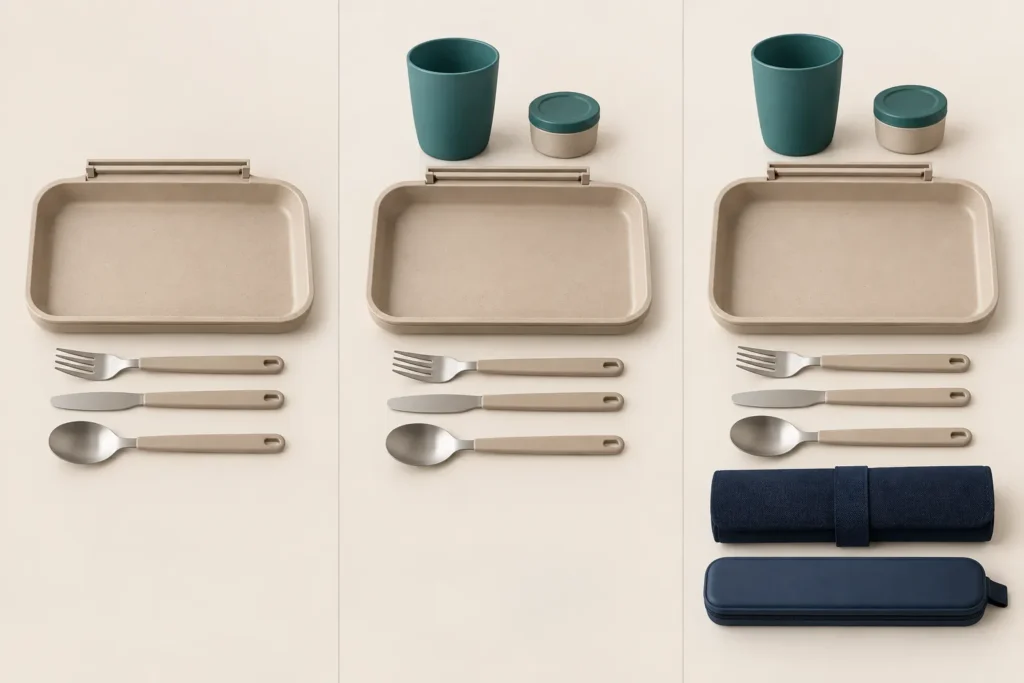
Do not compare suppliers only by piece count. Ask each supplier to identify required, optional and replaceable components; the proposed material and construction of each piece; the packed arrangement; and every field awaiting confirmation. When a component is removed, confirm whether the tray balance, case insert, carton quantity or washing rack also changes.
Control variants with codes
Give every approved combination a configuration code and revision. Tie the code to the bill of materials, approved sample, packing photograph, artwork and inspection checklist. This prevents an apparently minor substitution—such as a different cup or utensil sleeve—from becoming an undocumented production variant.
The companion Compact Rail Meal Service Set demonstrates a low-profile sand-beige PP tray, teal accessories, stainless-steel cutlery and a fitted navy case as one development direction. It is a concept for buyer discussion, so final sizes, compatibility, performance, MOQ and lead time remain subject to drawings and approved samples.
Validate Seat-Table Cart and Rack Fit Together
Geometry must be reviewed as a system. Record dimensions for every component, the closed tray, the packed case and the shipping pack. Then compare those measurements with the smallest relevant seat table, cart shelf, storage rack and collection container. Include handle, zipper and lid clearance rather than checking length and width alone.
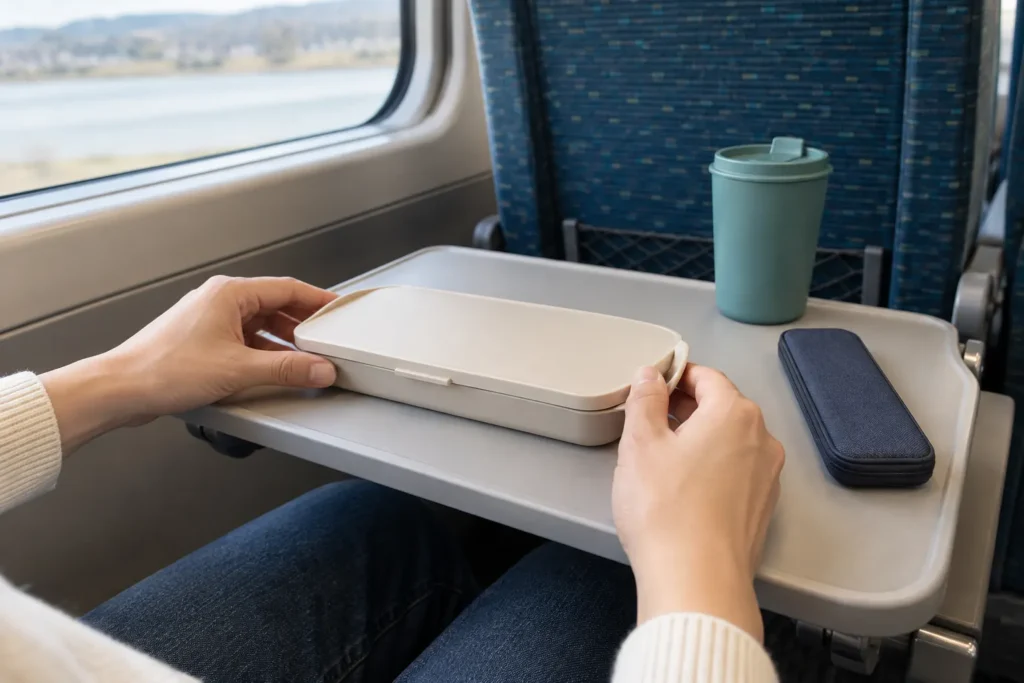
A practical seat-table trial places the approved sample in the passenger’s real access zone, opens it in the intended sequence and checks whether the cup, utensils and packaging still have defined positions. Repeat the check on each seat-table type in scope. Compatibility should be confirmed by project sample and drawing; a concept image is not evidence of fit.
Use a repeatable fit review
- Measure and photograph the approved components.
- Place the closed set on the limiting table type.
- Open and arrange components in the service order.
- Check access, clearance, stability and collection.
- Pack the set into the cart, rack and return container.
- Record the accepted arrangement in the specification.
Design Cleaning Drying and Turnaround Before Production
A reusable program depends on the return loop. Define where components are separated, how food residue is handled, which washing and drying equipment is used, how pieces are inspected and how incomplete sets are quarantined. The supplier should receive the relevant operating conditions without being asked to guarantee an undefined cleaning process.
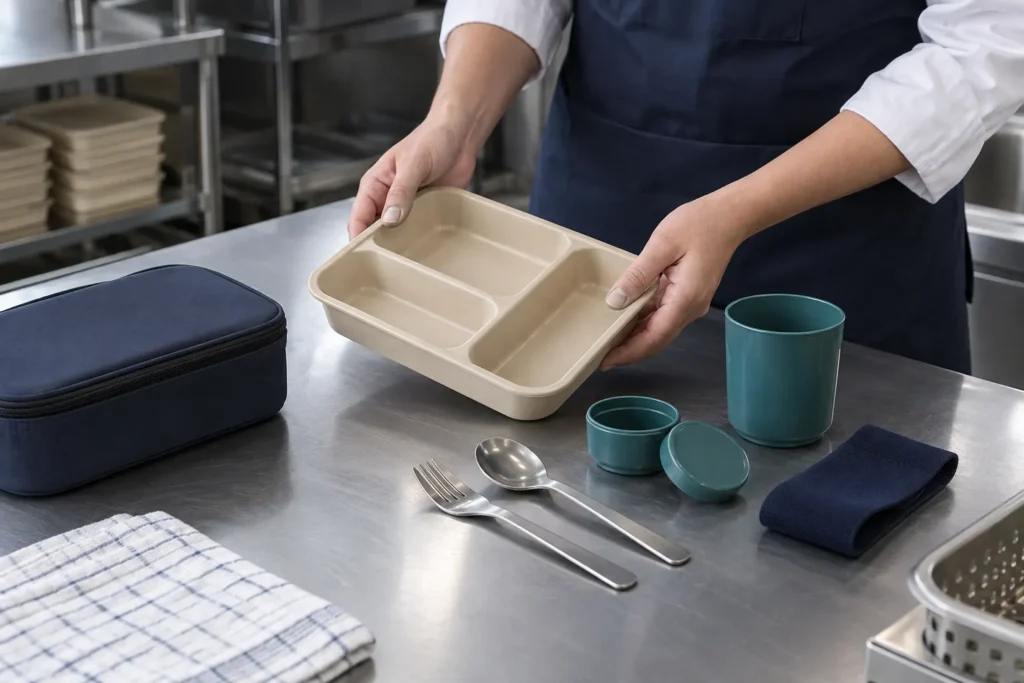
Color and shape can help teams distinguish parts during sorting, but identification should not depend on color alone. Consider molded part codes or controlled markings where traceability is required. The final marking method must remain readable after the approved cleaning cycle and should be verified on production-representative samples.
Textile sleeves and cases may follow a different cleaning route from food-contact components. Decide whether they travel with each service cycle, are issued separately or are used only for presentation. Moisture retention, drying time and replacement handling should be reviewed before the case is added to the final bill of materials.
Map Materials and Evidence to the Exact SKU
Material selection starts with intended use and process conditions. Food-grade PP may be considered for a lightweight molded tray and coordinated accessories; stainless steel may be selected for reusable cutlery; and textile materials may form the sleeve or case. Exact grades, colors, additives, thicknesses and constructions must be confirmed for the project.
For United States programs, review the FDA overview of food-contact substances. For European Union programs, review the European Commission framework for food-contact materials. These sources define frameworks; they do not certify this concept, supplier or finished set.
Request documents that identify the tested material or finished article, applicable standard, test conditions, result, laboratory and report date. Match the evidence to the selected color, construction and destination market. Use the internal Food-Grade PP, Stainless Steel and food-contact testing guide as planning references.
Approve Logo Color and Packaging on the Complete Set
Branding behaves differently on molded PP, stainless steel, textile and paper. Define the logo method and artwork area for each surface. Pantone references guide color development but do not replace physical approval because resin, texture, coating, textile weave and paper can display a target color differently.
Review the full passenger presentation sequence: outer shipping pack, service pack, case or sleeve, tray, accessories and return handling. Decide which layer carries required information and which carries the primary brand message. Trial packaging with the final component arrangement because inserts and sleeves change external dimensions and loading efficiency.
Compare Suppliers Against One Written Specification
Issue the same request for quotation to each supplier. Separate confirmed requirements from supplier proposals and require exceptions to be listed directly. A useful response identifies the component list, provisional dimensions, material route, decoration, packaging, testing scope, sample stages, tooling assumptions, MOQ and lead time.
| Comparison field | Required response | Risk if missing |
|---|---|---|
| Configuration | Included and optional pieces | Non-comparable quotes |
| Fit | Sample-verified dimensions | Table or cart conflict |
| Materials | Material by component | Unsupported assumptions |
| Turnaround | Cleaning and inspection inputs | Operational mismatch |
| Commercial | MOQ and timing by route | Budget or schedule change |
B2B Buyer Checklist
- Service route, passenger and menu are documented.
- Essential and optional components are separated.
- Seat-table, cart, rack and return-container limits are recorded.
- The real approved set has been opened, served, collected and repacked.
- Materials and evidence match the selected SKU and market.
- Cleaning, drying and incomplete-set handling are defined.
- Artwork and physical colors are approved on every material.
- The accepted sample is tied to written inspection criteria.
Reusable Rail Meal Kits FAQ
What should the specification include?
Define the route, passenger, menu, tray envelope, components, packing order, cleaning system, evidence, branding, return flow and approval stages.
How is seat-table compatibility confirmed?
Use approved physical samples on the actual table types and record placement, access, stability, clearance and repacking.
Can one platform support several service levels?
Yes, when every configuration is controlled with its own bill of materials, packing instruction and evidence scope.
Which compliance records are needed?
Request records applicable to the exact SKU, intended use and destination market; define the final list with the buyer’s compliance team.
When are MOQ and lead time confirmed?
After components, colors, decoration, packaging, testing, quantity and assembly route are defined.
Turn the Concept Into a Controlled Service Trial
Share the route, passenger profile, menu, component priorities, space constraints, cleaning process, quantity, markets, branding and schedule. Naike Tableware can compare existing-component and development routes, identify unconfirmed fields and prepare the next sample review.