
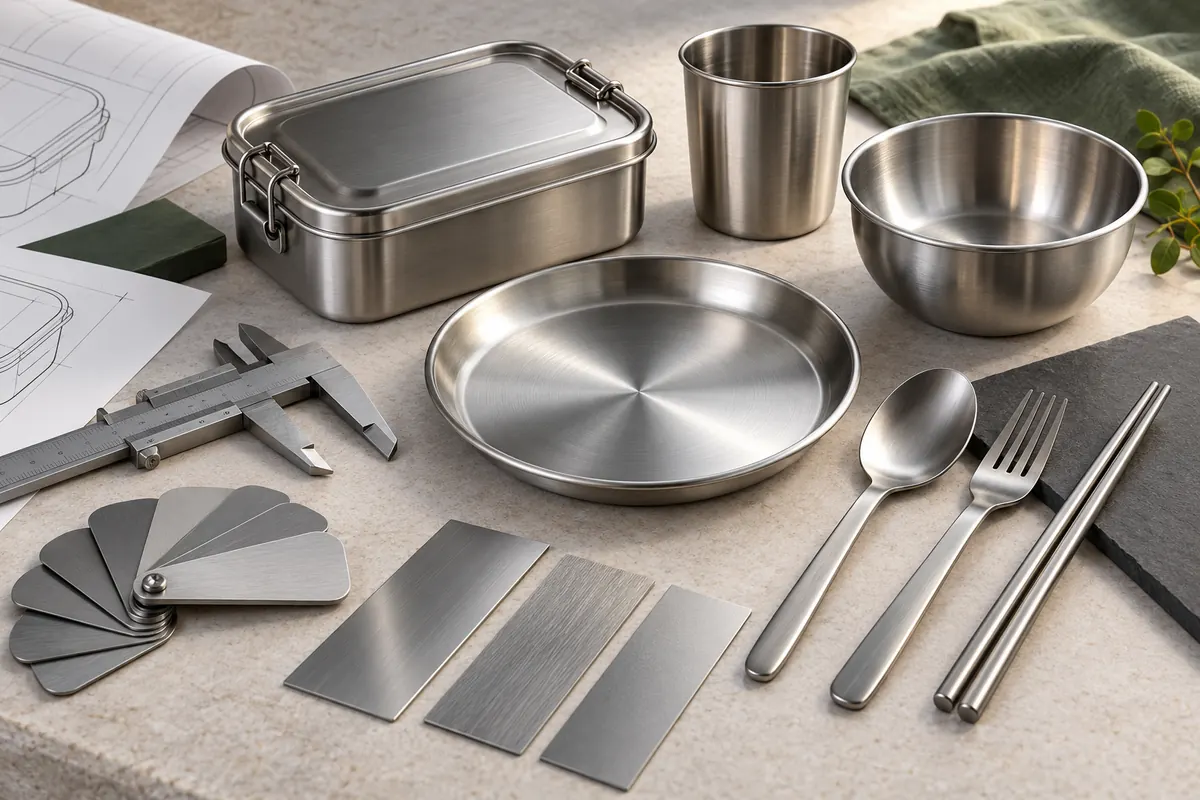
Specify the metal, geometry and finish as one product
A stainless steel tableware specification should identify the exact component, material grade or controlled material code, construction, finished wall and rim geometry, edge treatment, surface-finish direction, welded or joined areas, dimensional checks, food-contact use, packaging protection and approved sample. Thickness alone cannot predict stiffness, user comfort, cleanability or production consistency because forming, curves, seams and local reinforcement change the result.
Stainless steel tableware can look simple in a catalog: a bowl, plate, cup, lunch-box insert or cutlery set with a bright or brushed surface. For a buyer, the real product is a network of decisions about material identity, formed geometry, rim construction, finish, joints, fit and packaging. Leaving those decisions to a photo creates quotations that are difficult to compare and samples that are difficult to approve.
From the factory side, asking only for “food-grade stainless steel” and one thickness value is not a complete brief. The same nominal sheet can behave differently after drawing, rolling, welding or polishing, and the finished part can vary by location. A useful specification names what is measured, where it is measured and what functional result the buyer expects.
This guide is written for importers, private-label brands, retailers and distributors buying portable meal systems and reusable tableware. It does not publish one universal grade, thickness, edge radius, finish roughness or corrosion result because these must be selected and verified for the exact SKU, use, manufacturing route and destination market.
Start with the meal, user and carry scenario
Define whether the component is a dry-food plate, a deep bowl, a drinking cup, an inner tray, a lunch-box shell or eating utensil. Each format places stress in different areas and presents different edges to the user. A nested travel set also needs stack clearance and abrasion control that a single tabletop bowl may not need.
State the intended food type, contact duration, likely temperature state, cleaning method and transport pattern. A buyer should separate routine use from optional claims such as direct heating, freezer storage or dishwasher compatibility. Put each proposed claim into the approval plan rather than allowing a material name to imply performance.
Map who touches every edge. A spoon bowl, fork tine, cup lip, lunch-box rim and hidden rolled seam have different user-contact and cleaning roles. Parts that never touch the mouth can still trap residue or damage adjacent components if their edges are not controlled.
Record the destination market and the party responsible for regulatory review. Food-contact evidence must match the actual alloy or material code, product, finish, intended use and market. The supplier can assemble a document package, while the importer or brand should confirm that its scope supports the marketed SKU.
Control stainless steel identity before discussing polish
“Stainless steel” describes a family, not one interchangeable material. The purchase specification should name the agreed grade designation or supplier-controlled material code and identify the standard system used. If different components use different materials, the bill of materials should show that clearly instead of applying one grade statement to the whole set.
Ask how the material is traced from incoming coil, sheet, tube or purchased component to the finished production lot. A useful record connects supplier documentation, internal lot identification and the product order. The traceability route should survive subcontracted polishing or component assembly where those steps are part of the approved supply chain.
Do not select a grade solely by repeating a popular market phrase. Review food contact, forming needs, corrosion environment, finish expectations, magnetic behavior if commercially relevant, cost and supply availability together. Any grade claim printed on packaging should match the controlled purchase record.
What a stainless steel tableware specification must identify
Name the component, drawing revision, material designation, construction type and manufacturing route. Include any non-steel parts, coatings, solder, adhesive, seal or plastic accessory in a component map. Evidence for a steel body does not automatically cover every joined material.
Define the approved material documents and change triggers. A material source, grade, finish route or production site change may require document review, samples or testing. The purchase order should not permit silent substitution simply because two materials have a similar appearance.
Specify thickness by location and finished condition
A single nominal sheet value can be useful for quotation, but it does not fully describe a drawn product. Forming can redistribute material, particularly around walls, corners and transitions. Buyers should distinguish incoming stock thickness from finished-part measurements and specify locations that matter to function.
Use the drawing to mark measurement zones. A flat base, sidewall, radius, rolled rim and welded feature may not be measured in the same way. Agree the instrument, access and reporting method before turning a thickness number into an acceptance criterion.
Stiffness depends on geometry as well as gauge. Ribs, beads, curves, folds, double-wall construction and local reinforcements can change resistance to flex. Compare complete samples under the intended handling condition rather than assuming that a heavier number always produces a better user experience.
Weight is a useful cross-check, not a substitute for dimensional control. A stable component weight range may help reveal material or forming changes, but it can also be affected by handles, seams and accessories. Tie weight to the approved construction and component list.
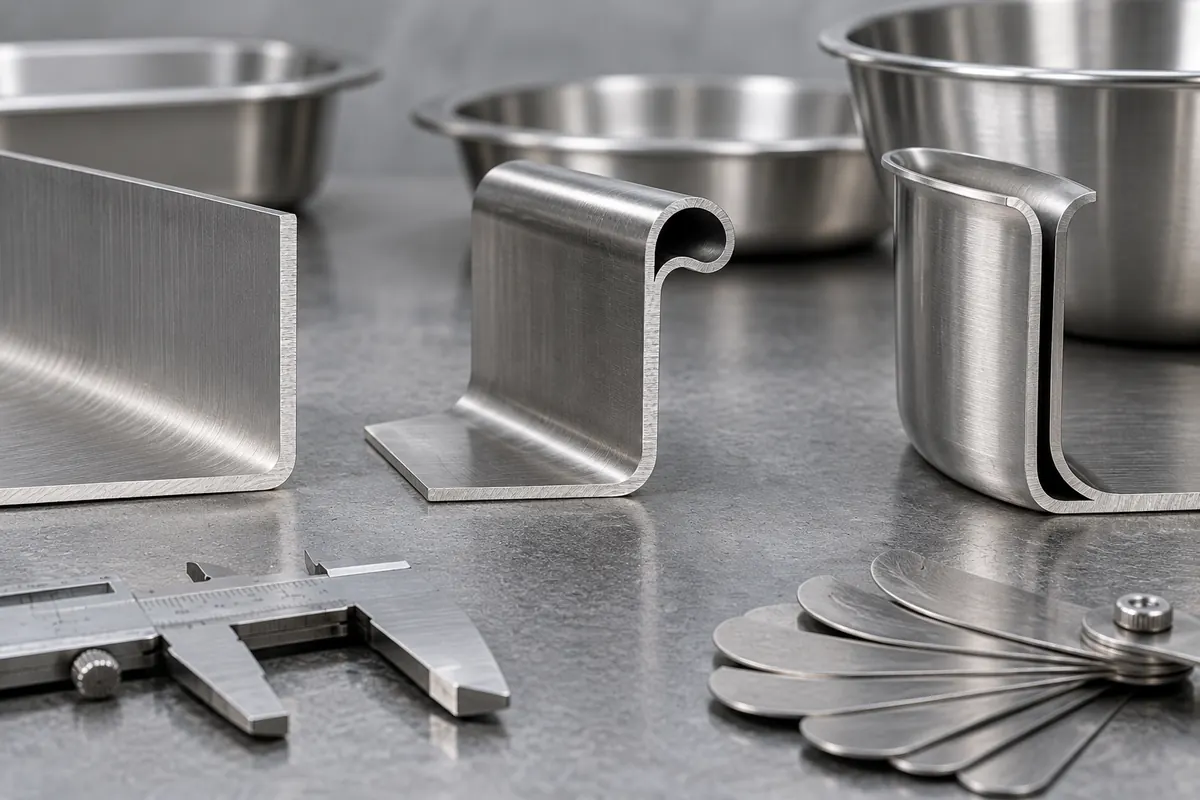
Design rims and edges around touch, cleaning and forming
An acceptable rim is more than “not sharp.” The buyer should define the construction, contact surfaces, smoothness, continuity, opening or closing of the roll and the relationship to lids or seals. A comfortable cup lip has a different design objective from a lunch-box rim that locates a gasket.
Cutlery needs its own edge map. Spoon bowls and handles should feel smooth, while fork tines need controlled tips and spaces that can be cleaned. A knife or spreading utensil may require a functional working edge, so blanket language can conflict with intended use.
Rolled edges can improve stiffness and user contact, but the roll geometry introduces a transition and potentially a concealed area. Buyers should review whether the construction is open, closed or otherwise finished, how it is cleaned, and how continuity is inspected. Do not assume every rolled rim is equivalent.
Inspect corners and trimmed openings closely. Formed corners can wrinkle or thin, and pierced features can leave burrs if the finishing route is not controlled. The drawing and golden sample should show which edges are exposed after final assembly.
Approve finish direction, gloss and transition zones
Terms such as brushed, satin, matte and mirror can be interpreted differently across suppliers. Define the approved physical sample, grain direction, target visual family and critical viewing surfaces. A photograph is useful for context but cannot replace a sample under consistent light.
Directional finishes need orientation control. Grain that runs vertically on one cup and horizontally on another can make a retail set look mismatched even when both surfaces are technically brushed. Mark direction on the drawing or appearance specification.
Polishing can soften edges, reveal waves or create different gloss around corners and welds. Buyers should identify which transitions are acceptable and which surfaces remain hidden after assembly. Do not require an unrealistic cosmetic standard in non-visible areas unless it serves cleaning or function.
Mirror surfaces show reflections and handling marks more readily, while textured or brushed finishes can reveal scratches in different ways. Packaging protection should be chosen after the final finish is approved. A protective film may help during processing, but its removal, adhesive residue and timing need control.

| Construction or finish choice | Potential buyer value | Questions to resolve | Approval focus |
|---|---|---|---|
| Single-wall formed vessel | Simple component structure and lower packed mass potential | Local thinning, stiffness, heat transfer, rim design and dent sensitivity | Finished thickness zones, geometry, handling and edge continuity |
| Double-wall vessel | Different handling and thermal experience depending on design | Seam route, trapped space, weight, nesting and whether the construction is sealed | Joint integrity, dimensions, cleaning surfaces and complete-sample use |
| Rolled rim | Stiffness and a smoother contact profile when properly executed | Open or closed geometry, consistency, cleaning access and lid interface | Cross-section, continuity, burr control and fit |
| Directional brushed finish | Controlled visual texture and reduced mirror reflection | Grain direction, transition zones, lot consistency and scratch visibility | Retained appearance sample under agreed light |
| Mirror-polished finish | High-reflection premium appearance for some programs | Handling marks, waves, polishing access and packaging protection | Visible-surface limits and pack-out protection |
Review welds, seams and attachments as food-use interfaces
Handles, dividers, bases and multi-wall assemblies may introduce welds, mechanical seams or other joints. The specification should identify the joining route and which surfaces are exposed to food, washing or user touch. A strong attachment can still be unacceptable if its transition is difficult to clean or visually inconsistent.
Review weld size and location against distortion and finish restoration. Polishing can blend a joint, but it should not hide incomplete work or create excessive local thinning. Functional checks should reflect how the handle or component is used rather than relying only on appearance.
Ask how crevices, pits, spatter and discoloration are controlled in relevant areas. Acceptance photographs can support inspection, while tactile checks and suitable lighting help reveal issues that a front-facing catalog image misses. Critical hidden areas may need a sample section or process record during development.

Build approval from coupons to assembled production samples
Begin with material and finish coupons when several options are under review. Coupons make side-by-side comparison efficient, but they do not reproduce drawing, curved surfaces, weld restoration or edge formation. Treat them as direction approval, not final product release.
Next review a formed component from the intended tooling or route. Check dimensions, local thickness zones, flatness, rim geometry, finish direction and stack behavior. If the item pairs with a lid, seal or carry case, approve the complete interface.
The assembled sample should carry a revision code and approved bill of materials. Record photographs, measurements, appearance limits, packaging condition and open actions. The tableware sample approval process explains how to distinguish reference, approval and golden samples.
Production release should use samples from the intended material source, tooling and finish route. If a pilot or pre-production run is used, state which checks move into routine inspection. A beautiful one-off sample is not enough unless its controls can be repeated.
B2B buyer checklist for stainless steel tableware
| Check | Question | Why It Matters |
|---|---|---|
| Component map | Which parts are stainless steel, and which use seals, coatings or other materials? | Prevents one material declaration from being applied to the complete set. |
| Material identity | What grade or controlled code and standard system are specified? | Creates a traceable basis for quotation, evidence and repeat orders. |
| Construction | Is each vessel single wall, double wall, assembled or formed from one piece? | Construction changes weight, seams, nesting and approval checks. |
| Thickness zones | Where is incoming and finished thickness measured? | Forming can redistribute metal, so one nominal value is incomplete. |
| Rim profile | How is the lip or rim formed, closed and inspected? | Rim geometry affects touch, cleaning, stiffness and lid fit. |
| Exposed edges | Which trimmed, pierced and utensil edges require tactile review? | Drawings can miss the final user-contact condition. |
| Finish sample | What physical sample defines gloss, grain and direction? | Finish names and photos are interpreted inconsistently. |
| Joints | Where are welds, seams and attachments, and how are they finished? | Joint transitions affect strength, appearance and cleanability. |
| Fit | Does the steel part mate with a lid, gasket, divider or carry system? | The complete interface must be approved under one revision. |
| Evidence | Do documents trace to the selected material, component and use? | Generic paperwork may not support the purchased SKU. |
| Pack protection | How are polished surfaces separated during transit? | Approved finishes can be damaged by nesting or loose components. |
| Change control | Which material, tooling, finish or site changes require reapproval? | Protects repeat-order consistency. |
Recognize incomplete quotations before comparing price
A quotation is incomplete when it lists a stainless steel product without naming material identity, construction, finish and included components. Two suppliers may appear to quote the same bowl while pricing different gauges, rims, polishing levels or packaging protection. Normalize the specification before comparing unit price.
Be cautious when one thickness value is presented as proof of quality. Ask where it applies and how the finished part is checked. Also question a finish described only by a marketing adjective without a physical reference.
Avoid accepting food-contact evidence solely because the title contains “stainless steel.” Match the sample description and material to the purchased product and intended use. The site’s stainless steel material page provides a starting point, while project documents must be reviewed for the selected SKU.
Finally, confirm packaging before locking the appearance standard. Mirror and directional finishes can be damaged by uncontrolled nesting, loose cutlery or abrasive separators. The finished set, not an isolated component, is the commercial product.
Frequently asked B2B questions about stainless steel specifications
Is thicker stainless steel always better for tableware?
No. Thickness influences mass and stiffness, but geometry, forming, folds, ribs and construction also matter. Select a finished performance and user experience, then specify relevant measurement zones.
Which stainless steel grade should a buyer request?
There is no universal answer for every component and market. Review intended food contact, forming, corrosion environment, finish, supply and destination requirements, then record the selected designation or controlled code in the purchase specification.
How should a buyer approve a brushed finish?
Approve a physical sample with grain direction, visible-surface limits and viewing conditions recorded. Keep it with photographs and the product revision so production teams can compare future lots consistently.
What should be checked on a rolled rim?
Review cross-section, continuity, exposed edges, cleaning access, user contact and any lid or seal interface. The final closed product should be inspected, not only a drawing of the roll.
Can a material certificate replace finished-product inspection?
No. Material documentation supports identity and scope, while finished inspection covers forming, dimensions, edges, finish, joints, fit and packaging condition. Both belong in a controlled approval file.
Conclusion: release one stainless steel tableware specification
A complete stainless steel tableware specification connects material identity, construction, finished thickness zones, rim and edge geometry, finish direction, joints, fit, evidence, packaging and change control. This lets buyers compare quotations fairly and gives the factory a repeatable basis for sampling and production.
Send the product format, destination market, intended use, material preference, dimensions, finish direction, quantity and packaging target for review. Naike Tableware can then identify which items use existing configurations and which technical details must be confirmed for the selected SKU.