

Verify the formulation, finished SKU and claim together
Wheat straw tableware verification should connect a named material formulation to the exact molded product, color, intended food-contact use, destination market and approved commercial claim. A buyer should review traceability, supplier declarations, relevant test scope, physical samples and production controls together; visible plant speckles alone cannot identify the formulation or prove safety, durability, recycled content, biodegradability or compliance.
Wheat-straw composite tableware is often selected because buyers want a natural-looking surface and a plant-fiber story. The procurement risk begins when appearance is treated as proof: beige color, visible flecks and the words “wheat straw” do not tell a buyer what polymer matrix, additives, pigments or fiber treatment are present.
From the factory side, the usable question is not whether a sample looks sustainable. It is whether the formulation can be identified, reproduced and linked to the finished SKU, intended food contact, use conditions, destination market and wording planned for packaging. This guide gives importers, brands, wholesalers and retailers a practical route for making that decision.
Naike Tableware publicly describes wheat-straw composite as a material option for lightweight reusable sets with a natural appearance. Project-specific composition, testing, color, molding route and commercial claims still need to be confirmed against the selected SKU; this article does not publish a universal fiber percentage, temperature limit, lifespan or compliance result.
Define what “wheat-straw composite” means for this SKU
A composite combines more than one material phase. In tableware described as wheat-straw composite, plant-derived filler may be combined with a polymer matrix plus colorants, processing aids or other ingredients selected for molding and end use. The exact system matters because the matrix and additives influence the article just as much as the visible fiber.
Begin with a plain-language formulation description that the supplier is permitted to disclose. It should identify the base resin family, plant-fiber source, controlled formulation or compound code, color route and any functional additives that affect the buyer’s use or claims. Confidential percentages can be handled under appropriate commercial controls, but confidentiality is not a reason to leave the material identity undefined.
Distinguish raw agricultural material from processed filler. Fiber may be cleaned, ground, screened, dried or treated before compounding, and those steps can influence consistency, odor, moisture behavior and appearance. A purchasing brief should ask how the supplied compound is identified and controlled rather than assuming loose straw enters the molding machine unchanged.
A wheat straw tableware verification brief needs boundaries
Name the products covered: plate, bowl, cup, cutlery, lunch-box shell or another component. A set can contain multiple materials, so one composite declaration should not automatically be extended to a silicone seal, clear lid, metal insert, coating, ink or adhesive. Build a component-level bill of materials before describing the complete set.
Record intended foods and use conditions without stretching them into unsupported performance promises. Contact duration, food type, temperature state, cleaning method and whether the article is intended for repeated use can change the evidence needed. If microwave, dishwasher, hot-fill or freezer language is planned, place each claim in the approval matrix and verify it for the exact finished construction.
Identify the destination market and responsible importer or brand reviewer. Food-contact expectations and permitted claims are market-specific, while terms such as biodegradable, compostable, recycled or plastic-free can trigger separate substantiation questions. A formulation acceptable for one project should not be copied into another market brief without review.
Turn every visible claim into a verification question
Packaging teams often receive a material name before technical review is finished. That sequence creates risk because short claims are easy to print but hard to qualify later. Build a claim map early, showing the proposed wording, the component it describes, the evidence owner and the condition or limitation that must remain visible.
“Contains wheat-straw fiber” is different from “made from wheat straw.” The first can describe one constituent when supported by the formulation record; the second may imply that the product is mainly or entirely plant material. Buyers should ask how a reasonable customer is likely to understand the phrase, not only whether the wording sounds attractive.
Do not infer biodegradability or compostability from plant content. A reusable molded composite may include a conventional polymer matrix, and the behavior of the complete article cannot be predicted from the fiber alone. Any end-of-life claim needs its own defined standard, conditions, scope and evidence, plus wording that does not confuse industrial processes with home disposal.
“Plastic-free” is particularly sensitive when a polymer matrix or plastic component is present. Likewise, “natural,” “eco-friendly” and “green” are broad terms unless the buyer defines what measurable attribute they refer to. The safer factory workflow is to freeze the actual formulation first and allow the brand’s legal or compliance reviewer to approve precise wording afterward.
| Proposed claim or signal | What it does not prove | Buyer verification route | Release decision |
|---|---|---|---|
| Visible beige fiber speckles | Fiber identity, percentage, food-contact status or batch consistency | Link approved plaque and SKU to a controlled compound code and supplier record | Approve appearance separately from composition |
| “Contains wheat-straw fiber” | That the whole article is plant based, plastic free or compostable | Review formulation evidence and limit wording to the covered component | Release only the substantiated statement |
| “Reusable” | A universal number of cycles or compatibility with every cleaning method | Define intended reuse scenario, care method and product-specific checks | Approve instructions and claim together |
| “Food grade” | Automatic compliance in every market or for every use condition | Map formulation, component, food type, contact condition and destination requirements | Accept only evidence tied to the actual SKU |
| “Biodegradable” or “compostable” | Performance in home compost, landfill or the open environment | Require a defined standard, complete-article scope, test conditions and qualified wording | Remove the claim when substantiation is incomplete |
This comparison prevents a common sourcing error: using one document to support several unrelated claims. A food-contact document addresses a different question from fiber content, and neither automatically proves durability or end-of-life behavior. Keep each claim connected to its own evidence and approval owner.
Build a controlled formulation and traceability record
The buyer does not need a public recipe, but the project needs an unambiguous identity. Ask for a formulation or compound code that can appear on the quotation, sample record, purchase order, inspection plan and change-control notice. If the code changes, the supplier should explain what changed and which approvals must be repeated.
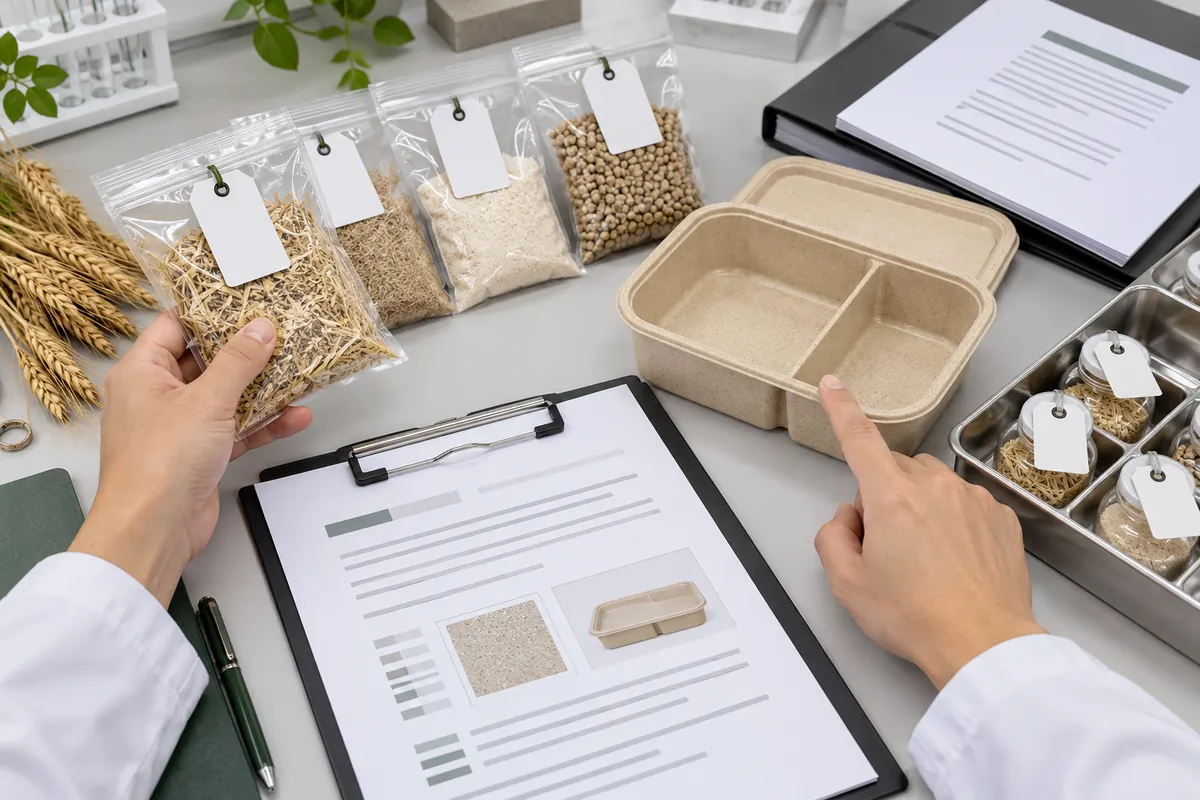
Record the material manufacturer or compounder, grade or internal code, production location when relevant, color masterbatch reference and applicable lot identifiers. Where the plant filler is a controlled input, define how its source and preparation are tracked. The objective is to connect the incoming material to the molded article without disclosing sensitive commercial information on consumer packaging.
Moisture and particle variation can affect molding behavior and surface appearance. Buyers should ask which incoming checks and storage controls are relevant to the selected compound, while avoiding arbitrary numeric limits copied from another resin or supplier. The factory and material provider should agree on workable controls for the actual formulation.
Color approval deserves its own standard. Natural filler can produce visual variation, but “natural variation” should not become an unlimited tolerance. Approve physical color and texture samples under defined viewing conditions, identify acceptable variation and clarify whether different components in one retail set must match or intentionally coordinate.
Change control should cover more than the headline fiber. A new resin grade, pigment, additive, compounder, fiber treatment or processing location may affect evidence and finished performance. The purchase agreement should identify which changes require advance notice, new samples, document review or re-testing.
Compare material plaques and finished products for different reasons
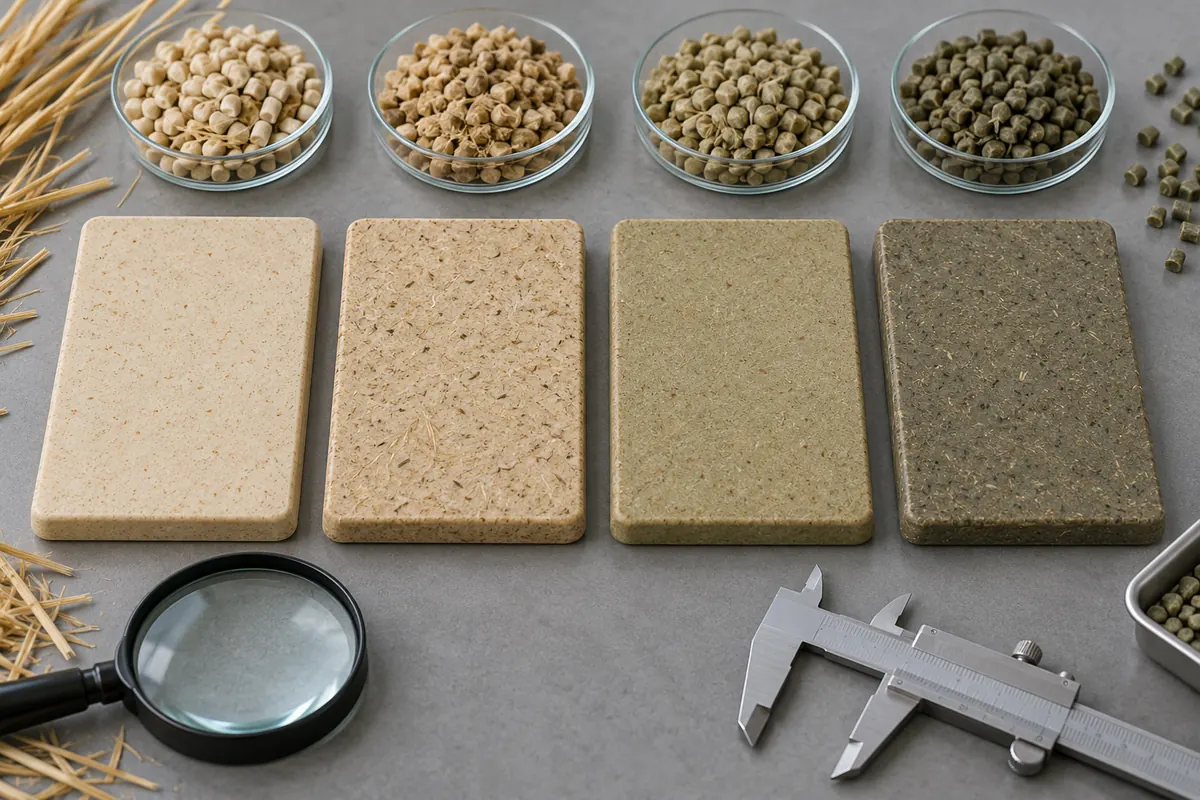
A flat material plaque helps buyers compare color, speckle distribution, surface feel and basic molding appearance. It is efficient for early screening, but it does not reproduce the flow path, wall thickness, corners, ribs, hinge areas or fit interfaces of a finished tableware product. Approving a plaque is therefore a material-direction decision, not final SKU approval.
The finished sample shows how the selected formulation behaves in the real geometry. Review fill, flow marks, fiber concentration, edge detail, flatness, stacking, dimensional fit and any moving or sealing interfaces. A shallow plate and a deep lunch-box body may reveal different issues even when molded from the same compound.
Compare samples from the intended tooling and process route whenever possible. A hand sample, machined model or small prototype can confirm size and use, but it may not reproduce production texture or fiber distribution. Label the sample route so commercial teams do not treat a visual model as production evidence.
Use a wheat straw tableware verification sample ladder
Start with a controlled color-and-texture plaque, then review an initial molded component, an assembled set and a packaging sample. At each stage, record the material code, tool or product revision, color reference, date and disposition. This ladder narrows decisions progressively and makes later troubleshooting more efficient.
Retain an approved reference sample under conditions that reduce fading, contamination or loss. A golden sample should not stand alone; pair it with photographs, drawing revisions and written acceptance points. When appearance is intentionally variable, include representative upper and lower boundaries rather than one unusually perfect part.
Do not approve odor by opening one freshly delivered carton and making a quick judgment. Define when the product is assessed, how it is conditioned, whether packaging contributes an odor and what escalation occurs if the result is inconsistent. Sensory checks are project controls, not substitutes for regulatory review or analytical testing.
Match food-contact evidence to the actual article and market
For the United States, the FDA explains that food-contact substances are reviewed according to their intended use and provides resources for determining regulatory status. Buyers should use the official food-contact substance framework with qualified advice where needed; a generic “FDA approved” statement is not a substitute for identifying the substance, conditions of use and regulatory basis.
For the European Union, Regulation (EC) No 1935/2004 establishes the general framework for food-contact materials. The European Commission’s food-contact materials legislation overview also explains that specific EU measures apply to some material groups and national provisions may remain relevant where specific measures do not exist. Review the complete composite and finished article against current requirements for the destination market.
Ask whether each report covers the selected formulation, color, component, food simulant or food type, contact time, temperature and repeated-use condition relevant to the brief. A report can be authentic yet out of scope for a new SKU. Record the laboratory, report number, sample description, date and conclusion without publishing confidential documents unless authorized.
Evidence for the base resin does not automatically cover the plant filler, pigment, additives or finished article. Conversely, one finished-product test does not create permanent approval for future unreported formulation changes. Build an evidence map that shows which document supports which component and claim.
Retail packaging should use only the claims approved by the buyer’s responsible reviewer. Country of sale, language, care instructions, recycling information and material naming may require additional decisions outside food-contact testing. Freeze artwork after the evidence matrix and product revision agree, not before.
Carry sample approval into repeat production
Once a formulation is approved, place its code and revision on the purchase specification. The production order should identify permitted color references, component mapping, approved sample, packaging version and required documents. Avoid purchase orders that say only “wheat straw lunch box,” because that description cannot prevent silent substitution.
Incoming material records should be retained according to the agreed traceability plan. During molding, the factory can monitor appearance and process indicators relevant to the selected material, but buyers should not demand invented universal ranges. Agree which records are shared, which remain internal and how an out-of-control condition is handled.
Finished inspection should combine visual, dimensional, fit and function checks. Speckle density may be part of appearance approval, while lid fit, stacking, edge quality and component weight belong to product control. Do not let an attractive natural surface distract from ordinary tableware requirements.
Packaging review matters because moisture, odor or abrasion can appear after products are enclosed and shipped. Evaluate the complete pack format, separators, bags or wraps, carton loading and storage assumptions. The multi-component export packaging guide helps connect product protection to the full set and shipment route.
Reapproval triggers should be written before the first order. Changes to formulation, compounder, production site, tool, pigment, component thickness, food-contact use or commercial claim can require different levels of review. A clear trigger matrix is faster than debating after goods are produced.

B2B buyer checklist for wheat-straw composite tableware
| Check | Question | Why It Matters |
|---|---|---|
| Component map | Which parts of the set use the wheat-straw composite, and which use other materials? | Prevents one material statement from being applied to unrelated seals, lids, inks or inserts. |
| Formulation identity | What controlled compound or formulation code is quoted and ordered? | Creates a repeatable reference without requiring a public recipe. |
| Matrix and filler | How are the base resin family, plant filler and relevant additives identified? | Visible fiber alone cannot define composition or regulatory status. |
| Use conditions | What foods, contact time, temperatures, cleaning and reuse scenario are intended? | Evidence and product checks must match real use rather than a generic material name. |
| Destination market | Which country or region will receive the finished SKU? | Food-contact and environmental claims need market-specific review. |
| Claim matrix | Which exact words will appear on the product page and packaging? | Prevents plant content from being expanded into unsupported plastic-free or compostable claims. |
| Sample route | Are we approving a plaque, prototype, molded component, assembled set or production sample? | Each stage answers a different procurement question. |
| Evidence scope | Does each report name or trace to the actual formulation, color, component and conditions? | An authentic but unrelated report does not control the selected SKU. |
| Appearance range | What variation in color, speckles and surface texture is acceptable? | Natural-looking variation still needs a commercial boundary. |
| Change control | Which supplier, material, color, tool or site changes require notice and reapproval? | Protects the connection between approved evidence and repeat production. |
| Production records | Which lot, inspection and release records will be retained or shared? | Supports investigation and repeat-order consistency. |
| Packaging fit | Has the complete set been reviewed after packing and handling? | Product approval is incomplete if pack-out creates odor, scuffing or deformation. |
Read warning signs before issuing the purchase order
A supplier may be offering a workable product even if every document is not available at first contact. The warning sign is not an open question; it is an answer that remains vague after the SKU, market and intended use are defined. “All wheat straw is the same” or “the color proves the fiber content” should trigger a deeper review.
Be cautious when a report has a different sample name, material code or color and no traceable explanation. Also question certificates presented as universal permissions rather than documents with scope and conditions. Ask the supplier to map the evidence to the purchase specification in writing.
Watch for claims that grow between quotation and packaging. A project can start with “natural appearance” and later become “100% natural, plastic free and biodegradable” without a formulation change or new evidence. Put the claim matrix under revision control so marketing edits cannot bypass technical approval.
Finally, do not let low sample cost justify skipping traceability. The cost of a sample is small compared with relabeling, delayed retail launch or investigating inconsistent production. A concise, controlled brief gives both buyer and factory a faster route to a defensible quotation.
Frequently asked B2B questions about wheat-straw tableware verification
Does visible plant fiber prove a product is made from wheat straw?
No. Visible particles show that a molded surface contains some type of particulate or fiber, but appearance alone cannot identify the source, percentage, treatment, polymer matrix or additives. Verify the controlled formulation and its supply record.
Can one food-contact report cover every wheat-straw composite SKU?
Not automatically. Review whether the report is traceable to the actual formulation, color, component, intended food contact, conditions and destination requirements. A new supplier, pigment, use condition or product construction may change the scope.
Is wheat-straw composite tableware plastic free?
Do not assume so. Many molded composites use a polymer matrix with plant filler, and the complete component list must be reviewed. Use “plastic free” only when the entire claim is accurately defined and substantiated for the finished product.
Should buyers specify an exact wheat-fiber percentage?
Only when the percentage is technically and commercially relevant and the measurement route is defined. A copied percentage can distort molding, appearance or performance and may be difficult to verify. Start with the use, claim and evidence requirement, then confirm a controllable formulation with the supplier.
What sample should be approved before mass production?
Approve the finished molded and assembled SKU from the intended route, not only a color plaque. Keep the formulation code, product revision, appearance limits, packaging version and evidence map with the signed approval record.
Conclusion: release a traceable wheat straw tableware verification file
A reliable wheat straw tableware verification file connects the formulation code, component map, use conditions, market, approved samples, evidence scope, claims and change-control triggers. It allows the factory to quote and reproduce the intended product while giving the buyer a clear basis for technical, compliance and packaging review.
Send the actual SKU list, destination market, food-contact scenario, color direction, proposed claims, quantity and packaging target before requesting a final route. Naike Tableware can then review the project against the selected products and identify which material, sample and documentation questions still need confirmation.