This fold-out travel dining kit is a configurable B2B concept for employee relocation, extended stays and corporate mobility programs. Original images show one consistent single-person system; they do not represent a verified production SKU, customer order, certification or performance result. Final dimensions, materials, fit, cleaning, weight, volume, tooling, MOQ, sampling and lead time are to be confirmed.
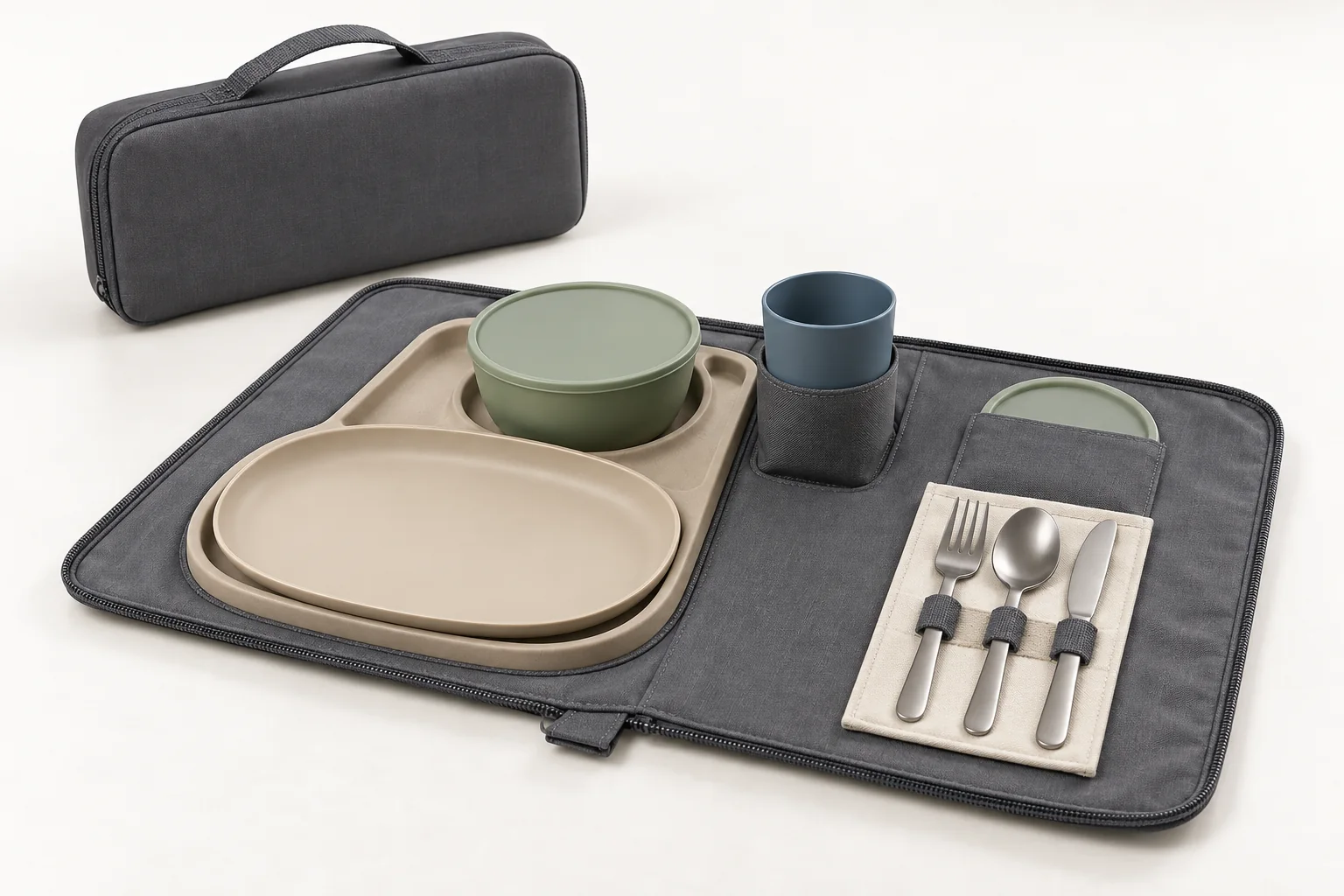
The Single-Person Fold-Out Travel Dining Kit Organizer combines one sand-beige oval PP plate, one sage-green lidded PP bowl, one smoky-blue PP tumbler, one stainless fork, spoon and blunt table knife in an off-white sleeve, and one graphite coated-textile zippered folio that opens flat as a placemat around a removable molded cradle and fitted pockets.
Fold-Out Travel Dining Kit Contents
Fold-Out Travel Dining Kit Designed For
The fold-out travel dining kit is designed for one adult traveler in employee relocation, extended-stay, serviced-apartment and corporate mobility programs. Its thin folio format keeps one controlled place setting together and provides a defined placemat surface when open.
One traveler and one controlled reusable place setting.
Relocation, extended stays, serviced apartments and onboarding packs.
Plate, lidded bowl, tumbler, three utensils, sleeve, cradle and fold-out folio.
Packed fit, component retention, cleanability and replacement control.
No universal leak, microwave, freezer, dishwasher, stain, impact, luggage or hygiene-performance claim is made. Validate the final construction against intended food, cleaning, travel and accommodation conditions.
Fold-Out Travel Dining Kit Set Configuration
The plate uses a low oval profile. The round bowl has a separate flat lid, the tumbler is straight-sided, and the three stainless utensils fit an off-white washable sleeve. A sand-beige molded cradle aligns food-contact components on one folio panel. The opposite panel provides utensil loops, tumbler and lid pockets.
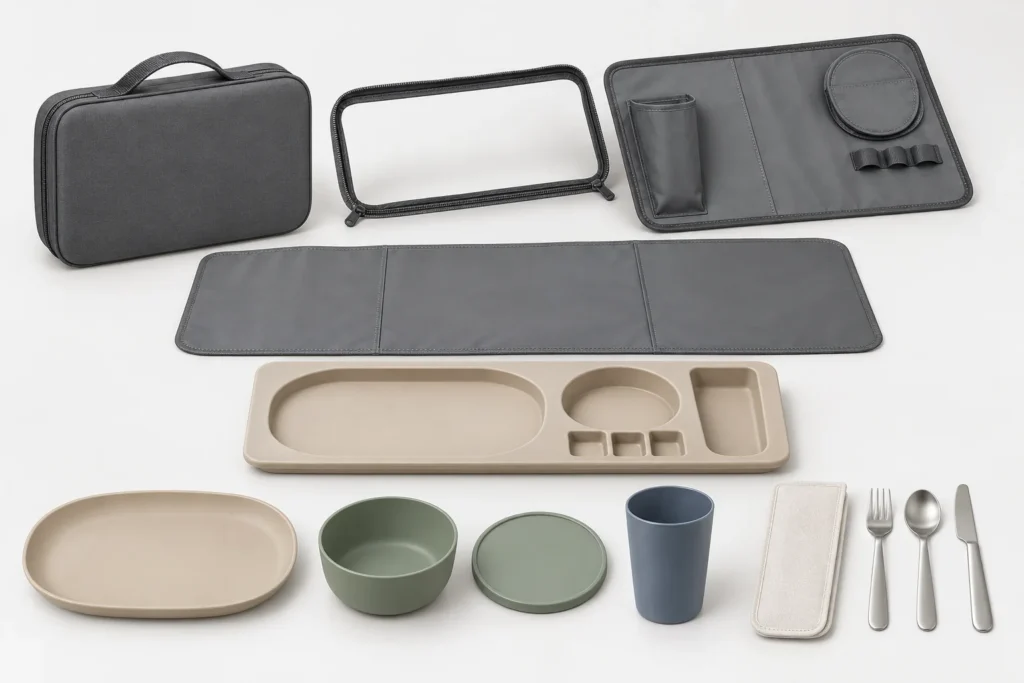
Every approved set requires a controlled bill of materials, drawing revision, color references and packing image. A change to plate rim, bowl lid, tumbler height, cradle geometry, pocket position or zipper path requires a new fit and closure review. Replacement components should match the accepted revision.
Before Packing → Packed → Carrying
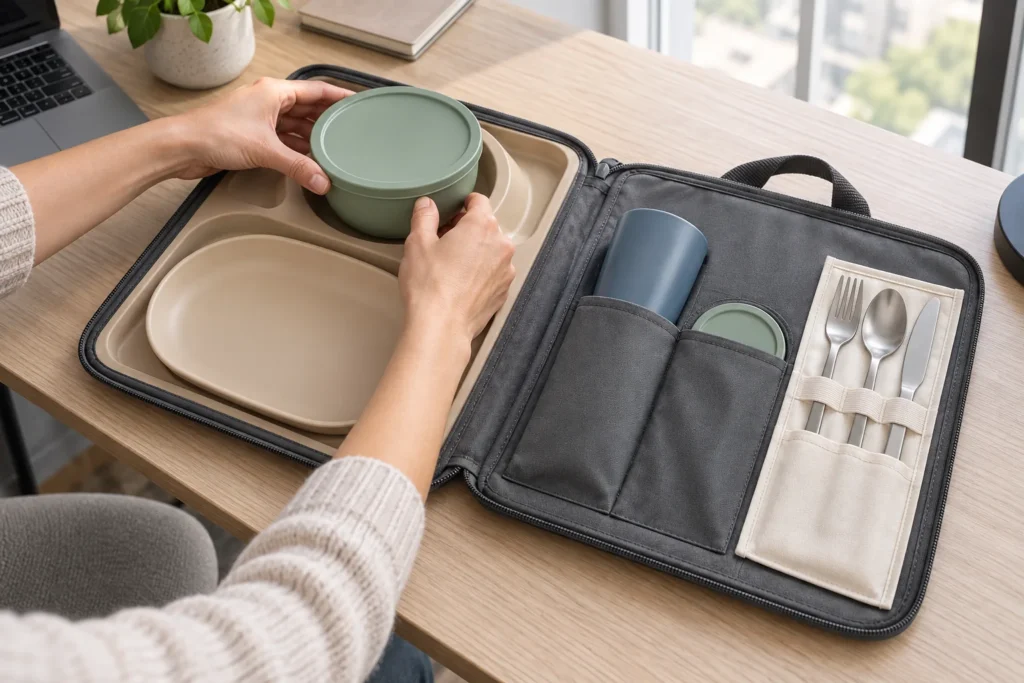
Before packing, count the plate, bowl, lid, tumbler, fork, spoon, knife, sleeve, cradle and folio. Confirm that all approved components are clean and dry. Place molded parts into their assigned cradle or pockets, secure utensils in the sleeve and loops, fold the placemat panels, and close the zipper without forcing the edges.
When packed, check thickness, zipper closure, handle attachment and component movement. During carrying, use the short top handle or place the closed folio according to the program’s luggage procedure. The concept has no shoulder strap, and imagery does not prove carrier acceptance or leak containment.
Product Parameters, Packed Size, Weight and Volume
| Service count | One reusable place setting. |
|---|---|
| Set quantity | One plate, lidded bowl, tumbler, fork, spoon, blunt knife, sleeve, cradle and folio. |
| Proposed materials | Food-grade PP, stainless steel and coated washable textile; exact specifications to be confirmed. |
| Packed size | To be confirmed after final component, cradle and folio approval. |
| Weight and volume | To be confirmed from the approved complete physical sample. |
| Stackability / nesting | Rim contact, release, cradle clearance and closed thickness to be confirmed. |
| Luggage compatibility | To be confirmed against each approved travel and room scenario. |
Carry Bag Internal Layout and Placemat
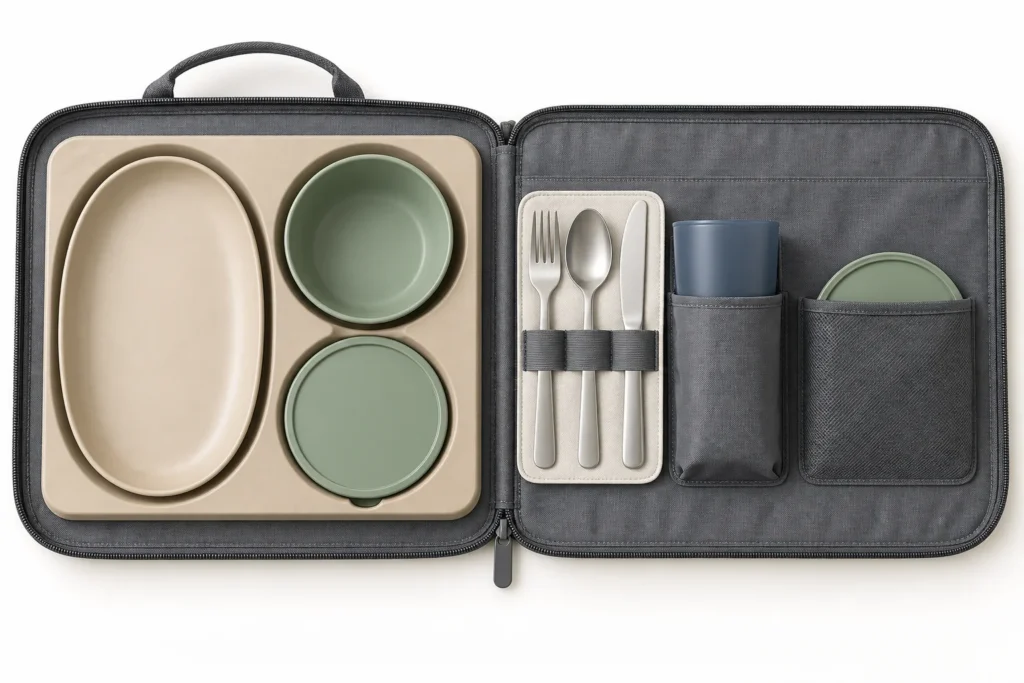
The graphite folio is proposed with a coated wipe-clean outer textile, perimeter zipper, short top handle, fold-flat inner panels, removable molded cradle, three utensil loops, one tumbler pocket and one lid pocket. Final fabric, coating, reinforcement, lining, foam, zipper, stitching, handle and pocket construction remain subject to approval.
Check access to every component, closed thickness, zipper clearance and the flatness of the placemat surface. Define how food-contact items, cradle, sleeve and folio are cleaned and dried separately. A wipe-clean appearance does not prove compatibility with a particular chemical or process.
Materials for the Fold-Out Travel Dining Kit
Food-grade PP is proposed for the plate, bowl, lid, tumbler and molded cradle; stainless steel is proposed for the fork, spoon and blunt knife; coated textile is proposed for the folio and washable material for the sleeve. Exact resin, additives, pigments, steel grade, finish, coating, lining, thread and hardware must be confirmed.
Food-contact evidence should match the exact selected SKU, color, intended use and destination. Buyers can review the FDA food-contact substances overview and the European Commission food-contact materials framework. These sources do not certify this concept.
Logo, Pantone and Packaging Customization
Potential logo routes include printing or molded identification on PP, laser marking on stainless steel, and woven or printed marks on the folio and sleeve. Feasibility depends on material and process. Pantone targets require physical approval on molded plastic, steel, coated textile and paper.
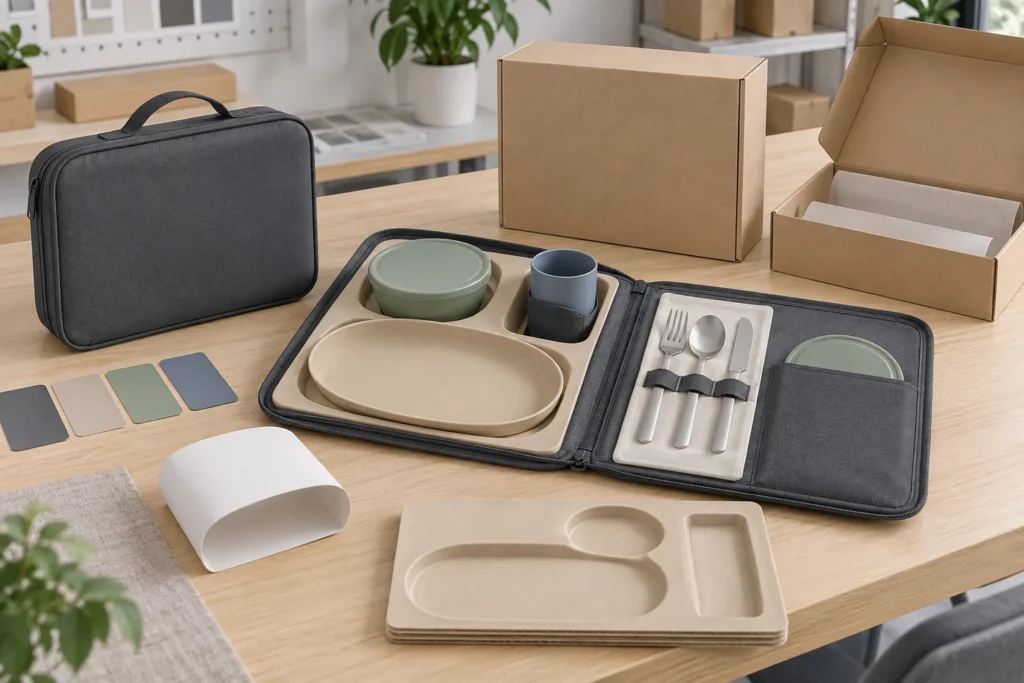
Packaging can be reviewed as a plain inner carton, recyclable paper band, molded-paper protector or relocation master carton. Define barcode, component count, instructions and destination information before artwork approval. Trial the full pack because inserts affect dimensions, weight and unpacking time.
Replaceable Components and Custom Molding
Plate, bowl, lid, tumbler, utensils, sleeve, cradle and folio can be managed as replacement items. Existing components should be evaluated first. Modified geometry or custom tooling may be considered when nesting, cradle fit or packed thickness cannot be achieved. Tooling feasibility, cost and timing are confirmed after drawings, tolerances and expected volume are available.
MOQ, Sampling and Lead Time
| MOQ | To be confirmed by configuration, color split, decoration, packaging and assembly route. |
|---|---|
| Sampling | To be confirmed after packed-fit constraints, drawings and approval stages are defined. |
| Lead time | To be confirmed after samples, testing, quantity, packaging and shipping plan are approved. |
| Custom tooling | Reviewed after geometry, tolerances and expected volume are available. |
SKU-Level Quality Inspection and Compliance Evidence
Potential inspection points include component count, dimensions, visual condition, bowl-lid fit, nesting, cradle clearance, pocket retention, zipper operation, placemat flatness, handle attachment, utensil finish, sleeve construction, logo position, color reference, packaging and complete-set verification.
Keep the accepted sample, drawings, bill of materials, artwork, packing instruction, evidence list and inspection criteria on one revision. Unknown fields remain “To be confirmed for the project.” Read the business travel tableware buyer guide for packed-fit, workflow and supplier-comparison logic.
Fold-Out Travel Dining Kit FAQ
What is included?
One PP plate, lidded bowl and tumbler, three stainless utensils, one sleeve, molded cradle and fold-out zippered folio.
Are packed dimensions, weight and volume confirmed?
No. They are confirmed after the final tableware, cradle and folio are approved as a physical sample.
Can colors, logos and packaging be customized?
Yes, subject to feasibility, artwork review, physical sample approval and commercial confirmation.
What are the MOQ, sampling and lead time?
They are confirmed after configuration, colors, decoration, packaging, testing and quantity are defined.
Compare Portable Dining, review Food-Grade PP, and see the Custom Tableware Travel Pouch for an utensil-focused alternative.
Build a Similar Fold-Out Travel Dining Kit
Share traveler profiles, luggage and room limits, ownership model, cleaning route, branding, packaging, target markets, quantity and schedule. The B2B team will identify existing-component and custom-development routes.
Open the Travel Kit Inquiry