

Review the claim as a traceable chain, not a fabric label
RPET carry bag evidence should connect the claimed recycled input to a defined fabric, the fabric to named bag components, and those components to the purchased production lot. Buyers should also separate the outer-shell claim from zippers, webbing, thread, insulation and lining, then approve the finished bag for fit, durability, appearance, packaging and the exact wording intended for the destination market.
An RPET tableware carry bag may look like one textile product, but a commercial bag normally combines several materials and processes. The outer textile, backing, print layer, zipper tape, slider, webbing, thread, foam, reflective lining, binding and labels can come from different sources. A claim that is reasonable for one fabric should not silently migrate to the complete bag.
For importers, retail brands and promotional-product buyers, the central question is not whether a supplier can provide a document containing the letters “RPET.” The question is whether the available records identify the same material, component, manufacturing route and production lot that will be delivered. This distinction protects quotation accuracy and reduces late packaging revisions.
This guide offers a procurement framework rather than legal advice or a universal certification requirement. Claim wording, substantiation and labeling duties vary by market and sales channel, so the buyer should confirm the final statement with its own compliance adviser. The factory-side task is to make the product and evidence trail specific enough for that review.
Start by freezing the exact RPET claim
Ask the commercial team to write the proposed claim before samples are approved. “Made with recycled polyester,” “outer fabric contains recycled polyester” and “bag made from recycled bottles” do not describe the same scope. Each phrase creates different questions about percentage, component coverage, source material and the proof needed to support it.
Define where the claim will appear. A statement printed on the bag, retail box, hangtag, online listing or customer catalog may be read without the technical qualification stored in the sourcing file. Keep the public wording and the controlled internal specification aligned so a short marketing phrase does not overstate the approved component.
Record whether the percentage refers to a polymer, yarn, fabric or the mass of the finished bag. Those denominators can produce very different numbers. A supplier cannot quote or substantiate a percentage consistently when the buyer has not defined what the percentage measures.
Do not use color, texture or a recycling symbol as evidence. Virgin and recycled polyester can be visually similar, and a fabric with a sustainable appearance may contain unrelated materials. Evidence must come from controlled records and a defined supply route rather than product styling.
What an RPET carry bag evidence brief should state
The brief should name the bag version, drawing or specification revision, claimed component, proposed wording, percentage basis, destination market and responsible reviewer. It should also identify any excluded parts and list the evidence expected before artwork release. This turns a broad sustainability request into a supplier-comparable requirement.
Add change triggers at the same time. A different fabric mill, coating, print method, backing, recycled-content percentage or assembly site may require document review or new samples. If change control is left until production, the evidence package can become disconnected from the approved item.
Map the carry bag before requesting documents
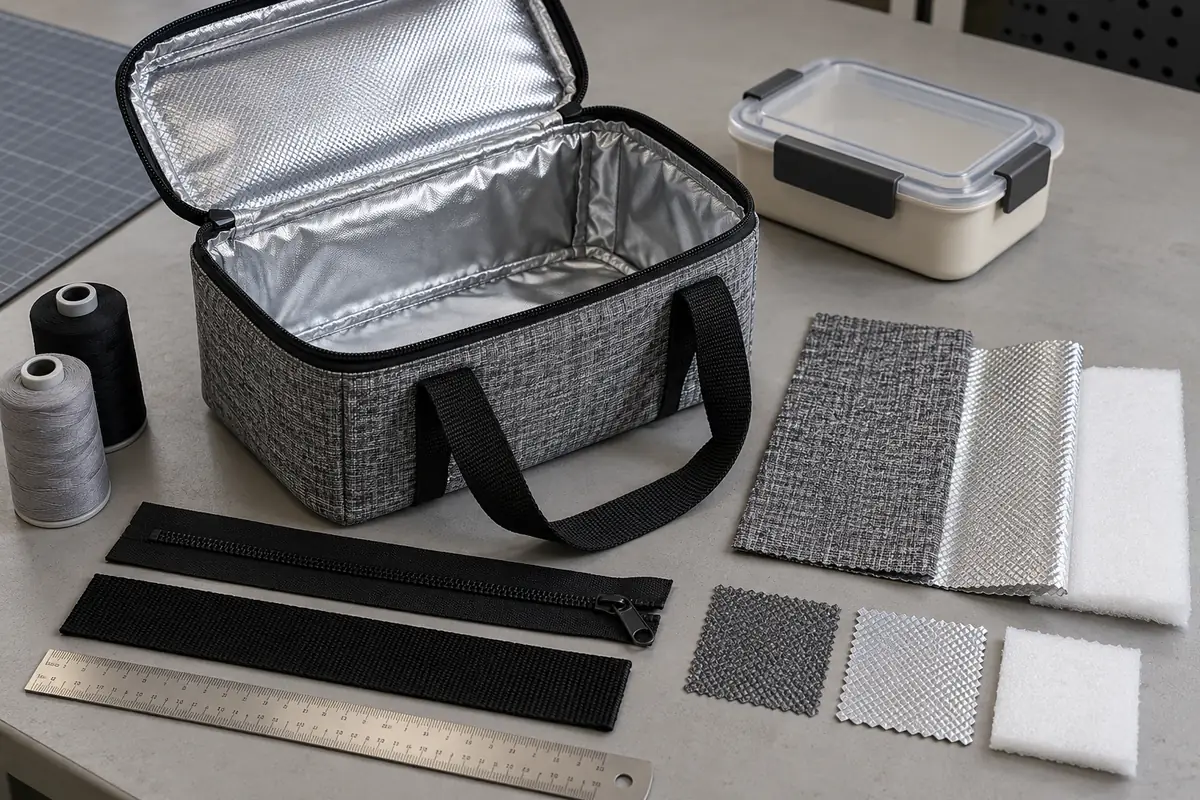
Create a component map for the entire finished bag. At minimum, separate the outer shell, inner lining, insulation, backing or coating, zipper tape and teeth, slider, handle webbing, shoulder strap, binding, sewing thread, hook-and-loop parts, printed panels, labels and reinforcement boards. The map should reflect the actual construction, not a generic bag drawing.
Next to every component, record the stated material and whether it falls inside the proposed claim. This quickly reveals ambiguous phrases such as “100% RPET bag” when only the visible woven shell is specified as recycled polyester. It also helps costing because recycled-content options may not be available or appropriate for every small component.
Insulated bags need particular care. The reflective inner layer, foam, adhesive or laminated backing can change the total construction even when the face fabric remains the same. Ask the supplier to identify each layer of a composite textile and explain which layer a document covers.
Keep food-contact language separate from the carry-bag claim. The bag may transport a closed lunch box without being intended for direct food contact, while the tableware inside has its own material and testing route. Mixing those scopes in one statement makes both product files harder to review.
| Claim scope | What it may describe | Main evidence question | Buyer risk if left vague |
|---|---|---|---|
| Recycled polyester outer fabric | The named face fabric or laminated textile used for external panels | Does the record identify the supplied fabric construction and recycled-content basis? | The claim may be extended to lining, handles or the complete bag without support. |
| Recycled polyester yarn | A yarn input used to weave or knit a selected textile | Can the yarn record be connected to the fabric batch and purchase order? | A valid yarn document may not identify the finished coated fabric. |
| Recycled content by component mass | The calculated share within a defined component | Are included and excluded materials, moisture and coatings handled consistently? | Percentages may be compared even though their denominators differ. |
| Recycled content in finished bag | A calculation across specified bag components | Is there a current bill of materials with verified component weights and claim status? | The headline number may ignore conventional zippers, foam, lining and trims. |
| Post-consumer source statement | The stated origin category of recycled feedstock | What controlled records support that source category through the chain? | “Recycled” may be presented as “post-consumer” without matching evidence. |
Build an unbroken record from input to finished lot
Organize evidence as a chain with defined handoffs. One record may concern recycled input, another the yarn, another the textile and another the finished bag assembly. The buyer needs a reasonable way to connect those stages through supplier names, material codes, transaction references, batch numbers or other controlled identifiers.
A certificate or declaration can be useful, but its title is not enough. Read the scope, holder, material description, site, validity period and any transaction or product limitations. Then compare those fields with the fabric specification and the party supplying the actual production lot.
Where a mass-balance, chain-of-custody or other accounting route is proposed, have the responsible compliance reviewer assess what the system permits the brand to say. Do not convert a supply-chain method into a consumer statement by assumption. The quotation should identify the evidence route so competing offers are compared on the same basis.
Retain commercial records that bridge the formal document to the order. Purchase orders, delivery notes, batch sheets, fabric roll labels and cutting records can help show how the selected input moved into production. The exact record set depends on the supply route, but there should not be an unexplained gap between a mill document and the assembled bag.

Read the document scope before approving artwork
Check whether the document covers a company, site, process, product group or specific material. A company-level registration may show that a management system exists without proving the recycled content of one fabric. Conversely, a material record may be precise but apply to a different mill, weight, color or construction.
Compare dates carefully. The relevant evidence should align with the quotation, sample and expected production period, while expired or future-dated records need explanation. Renewal status can matter when a program spans multiple purchase orders, so identify who will monitor it.
Review product descriptions and codes character by character. Similar codes can represent different weights, weaves, coatings or recycled-content levels. If the supplier uses an internal cross-reference, keep that mapping with the approved fabric swatch and bill of materials.
Translations and cropped screenshots can hide limitations. Request a complete readable file and retain the original version when a translated summary is used. Any public database check should be recorded with its date because online status can change.
Warning signs in recycled polyester lunch bag documentation
Treat generic declarations with no material code or site as incomplete, not automatically false. Also investigate mismatched company names, unexplained intermediaries, dates outside the order period and percentages that lack a defined basis. A supplier should be able to explain the chain in plain commercial language.
Be cautious when a sample tag makes a broader claim than the quotation or bill of materials. Artwork may have been reused from another project, especially on early reference samples. Freeze claim copy only after the evidence scope, component map and production route are aligned.
Verify the finished bag as a product, not only a claim
Evidence review does not replace product approval. The outer textile still needs an agreed color, hand feel, weave, coating, weight or construction, while the assembled bag must meet dimensions, fit and workmanship requirements. A credible recycled-content file cannot compensate for poor zipper travel, weak handle attachment or an undersized interior.
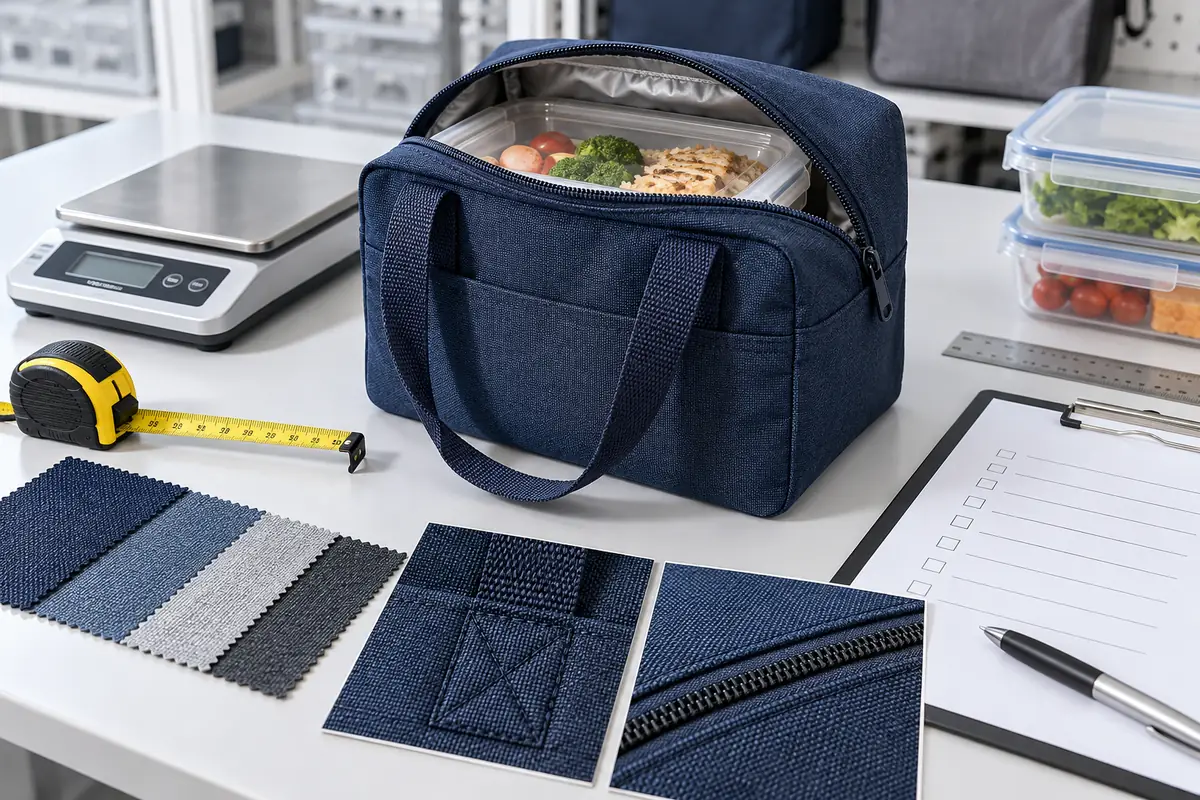
Load the bag with the intended lunch box, cutlery case, bottle or accessory set. Check insertion, removal, lid clearance, closure path, balance and whether hard components rub the lining. Measure the usable internal space rather than relying only on external dimensions.
Review seams, binding, handle reinforcement, zipper ends and corners under the expected load. Specify a project-appropriate inspection or test method rather than adopting an arbitrary universal number. The buyer and supplier should agree the sample condition, load, repetitions and acceptance evidence before production.
Appearance review should include fabric lot variation, print alignment, color relationship with the tableware and the location of labels or claim copy. Laminated textiles can show wrinkles or edge behavior differently after sewing. Approve the complete bag, not only a flat swatch.
Normalize quotations before comparing an RPET option
Ask every supplier to quote the same bag drawing, component map, claimed scope, evidence route, color, print, packaging and inspection expectation. A lower quotation may use conventional polyester for more components, a different fabric weight or a narrower document scope. Those differences should be visible before the buyer compares unit prices.
Separate one-time and recurring costs. Initial evidence review, artwork adaptation or sample development may be charged differently from production material, transaction records and routine quality control. Request clear assumptions rather than forcing all costs into an unexplained unit price.
MOQ and lead time should be confirmed for the exact fabric and color route. Stock colors, made-to-order fabric and custom printing may have different commercial conditions. Do not publish a recycled-content claim before the selected supply route is commercially workable for the expected order quantity.
Also confirm packaging segregation and labeling at the factory. A recycled-content fabric can be mixed with a similar conventional fabric if roll identification and cutting controls are weak. The production plan should show how the approved material code remains distinguishable through cutting, sewing, finishing and packing.
Carry the approved evidence route into repeat orders
Release production against one controlled specification. It should link the claim wording, component map, material codes, approved swatches, evidence files, finished sample, artwork and packaging revision. This prevents departments from approving isolated pieces that do not describe the same commercial item.
Define what the incoming team checks on fabric rolls and purchased components. Identification, color, width, construction, quantity and document references may all be relevant, depending on the project. Record deviations before cutting because replacement or segregation becomes harder after materials are converted.
During production, retain lot links appropriate to the order. If several fabric batches are used, decide whether they can be mixed and how appearance is controlled. If an approved component becomes unavailable, stop and review the substitute rather than changing the claim scope informally.
For repeat orders, do not assume last season’s evidence remains current. Recheck the material source, product code, site, document status, claim wording and bag bill of materials. A repeat color with a new coating or supplier can create a new evidence question even when the consumer-facing design is unchanged.
Buyer checklist for RPET carry bag evidence
| Check | Question | Why It Matters |
|---|---|---|
| Claim wording | What exact statement will appear on the bag, packaging and sales page? | The evidence scope must support the words a buyer or consumer will see. |
| Percentage basis | Does the percentage apply to polymer, yarn, fabric, a component or the finished bag? | Different denominators cannot be compared as if they were identical. |
| Component map | Which shell, lining, zipper, webbing, thread, foam and trim parts are included? | Prevents a fabric claim from being extended to unverified components. |
| Material code | Does the evidence identify the quoted fabric construction and supplier code? | Similar-looking textiles can use different feedstock, coatings and claim levels. |
| Chain link | How are recycled input, yarn, fabric roll and finished order connected? | Isolated documents do not automatically describe the purchased lot. |
| Document scope | Does each file cover the relevant holder, site, material and period? | A valid document can still be irrelevant to the selected supply route. |
| Finished fit | Has the bag been loaded with the intended tableware configuration? | Material evidence does not confirm practical capacity or closure clearance. |
| Workmanship | Are seams, handles, zippers, binding and lining approved under defined checks? | The commercial product must remain usable and repeatable. |
| Artwork release | Was claim copy frozen only after technical and compliance review? | Early printing can lock an unsupported or overbroad statement into stock. |
| Change control | Which source, coating, site, component or percentage changes trigger reapproval? | Protects the evidence chain when materials or production routes change. |
| Lot records | What roll, batch or purchase records will be retained for the order? | Supports the connection between approval documents and delivered goods. |
| Repeat order | Who rechecks status and material identity before the next purchase? | Historical evidence may not cover a later supply route. |
Use an evidence matrix to release the project
Create one matrix with rows for every claim and component. Its columns should show proposed wording, material code, supplier, site, evidence file, validity or review date, production-lot link, artwork location and responsible approver. This becomes the working index for sourcing, compliance, quality and marketing teams.
The matrix should distinguish “received,” “reviewed,” “accepted for this claim” and “requires clarification.” Simply collecting files in a folder can create false confidence when no one has matched them to the SKU. Status language makes open questions visible before purchase-order release.
Attach the approved fabric swatch and finished bag sample to the same revision. Photos help remote teams, but physical samples preserve color, texture, layer construction and sewing details that images may not show accurately. The sample approval route should identify which item becomes the golden reference.
Finally, record the buyer’s own decision. A supplier can provide material information and traceability records, while the importing brand remains responsible for deciding whether the proposed claim and evidence meet its legal, retailer and market requirements. Clear ownership prevents a sourcing document from being mistaken for final claim approval.
Frequently asked B2B questions about RPET bags
Is a supplier declaration enough for RPET carry bag evidence?
A declaration can be one part of the file, but buyers should review its scope, material code, site, date and connection to the production lot. The required evidence depends on the claim, market, customer requirements and supply-chain route.
Can the whole bag be called RPET when only the outer fabric is recycled?
That wording may overstate the verified scope because the lining, foam, zipper, webbing, thread and trims can use other materials. Define the statement precisely and have the responsible compliance reviewer approve it for the destination market.
Should the recycled-content percentage be based on fabric or bag weight?
Either basis can produce a number, but the denominator must be stated and used consistently. A percentage for one textile cannot be presented as the percentage of the complete finished bag without a supported calculation.
Does recycled polyester evidence prove bag durability?
No. Recycled-content evidence addresses material or supply-chain claims, while durability depends on fabric construction, coating, seams, handles, zippers, loading and workmanship. Approve the finished bag under project-specific functional checks.
What should trigger reapproval on a repeat order?
Changes to the fabric mill, material code, recycled-content level, coating, color route, print process, component map, production site or evidence status may require review. Define triggers in the purchase specification rather than deciding after substitution.
Conclusion: release the product and claim together
Reliable RPET carry bag evidence connects exact claim wording to a component map, defined percentage basis, material identities, supply-chain records, production lot and approved artwork. The same release file should also control the finished bag’s dimensions, fit, construction, workmanship and packaging. This gives B2B buyers a defensible decision trail without treating one certificate as proof of every product statement.
Send the carry-bag drawing or target dimensions, intended tableware set, quantity, destination market, proposed claim, color and packaging requirement for a project review. Naike Tableware can help identify the material and sample questions that need confirmation before quotation and approval.