
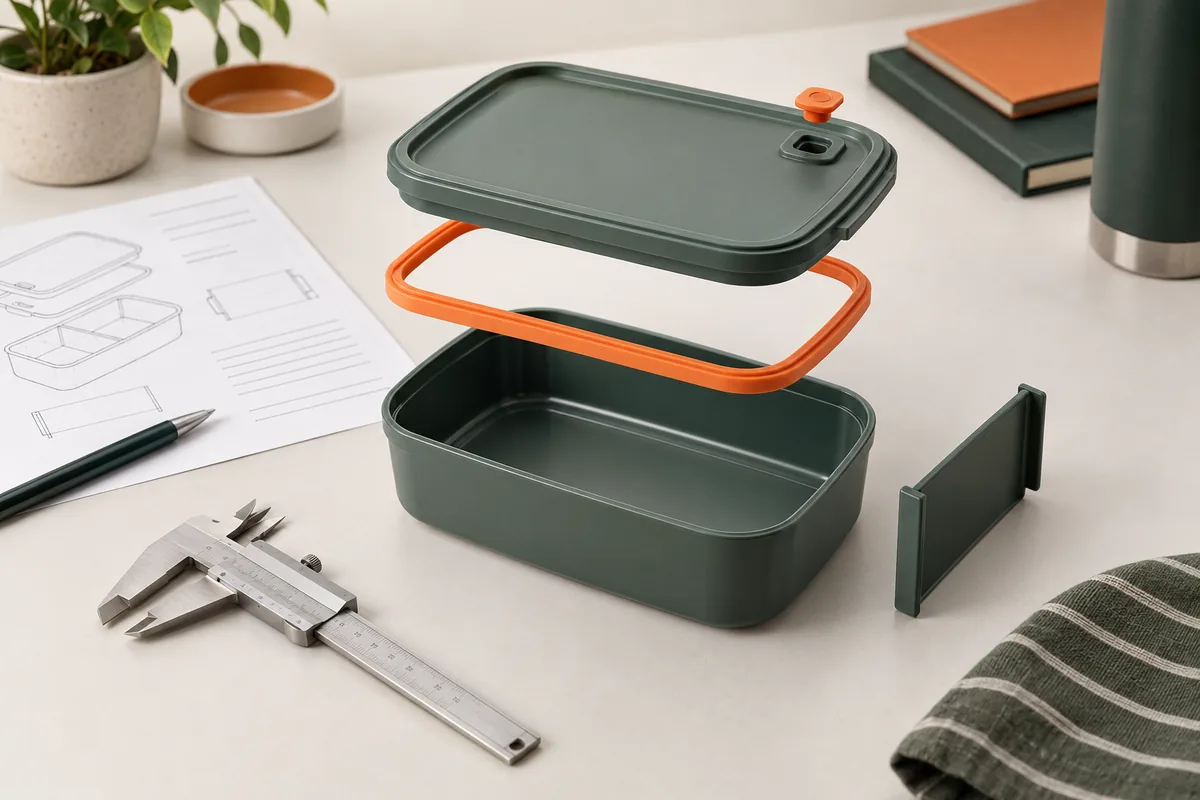
Specify the seal as part of the complete lid system
A silicone seal specification should define the exact container and lid revision, gasket profile, groove geometry, material identification, color, retention method, cleaning access, intended food and use conditions, sample checks, replacement route and market-specific evidence. Buyers should approve the rigid and flexible parts together because a compliant silicone compound cannot compensate for an inconsistent rim, distorted lid or uncontrolled assembly.
Portable meal systems often combine a rigid container, rigid lid, flexible perimeter gasket, vent plug, latches and removable dividers. Buyers sometimes specify “food-grade silicone seal” as one line and expect the supplier to solve everything else. From the factory side, that line is not enough to control fit, leakage risk, cleaning access, replacement compatibility or the evidence attached to the finished SKU.
The seal works only through its interfaces. Its result depends on the molded gasket, lid groove, container rim, latch position, local stiffness, assembly method and the actual conditions in which the buyer expects the set to travel. A useful specification therefore connects material, geometry, product function and approval evidence instead of treating silicone as an isolated ingredient.
This guide is for importers, private-label brands, retailers and distributors preparing a portable lunch box or meal-set brief. It does not publish a universal hardness, compression figure, service temperature, dishwasher claim or leak rating, because those values must be confirmed against the selected formulation, design, finished sample, intended food contact and destination market.
Start with the meal, transport and care scenario
Describe what the closed container must do before choosing the gasket. State whether the product carries dry snacks, dressed salad, sauce, soup or mixed foods, and whether it travels upright in a structured bag or in changing orientations. Also record the expected fill condition, storage time, likely temperature state and opening sequence.
Separate a buyer’s practical objective from an absolute claim. “Reduce movement of dressing during an upright commute” is a different engineering brief from “leakproof in every orientation.” If the commercial claim is broader than the approved test method and use condition, packaging and marketing can create a promise the product specification does not support.
Define how users are expected to clean and reassemble the product. A removable gasket may improve groove access, but buyers should consider whether it can be installed incorrectly, stretched during removal or lost in a shared wash process. A retained design may reduce loose parts while making inspection and drying more dependent on the groove geometry.
Identify the destination market and responsible reviewer before requesting evidence. Food-contact requirements depend on the actual material, article, intended use and market. The buyer should not use an unrelated test report or a general phrase such as “FDA approved silicone” as a substitute for reviewing the regulatory status and documentation relevant to the selected component and finished SKU.
Map every sealing interface before approving the material
The sealing path should be visible on a drawing or marked sample. Trace the full perimeter, including corners, latch zones, hinge areas, vent features and any transition where the profile changes. If the container has internal compartments that are intended to resist cross-flow, treat those internal contact lines as separate interfaces rather than assuming the perimeter gasket controls them.
What a silicone seal specification must name
Name the gasket as a controlled component with its own revision, color, drawing reference and assembly position. Link it to the exact lid and container revisions it must fit. If several container sizes share a visual design, do not assume their seals are interchangeable until geometry and functional samples confirm that relationship.
Record the cross-section, corner construction, joint or gate area if relevant, surface condition and permitted visual defects. The objective is not to prescribe a factory process without evidence; it is to define which features affect assembly and function. Critical dimensions should be agreed on drawings, while actual acceptance remains connected to a complete assembled sample.
Specify how the gasket is located and retained. A groove may rely on shape, friction, undercuts or other design features, and each route affects assembly, cleaning and replacement. The buyer should ask how an operator confirms that the gasket is fully seated and how an inspector detects twist, stretch, lift or local misplacement.
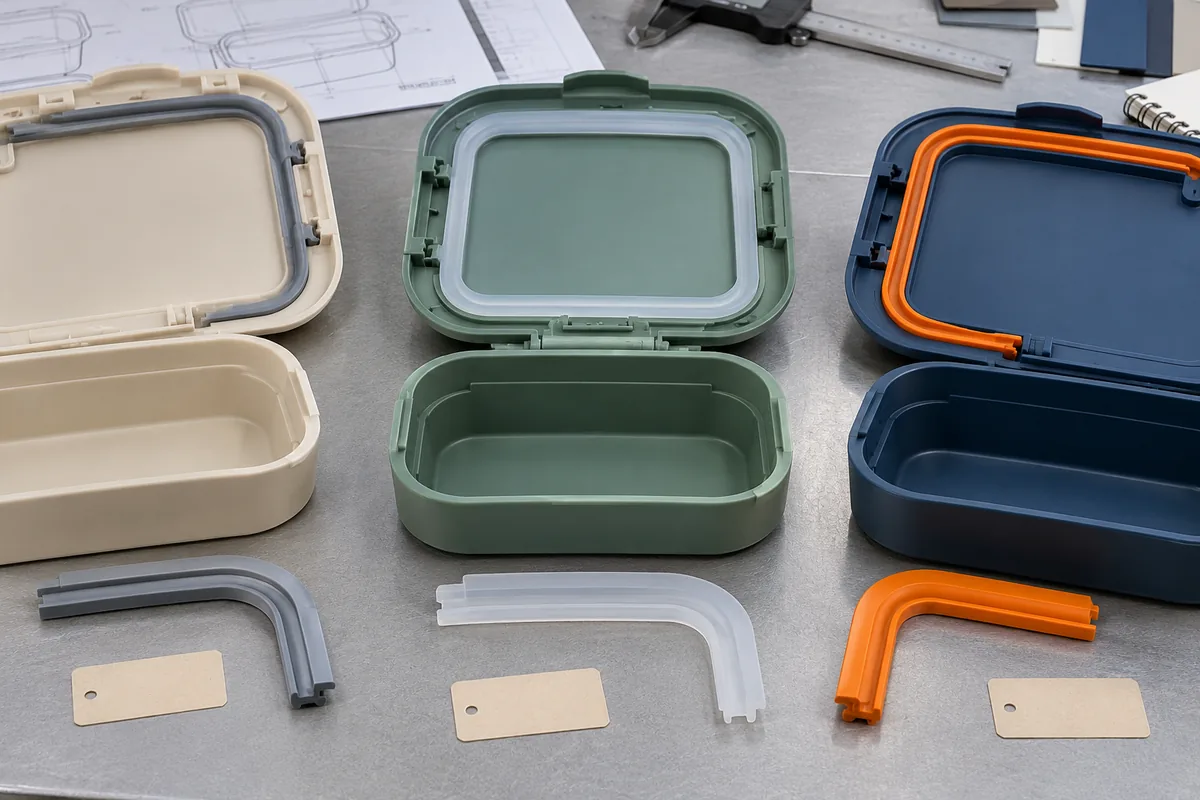
Include nearby components in the interface map. Latches create closure force, hinges influence alignment and a vent plug creates another opening through the lid. A design can have an acceptable perimeter gasket yet still perform inconsistently if closure force is uneven or another interface is not controlled.
Compare lid and gasket architectures as systems
There is no single gasket architecture that is best for every portable meal program. The practical route depends on product shape, cleaning expectations, assembly method, replacement strategy, target experience and the claims the buyer intends to make. Compare options against the same container, use scenario and approval method.
| Architecture | Potential buyer advantages | Questions to resolve | Approval focus |
|---|---|---|---|
| Removable perimeter gasket | Separate cleaning and visual inspection; possible service replacement | Orientation, stretch during removal, loss risk, reassembly errors and compatible spare-part control | Seating, corner continuity, removal method and repeat assembly on the approved sample |
| Retained gasket in a lid groove | Fewer loose parts during normal use and packing | Groove access, drainage, visual inspection and how retention is verified | Local lift, twist, trapped residue and groove consistency |
| Overmolded or permanently bonded flexible interface | Integrated appearance and reduced user handling of the seal | Material compatibility, process control, repair route and end-of-life separation | Interface continuity, adhesion or mechanical lock and finished-part evidence |
| Flexible lid with integral sealing geometry | Potentially fewer distinct components | Lid stiffness, deformation, opening force, stack behavior and dimensional stability | Complete-lid fit across production samples and intended use conditions |
| Perimeter seal plus vent component | Controlled vent feature separated from the main closure path | Vent-plug retention, cleaning access, open/closed identification and another possible leak path | Perimeter and vent tested as separate interfaces and as one assembled lid |
A removable gasket can support a replacement-parts program only if the spare is controlled by SKU and revision. Color alone is not an adequate identifier because visually similar seals can differ in cross-section or perimeter length. The replacement package and customer-service record should tell the buyer which lid and container the part fits.
An integrated construction can simplify the user’s part count, but it changes the development and service questions. Ask what happens if the flexible interface is damaged, how the combined part is inspected and whether the selected manufacturing route has been reviewed for the exact rigid and flexible materials. Do not convert a design preference into a durability or recyclability claim without supporting evidence.
The factory quotation should identify which architecture is being costed. Tooling, assembly, inspection, packaging and spare-part planning can differ, even when two concepts look similar in a rendering. Compare quotations only after both suppliers are pricing the same controlled product route.
Control gasket geometry, compression and retention together
A seal must engage around the full perimeter without being cut, twisted, over-stretched or left locally uncompressed. The specification should identify the drawing dimensions that matter and the functional checks that confirm the assembled result. Nominal dimensions alone do not capture all effects of molded-part variation, lid stiffness and closure hardware.
Review corner geometry closely. Corners can concentrate stretch, create seating difficulty or reveal mismatch between a seal profile and its groove. A buyer should inspect corners on loose parts, assembled lids and closed samples rather than approving only a straight cross-section.
Check the relationship between groove fill and cleaning access. A deeper or more enclosed groove may retain a seal securely, while also making residue or moisture harder to see and remove. The decision should be made against the intended cleaning method, user instructions and inspection plan.
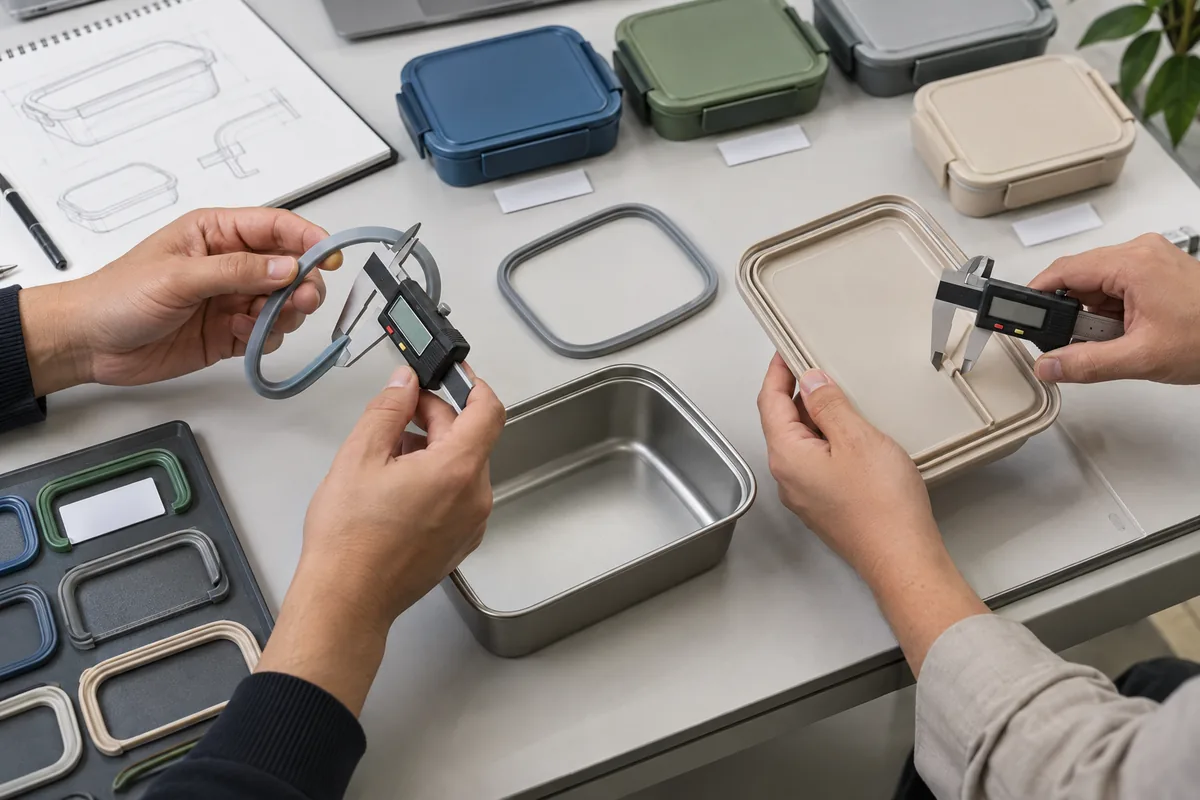
Closure force should be distributed by the complete lid structure. Latches that are too far from a corner, a warped lid or a rim that changes locally can alter contact even when the loose gasket is within its drawing tolerance. Functional sampling should therefore cover more than one part and should use components from the intended production route.
Ask how the factory will control assembly. A work instruction can define gasket orientation, starting point, seating sequence and visual checks, but the product should not depend on an unrealistic operator technique. Buyers should observe whether the design makes correct assembly evident and whether a mis-seated seal can pass a superficial final glance.
Separate perimeter sealing from pressure and vent decisions
A perimeter gasket and a vent solve different problems. Adding a plug or valve introduces another component, another opening and another cleaning interface. The buyer should define why the vent exists, how it is operated and which position is required during filling, heating if applicable, cooling, transport and opening.
Do not assume that a vent automatically makes a sealed container suitable for heating or hot filling. Those uses depend on the complete material and product specification, applicable instructions and project-specific verification. If the intended program includes temperature transitions, record them in the brief and obtain advice appropriate to the product and market.
Specify retention and replacement for the vent component. A small plug may be removable for cleaning, permanently retained or integrated into another part. Review how users identify correct installation and how the supply chain manages the component if it can be lost.
Functional checks should distinguish leakage at the perimeter from leakage at the vent. Recording only “sample failed” does not help an engineer identify the interface responsible. The lunch box leak test buyer guide provides a broader framework for defining orientation, fill, duration and acceptance without turning one test into a universal claim.
Design cleaning, drying and replacement into the product brief
A portable meal system is repeatedly opened, filled, carried, emptied and cleaned. Buyers should review whether the gasket can be reached, removed when intended, rinsed, inspected, dried and reassembled without damage. Care instructions must match the approved material and construction rather than a generic instruction copied from another lunch box.
Look for narrow corners, blind recesses and features that can hold liquid. Evaluate the lid both assembled and disassembled according to the proposed user process. If a component is not intended for removal, the buyer still needs a practical way to clean and visually inspect the accessible areas.
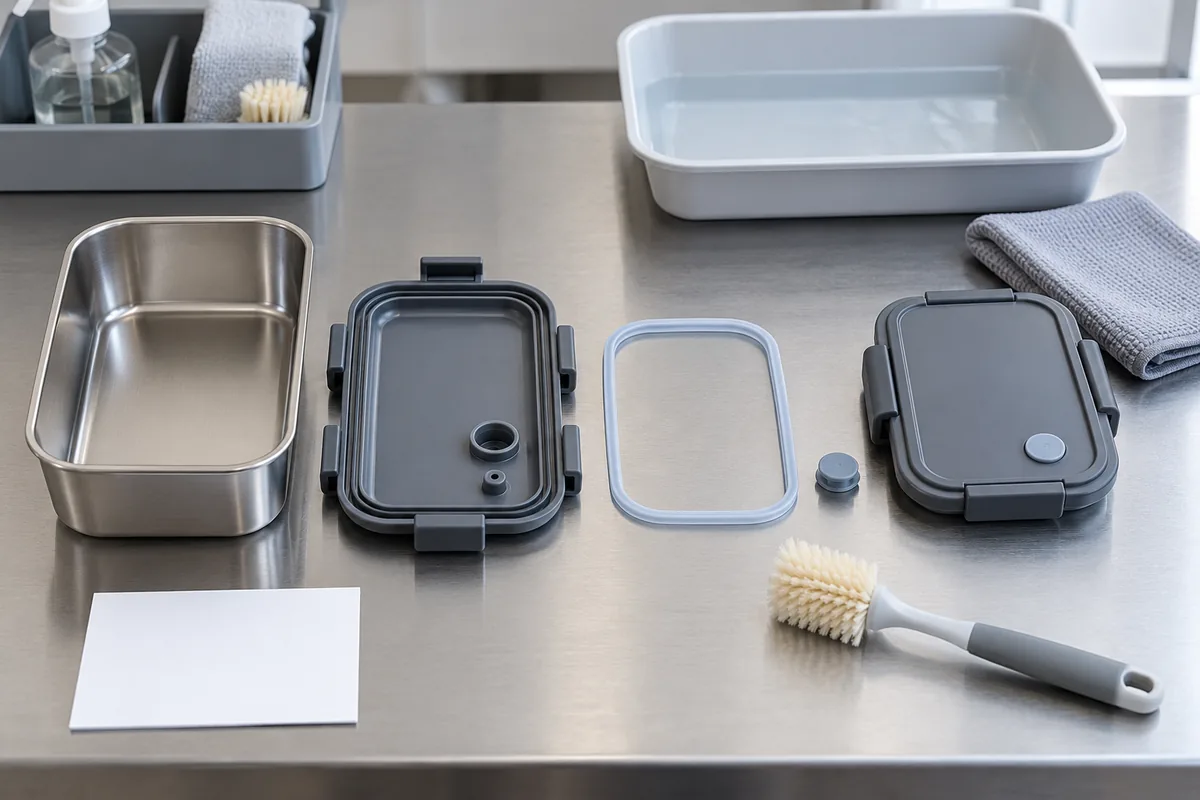
Replacement planning should begin before packaging is finalized. Decide whether the gasket is a service part, how it will be identified and whether it is supplied individually or in a controlled kit. Confirm packaging, labeling and inventory responsibilities for the spare rather than promising availability without a defined supply route.
Keep revision compatibility visible. If the lid groove changes, an earlier gasket may look acceptable but no longer match the approved interface. The replacement-parts planning guide explains how brands can connect service parts to the correct set version.
Match food-contact evidence to the actual seal and intended market
“Silicone” is a material family, not complete evidence for a finished component. The buyer should obtain the formulation or material identification that the project is permitted to share, the component reference, color or additive information where relevant, intended food contact and use conditions, manufacturing responsibility and the documents required for the destination market.
For the United States, the FDA provides resources on the regulatory status and conditions of use for food-contact substances. Buyers should review the applicable regulatory basis for the actual substance and use rather than ask for an undefined “FDA certificate.” The FDA page is a regulatory resource, not proof that a supplier’s selected seal is compliant.
For the European Union, Regulation (EC) No 1935/2004 provides the general food-contact framework, and the European Commission explains that materials should not release constituents at harmful levels or unacceptably change food composition, taste or odor. The Commission also notes that specific measures cover some material groups while national provisions can apply where no specific EU measure exists; buyers should review the current EU food-contact legislation and the destination country for the actual project.
Do not attach a report for one color, supplier or test condition to every future seal automatically. Link reports and declarations to the material/component code and keep the sample and production revision aligned. When the finished product combines silicone, plastic, metal, ink or adhesive interfaces, review the complete SKU evidence map rather than isolating one passing document.
The buyer should also control commercial wording. Terms such as food-grade, BPA-free, leakproof, freezer-safe, microwave-safe or dishwasher-safe each need an applicable definition and evidence for the actual product and intended use. If a claim is not part of the approved specification, it should not appear on artwork or product listings.
Build sample approval around function and revision control
The first useful sample may be an interface sample rather than a complete decorated product. It can help review gasket profile, groove seating, rim engagement and closure behavior before colors and packaging are finalized. State what each sample is intended to prove so a visual sample is not mistaken for production approval.
For a functional sample, record the container, lid, gasket, latch and vent revisions as one set. Note whether parts come from intended tooling or another route and which conclusions remain provisional. Use the same defined fill, orientation, time and handling sequence when comparing revisions.
Color approval should cover both appearance and identification. A buyer may want the seal to match the lid, contrast for cleaning visibility or distinguish replacement versions. Confirm the approved physical color sample and do not rely only on a screen rendering or Pantone reference when appearance differs across silicone and rigid plastic.
Before production release, approve a complete assembled set and the records used for inspection. The sample should connect to drawings, material references, color approval, functional method, packaging BOM and any required evidence. Follow the tableware sample approval process so later changes are reviewed instead of quietly absorbed.
B2B buyer checklist for silicone seals and lids
| Check | Question | Why It Matters |
|---|---|---|
| Use scenario | What food, fill condition, orientation, storage and transport must the closed set handle? | Defines a realistic functional brief and prevents unsupported universal claims. |
| Matched revisions | Are the gasket, lid, container, latch and vent tied to exact drawing or sample revisions? | Stops visually similar but incompatible parts from being mixed. |
| Seal path | Is the complete perimeter, including corners and transitions, visible on a drawing or marked sample? | Makes local interface risks reviewable. |
| Retention | How is the gasket seated, retained and checked after assembly? | Reduces twist, lift and incomplete seating risk. |
| Closure system | How do lid stiffness, latches and rim geometry distribute contact? | The gasket cannot compensate for uncontrolled rigid parts. |
| Vent interface | Is the vent function, position, cleaning route and retention defined separately? | Prevents a second opening from being ignored in functional approval. |
| Cleaning | Can intended users access, inspect, dry and correctly reassemble each relevant part? | Connects product design with repeat use and care instructions. |
| Replacement | Will the gasket be a service part, and how is compatibility identified? | Avoids unsupported spare-part promises and incorrect replacements. |
| Evidence | Do documents identify the actual material, component, use condition and destination market? | General supplier files may not support the finished SKU. |
| Approval method | Are visual, dimensional, assembly and functional checks recorded with acceptance rules? | Creates one release standard for buyer and factory teams. |
Read early warning signs before production release
A gasket that repeatedly lifts at one corner is not only an assembly issue. It can indicate a profile, perimeter, groove or corner mismatch that deserves engineering review. Re-seating the same part by hand may hide the pattern without controlling it.
Large differences in latch feel across samples can indicate variation in the rigid components or closure geometry. The buyer should not solve the symptom by changing gasket material without identifying the responsible interface. Compare matched sets and record where resistance changes.
Moisture that remains in a groove after the proposed cleaning process is a design and instruction signal. Review access, drainage, removal expectations and drying rather than adding an unsupported hygiene claim. Likewise, a seal that is difficult to reinstall may require clearer orientation features or a different service strategy.
When a supplier cannot connect the material report to a component code or cannot identify which lid revision was tested, treat the evidence as incomplete. A professional answer can state what is known, what must be tested and who owns the next decision; a vague “all passed” response is not a controlled approval record.
Frequently asked B2B questions about silicone seals
What should a silicone seal specification include?
It should identify the intended use, exact gasket and matched rigid-part revisions, material reference, color, profile and critical geometry, retention and assembly method, cleaning route, vent relationship, functional sample method, replacement plan and destination-market evidence. Project-specific tolerances and acceptance criteria should come from drawings and approved samples.
Does food-grade silicone guarantee that a lunch box will not leak?
No. Material suitability and assembled sealing function are different questions. Leakage risk depends on the complete gasket, lid, rim, latches, vent, assembly and defined test conditions, so the finished configuration must be reviewed.
Should the gasket be removable for cleaning?
That is a product decision, not a universal rule. Removable seals can improve access and replacement options, while creating reassembly and loss risks; retained seals reduce loose parts but require suitable groove access and inspection.
Can one silicone report cover every gasket color and product?
Do not assume so. The buyer should check the report scope against the actual formulation, color or additives where relevant, component, manufacturing source, intended food and use condition, finished SKU and destination-market requirement.
When should buyers approve replacement seals?
Approve the service route before production release if replacement is part of the offer. Control the spare by compatible lid/container revision, packaging, identification and supply responsibility, then verify fit with the approved product.
Conclusion: release one controlled silicone seal specification
A reliable silicone seal specification is not a material label. It is a controlled connection between the gasket, rigid lid, container rim, latches, vent, cleaning process, sample method, replacement route and market evidence. Buyers who approve those elements together create a clearer basis for quotation, sampling, production and inspection.
Prepare the first review with the complete product format, intended foods, transport orientation, lid and container drawings or samples, cleaning expectation, destination market, quantity, branding and packaging direction. Naike can then review which decisions fit an existing configuration and which require project-specific development or confirmation.